Thank you for visiting SNEWPapers!
Sign up free
The New Hampshire Gazette
Portsmouth, Rockingham County, New Hampshire
What is this article about?
In Richmond on Sept. 15, the trial of Aaron Burr for a misdemeanor related to providing means for a military expedition ended with a not guilty verdict after the prosecution entered a nolle prosequi attempt was denied. Plans were announced to commit Burr for trial elsewhere, involving associates like Blennerhassett and Dayton.
Clipping
OCR Quality
Full Text
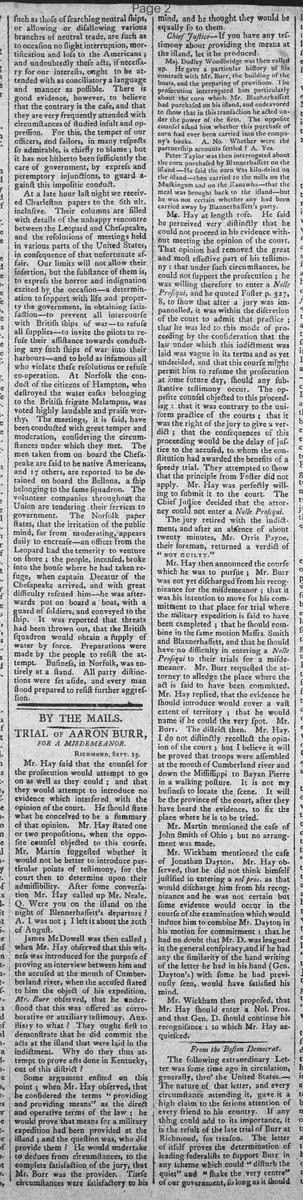
TRIAL OF AARON BURR,
FOR A MISDEMEANOR.
Richmond, Sept. 15.
Mr. Hay said that the counsel for the prosecution would attempt to go on as well as they could; and that they would attempt to introduce no evidence which interfered with the opinion of the court. He should state what he conceived to be a summary of that opinion. Mr. Hay stated one or two propositions, when the opposite counsel objected to this course: Mr. Martin suggested whether it would not be better to introduce particular points of testimony, for the court then to determine upon their admissibility. After some conversation Mr. Hay called up Mr. Neale.
Q. Were you on the island on the night of Blennerhassett's departure?
A. I was not; I left it about the 20th of August.
James McDowell was then called; when Mr. Hay observed that this witness was introduced for the purpose of proving an interview between him and the accused at the mouth of Cumberland river, when the accused stated to him the object of his expedition.
Mr. Burr observed, that he understood that this was offered as corroborative or auxiliary testimony. Auxiliary to what? They ought first to demonstrate that he did commit the acts at the island that were laid in the indictment. Why do they thus attempt to prove acts done in Kentucky, out of this district?
Some argument ensued on this point when Mr. Hay observed, that he considered the terms "providing and providing means", as the direct and operative terms of the law; he would prove that means for a military expedition had been provided at the island: and the question was; who did provide them? He would undertake to deduce from circumstances, to the complete satisfaction of the jury, that Mr. Burr was the provider. These circumstances were satisfactory to his mind, and he thought they would be equally so to them.
Chief Justice—If you have any testimony about providing the means at the island, let it be produced.
Maj. Dudley Woodbridge was then called up. He gave a particular history of his contract with Mr. Burr, the building of the boats, and the preparing of provisions. The prosecution interrogated him particularly about the corn which Mr. Blennerhassett had purchased on his island, and endeavored to show that in this transaction he acted under the power of the firm. The opposite counsel asked him whether this purchase of corn had ever been carried into the company's books. A. No. Whether were the partnership accounts settled? A. Yes.
Peter Taylor was then interrogated about the corn purchased by Blennerhassett on the island—He said the corn was kiln-dried on the island—then carried to the mills on the Muskingum and on the Kanawha—that the meal was brought back to the island—but he was not certain whether any had been carried away by Blennerhassett's party.
Mr. Hay at length rose. He said he perceived very distinctly that he could not proceed in his evidence without meeting the opinion of the court. That opinion had removed the great and most effective part of his testimony: that under such circumstances, he could not support the prosecution; he was willing therefore to enter a Nolle Prosequi, and he quoted Foster p. 327, 8, to show that after a jury was impannelled, it was within the discretion of the court to admit that practice; that he was led to this mode of proceeding by the consideration that the law under which this indictment was laid was vague in its terms and as yet undecided, and that this course might permit him to resume the prosecution at some future day, should any substantive testimony occur. The opposite counsel objected to this proceeding: that it was contrary to the uniform practice of the courts; that it was the right of the jury to give a verdict; that the consequences of this proceeding would be the delay of justice to the accused, to whom the constitution had awarded the benefits of a speedy trial. They attempted to show that the principle from Foster did not apply. Mr. Hay was perfectly willing to submit it to the court. The Chief Justice decided that the attorney could not enter a Nolle Prosequi.
The jury retired with the indictments and after an absence of about twenty minutes, Mr. Orris Payne, their foreman, returned a verdict of "NOT GUILTY."
Mr. Hay then announced the course which he was to pursue: Mr. Burr was not yet discharged from his recognizance for the misdemeanor; that it was his intention to move for his commitment to that place for trial where the military expedition is said to have been completed: that he should combine in the same motion Messrs. Smith and Blennerhassett, and that he should have no difficulty in entering a Nolle Prosequi to their trials for a misdemeanor. Mr. Burr requested the attorney to allege the place where the act is said to have been committed.
Mr. Hay replied, that the evidence he should introduce would cover a vast extent of territory; that he would name if he could the very spot. Mr. Burr. The district then. Mr. Hay. I do not distinctly recollect the opinion of the court: but I believe it will be proved that troops were assembled at the mouth of Cumberland river and down the Mississippi to Bayou Pierre in a walking posture. It is not my business to locate the scene. It will be the province of the court, after they have heard the evidence, to fix the place where he is to be tried.
Mr. Martin mentioned the case of John Smith of Ohio; but no arrangement was made:
Mr. Wickham mentioned the case of Jonathan Dayton. Mr. Hay observed, that he did not think himself justified in entering a nol. pros. as that would discharge him from his recognizance and he was not certain but some evidence would occur in the course of the examination which would induce him to combine Mr. Dayton in his motion for commitment: that he had no doubt that Mr. D. was leagued in the general conspiracy, and if he had any the similarity of the hand writing of the letter he had in his hand (Gen. Dayton's) with some he had previously seen, would have satisfied his mind.
Mr. Wickham then proposed, that Mr. Hay should enter a Nol. Pros. and that Gen. D. should continue his recognizance: to which Mr. Hay acquiesced.
What sub-type of article is it?
What keywords are associated?
What entities or persons were involved?
Where did it happen?
Domestic News Details
Primary Location
Richmond
Event Date
Sept. 15
Key Persons
Outcome
verdict of not guilty by the jury. prosecution's attempt to enter nolle prosequi denied. plans to move for burr's commitment for trial elsewhere, combining with smith and blennerhassett; nolle prosequi for their misdemeanor trials. acquiescence to nolle prosequi for dayton with continued recognizance.
Event Details
During the trial for misdemeanor involving providing means for a military expedition, prosecution called witnesses like Neale, McDowell, Woodbridge, and Taylor to testify on events at Blennerhassett's island, boat building, provisions, and interviews. Arguments over admissibility of evidence from outside the district. Prosecution conceded inability to proceed fully due to court opinion, sought nolle prosequi which was denied. Jury returned not guilty verdict after brief deliberation. Post-verdict discussions on further commitments and nolle prosequi for associates.