Thank you for visiting SNEWPapers!
Sign up free
Editorial
February 28, 1815
Alexandria Gazette, Commercial And Political
Alexandria, Virginia
What is this article about?
This editorial joyfully celebrates the Treaty of Ghent ending the War of 1812, reflecting on wartime gloom turning to universal joy, American defensive triumphs against British invasions, the distinction between aggressive and defensive wars, and the enduring reverence for George Washington amid the ruins of the Capitol.
Clipping
OCR Quality
75%
Good
Full Text
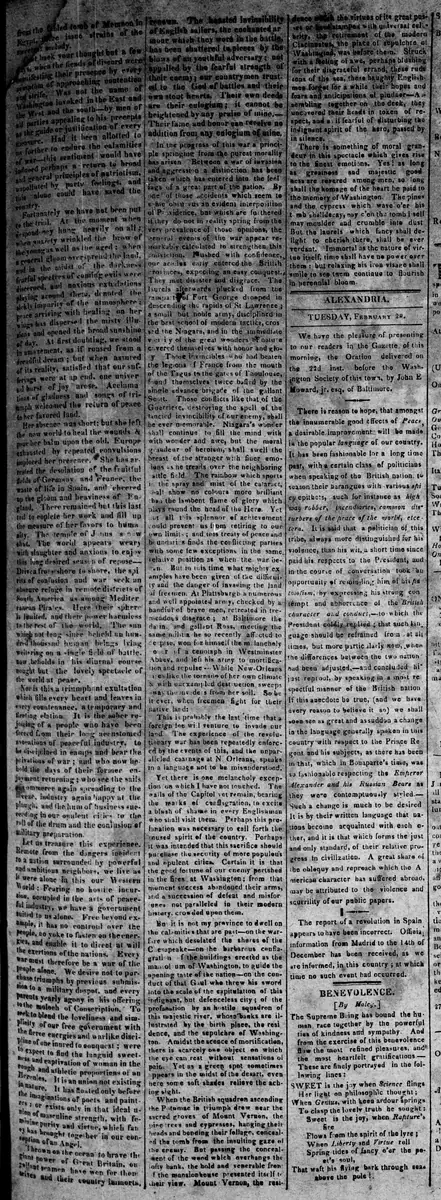
Cast your thoughts back but a few months, when the fiends of discord were approaching, lagging contention in the West and the South by men of spirit. Was not the name of Washington invoked in the East and no further to endure the calamities of war? Thus sentiment would have judged perhaps a return to broad and general principles of patriotism, unpolled by party feeling, and to the trial. At the moment when fortunately we have not been put to the guide or justification of every parties appealing to his presence measure had it been allotted to a the country could have saved the.
Despair hung heavily on all: when anxiety wrinkled the brow of the young as well as the aged: when a general gloom overspread the land, and in the midst of the darkness fearful spectres of coming evils were perceived, and noxious exhalations hanging around there denoted the sickly impurity of the atmosphere. Peace arriving with healing on her wings dispersed the misty ill none and opened the broad sunshine of day. At first doubting, we stood in amazement, as if roused from a dreadful dream; but when assured of its reality, satisfied that our sufferings were at an end, one universal burst of joy arose. Acclamations of gladness and songs of triumph welcomed the return of peace to her favored land.
Her absence was short: but she left the new world to heal the wounds & pour her balm upon the old. Europe exhausted by repeated convulsions implored her presence. She has arrested the desolation of the fruitful fields of Germany and France, the waste of life in Spain, and cheered up the gloom and heaviness of England. There remained but this last to complete her work and fill up the measure of her favors to humanity. The temple of Janus now shut. The world appears weary with slaughter and anxious to enjoy this long desired season of repose. Driven from shore to shore, the spirits of confusion and war seek an obscure refuge in remote districts of South America as among Mediterranean Pirates. Here their sphere is limited, and their power harmless to the rest of the world. The sun which not long since beheld an hundred thousand human beings lying weltering on a single field of battle, now beholds in his diurnal course nought but the lovely spectacle of the world at peace.
Nor is this a triumphant exultation which fills every heart and leaves in every countenance a temporary and fleeting elation. It is the sober rejoicing of a people who have been diverted from their long accustomed avocations of peaceful industry, to be disciplined in camps and bear the privations of war; and who now behold the days of their former enjoyment returning; who see the sails of commerce again spreading to the breeze, industry again happy at the plough, and the hum of business resuming in our opulent cities to the roll of the drum and the confusion of military preparation.
Let us treasure this experience. Remote from the dangers incident to a nation surrounded by powerful and ambitious neighbors, we live as it were alone in this our Western world: Fearing no hostile incursion, occupied in the arts of peaceful industry, we have a government suited to us alone. Free beyond example, it has no control over the people, to wake to attention the energies, and enable it to direct at will the exertions of the nation. Every war must therefore be a war of the people alone. We desire not to purchase triumphs by previous submission to a military despot, and every parent's yearly agony in his offering to the Moloch of Conscription. To seek to blend the loveliness and simplicity of our free government with the fierce energies and warlike discipline of one inured to conquest; were to expect to find the languid sweetness and captivation of woman in the rough and athletic proportions of an Hercules. It is an union not existing in nature. It has floated only before the imaginations of poets and painters: or exists only in that ideal union of masculine strength, with feminine purity and virtue, which fancy has brought together in our conception of an Angel.
Thrown on the ocean to brave the giant power of Great Britain, our gallant seamen have won for themselves of English sailors, the enchanted armour which they wore in the battle has been shattered to pieces by the lions of our youthful adversary not appalled by the fearful strength of their enemy. Our countrymen trusted to the God of battles and their own stout hearts. Their own deeds are their eulogium; it cannot be heightened by any praise of mine. Their fame and honor can receive no addition from any eulogium of mine.
In the progress of this war a principle springing from the purest morality has arisen. Between a war of invasion and aggression a distinction has been taken which has entered into the feelings of a great part of the nation. By one of those accidents which seem to some obscurely an evident interposition of Providence, but which are furthered in they do not in reality spring from the very prevalence of those opinions, the general events of the war appear remarkably calculated to strengthen this conviction. Flushed with confidence our armies early entered the British provinces, expecting an easy conquest. They met disaster and disgrace. The laurels afterwards plucked from the rampart of Fort George drooped in descending the rapids of St Lawrence; a small but noble army, disciplined in the best school of modern tactics crossed the Niagara, and in the immediate vicinity of the great wonders of nature covered themselves with honor and glory. Those invincibles who had beaten the legions of France from the mouth of the Tagus to the gates of Toulouse, found themselves twice baffled by the single advance brigade of the gallant Scott. Those conflicts like that of the Guerriere, destroying the spell of the fancied invincibility of our enemy, shall be ever memorable. Niagara's wonder shall continue to fill the mind with wonder and awe, but the moral grandeur of heroism shall swell the breast of the stranger with finer emotions as he treads over the neighboring battle field. The rainbow which sports in the spray and mist of the cataract, shall show no colours more brilliant than the lambent flame of glory which plays round the head of the Hero. Yet not all this splendour of achievement could prevent us from retiring to our own limits; and this treaty of peace and boundaries finds the conflicting parties with some few exceptions in the same relative position as when the war began. But in this time what mighty examples have been given of the difficulty and the danger of invading the land of freemen. At Plattsburgh a numerous and well appointed army, checked by a handful of brave men, retreated in tremendous disgrace; at Baltimore the daring and gallant Ross, meeting the same militia he so recently affected to despise, won for himself the melancholy honor of a cenotaph in Westminster Abbey, and left his army to mortification and repulse. While New-Orleans like the tornado of her own climate with unexampled destruction sweeps away the invaders from her soil. So be it ever, when freemen fight for their native land:
This is probably the last time that a foreign foe will venture to invade our land. The experience of the revolutionary war has been repeatedly enforced by the events of this, and the unparalleled carnage at N. Orleans, speaks in a language not to be misunderstood.
Yet there is one melancholy exception on which I have not touched. The walls of the Capitol yet remain, bearing the marks of conflagration, to excite a blush of shame in every Englishman who shall visit them. Perhaps this profanation was necessary to call forth the national spirit of the country. Perhaps it was intended that this sacrifice should purchase the security of more populous and opulent cities. Certain it is that the good fortune of our enemy perished in the fires at Washington; from that moment success abandoned their arms, and a succession of defeat and misfortunes not paralleled in their modern history, crowded upon them.
But it is not my province to dwell on the calamities that are past--on the warfare which desolated the shores of the Chesapeake on the barbarous conflagration of the buildings erected as the mausoleum of Washington, to guide the opening taste of the nation -on the conduct of that Gaul who threw his sword into the scale of the capitulation of this indignant, but defenceless city; of the profanation by an hostile squadron of this majestic river, whose banks are illustrated by the birth place, the residence, and the sepulchre of Washington. Amidst the scene of mortification, there is scarcely one object on which the eye can rest without sensations of pain. Yet as a green spot sometimes appears in the midst of the desart, even here some soft shades relieve the aching sight.
When the British squadron ascending the Potomac in triumph drew near the sacred groves of Mount Vernon, the pine trees and cypresses, hanging their heads and bending their foliage, concealed the tomb from the insulting gaze of the crew. But passing the concealment of the wood which overhangs the lofty bank, the bold and venerable front of the mansion house presented itself to their view. Mount Vernon, the residence of the modern Cincinnatus the place of sepulchre of Washington, was before them. Struck with a feeling of awe, perhaps blushing for their disgraceful errand those rude sons of the sea, these haughty Englishmen forgot for a while their hopes and fears-and anticipations of plunder. Assembling together on the deck they uncovered their heads in token of respect, and as if fearful of disturbing the indignant spirit of the hero passed by in silence.
There is something of moral grandeur in this spectacle which gives rise to the finest emotions. Yes! as long as greatness and majestic goodness are revered among men, so long shall the homage of the heart be paid to the memory of Washington. The pines and the cypress which wave o'er his tomb shall decay, nay e'en the tomb itself may moulder and crumble into dust. But the laurels which fancy shall delight to cherish there, shall be ever verdant. Immortal as the nature of virtue itself, time shall have no power over them: but relaxing his iron visage shall smile to see them continue to flourish in perennial bloom.
Despair hung heavily on all: when anxiety wrinkled the brow of the young as well as the aged: when a general gloom overspread the land, and in the midst of the darkness fearful spectres of coming evils were perceived, and noxious exhalations hanging around there denoted the sickly impurity of the atmosphere. Peace arriving with healing on her wings dispersed the misty ill none and opened the broad sunshine of day. At first doubting, we stood in amazement, as if roused from a dreadful dream; but when assured of its reality, satisfied that our sufferings were at an end, one universal burst of joy arose. Acclamations of gladness and songs of triumph welcomed the return of peace to her favored land.
Her absence was short: but she left the new world to heal the wounds & pour her balm upon the old. Europe exhausted by repeated convulsions implored her presence. She has arrested the desolation of the fruitful fields of Germany and France, the waste of life in Spain, and cheered up the gloom and heaviness of England. There remained but this last to complete her work and fill up the measure of her favors to humanity. The temple of Janus now shut. The world appears weary with slaughter and anxious to enjoy this long desired season of repose. Driven from shore to shore, the spirits of confusion and war seek an obscure refuge in remote districts of South America as among Mediterranean Pirates. Here their sphere is limited, and their power harmless to the rest of the world. The sun which not long since beheld an hundred thousand human beings lying weltering on a single field of battle, now beholds in his diurnal course nought but the lovely spectacle of the world at peace.
Nor is this a triumphant exultation which fills every heart and leaves in every countenance a temporary and fleeting elation. It is the sober rejoicing of a people who have been diverted from their long accustomed avocations of peaceful industry, to be disciplined in camps and bear the privations of war; and who now behold the days of their former enjoyment returning; who see the sails of commerce again spreading to the breeze, industry again happy at the plough, and the hum of business resuming in our opulent cities to the roll of the drum and the confusion of military preparation.
Let us treasure this experience. Remote from the dangers incident to a nation surrounded by powerful and ambitious neighbors, we live as it were alone in this our Western world: Fearing no hostile incursion, occupied in the arts of peaceful industry, we have a government suited to us alone. Free beyond example, it has no control over the people, to wake to attention the energies, and enable it to direct at will the exertions of the nation. Every war must therefore be a war of the people alone. We desire not to purchase triumphs by previous submission to a military despot, and every parent's yearly agony in his offering to the Moloch of Conscription. To seek to blend the loveliness and simplicity of our free government with the fierce energies and warlike discipline of one inured to conquest; were to expect to find the languid sweetness and captivation of woman in the rough and athletic proportions of an Hercules. It is an union not existing in nature. It has floated only before the imaginations of poets and painters: or exists only in that ideal union of masculine strength, with feminine purity and virtue, which fancy has brought together in our conception of an Angel.
Thrown on the ocean to brave the giant power of Great Britain, our gallant seamen have won for themselves of English sailors, the enchanted armour which they wore in the battle has been shattered to pieces by the lions of our youthful adversary not appalled by the fearful strength of their enemy. Our countrymen trusted to the God of battles and their own stout hearts. Their own deeds are their eulogium; it cannot be heightened by any praise of mine. Their fame and honor can receive no addition from any eulogium of mine.
In the progress of this war a principle springing from the purest morality has arisen. Between a war of invasion and aggression a distinction has been taken which has entered into the feelings of a great part of the nation. By one of those accidents which seem to some obscurely an evident interposition of Providence, but which are furthered in they do not in reality spring from the very prevalence of those opinions, the general events of the war appear remarkably calculated to strengthen this conviction. Flushed with confidence our armies early entered the British provinces, expecting an easy conquest. They met disaster and disgrace. The laurels afterwards plucked from the rampart of Fort George drooped in descending the rapids of St Lawrence; a small but noble army, disciplined in the best school of modern tactics crossed the Niagara, and in the immediate vicinity of the great wonders of nature covered themselves with honor and glory. Those invincibles who had beaten the legions of France from the mouth of the Tagus to the gates of Toulouse, found themselves twice baffled by the single advance brigade of the gallant Scott. Those conflicts like that of the Guerriere, destroying the spell of the fancied invincibility of our enemy, shall be ever memorable. Niagara's wonder shall continue to fill the mind with wonder and awe, but the moral grandeur of heroism shall swell the breast of the stranger with finer emotions as he treads over the neighboring battle field. The rainbow which sports in the spray and mist of the cataract, shall show no colours more brilliant than the lambent flame of glory which plays round the head of the Hero. Yet not all this splendour of achievement could prevent us from retiring to our own limits; and this treaty of peace and boundaries finds the conflicting parties with some few exceptions in the same relative position as when the war began. But in this time what mighty examples have been given of the difficulty and the danger of invading the land of freemen. At Plattsburgh a numerous and well appointed army, checked by a handful of brave men, retreated in tremendous disgrace; at Baltimore the daring and gallant Ross, meeting the same militia he so recently affected to despise, won for himself the melancholy honor of a cenotaph in Westminster Abbey, and left his army to mortification and repulse. While New-Orleans like the tornado of her own climate with unexampled destruction sweeps away the invaders from her soil. So be it ever, when freemen fight for their native land:
This is probably the last time that a foreign foe will venture to invade our land. The experience of the revolutionary war has been repeatedly enforced by the events of this, and the unparalleled carnage at N. Orleans, speaks in a language not to be misunderstood.
Yet there is one melancholy exception on which I have not touched. The walls of the Capitol yet remain, bearing the marks of conflagration, to excite a blush of shame in every Englishman who shall visit them. Perhaps this profanation was necessary to call forth the national spirit of the country. Perhaps it was intended that this sacrifice should purchase the security of more populous and opulent cities. Certain it is that the good fortune of our enemy perished in the fires at Washington; from that moment success abandoned their arms, and a succession of defeat and misfortunes not paralleled in their modern history, crowded upon them.
But it is not my province to dwell on the calamities that are past--on the warfare which desolated the shores of the Chesapeake on the barbarous conflagration of the buildings erected as the mausoleum of Washington, to guide the opening taste of the nation -on the conduct of that Gaul who threw his sword into the scale of the capitulation of this indignant, but defenceless city; of the profanation by an hostile squadron of this majestic river, whose banks are illustrated by the birth place, the residence, and the sepulchre of Washington. Amidst the scene of mortification, there is scarcely one object on which the eye can rest without sensations of pain. Yet as a green spot sometimes appears in the midst of the desart, even here some soft shades relieve the aching sight.
When the British squadron ascending the Potomac in triumph drew near the sacred groves of Mount Vernon, the pine trees and cypresses, hanging their heads and bending their foliage, concealed the tomb from the insulting gaze of the crew. But passing the concealment of the wood which overhangs the lofty bank, the bold and venerable front of the mansion house presented itself to their view. Mount Vernon, the residence of the modern Cincinnatus the place of sepulchre of Washington, was before them. Struck with a feeling of awe, perhaps blushing for their disgraceful errand those rude sons of the sea, these haughty Englishmen forgot for a while their hopes and fears-and anticipations of plunder. Assembling together on the deck they uncovered their heads in token of respect, and as if fearful of disturbing the indignant spirit of the hero passed by in silence.
There is something of moral grandeur in this spectacle which gives rise to the finest emotions. Yes! as long as greatness and majestic goodness are revered among men, so long shall the homage of the heart be paid to the memory of Washington. The pines and the cypress which wave o'er his tomb shall decay, nay e'en the tomb itself may moulder and crumble into dust. But the laurels which fancy shall delight to cherish there, shall be ever verdant. Immortal as the nature of virtue itself, time shall have no power over them: but relaxing his iron visage shall smile to see them continue to flourish in perennial bloom.
What sub-type of article is it?
War Or Peace
Military Affairs
Moral Or Religious
What keywords are associated?
War Of 1812
Treaty Of Ghent
American Defense
Peace Celebration
Washington Legacy
British Invasion
What entities or persons were involved?
George Washington
British Forces
American Seamen
General Scott
General Ross
Editorial Details
Primary Topic
Celebration Of Peace After The War Of 1812 And American Defensive Heroism
Stance / Tone
Triumphant Patriotic Rejoicing And Moral Reflection
Key Figures
George Washington
British Forces
American Seamen
General Scott
General Ross
Key Arguments
Peace Ends Wartime Sufferings And Restores Joyful Industry
American People Successfully Defended Their Land Without Standing Army
Distinction Between Defensive War Of Freemen And Aggressive Invasion
British Invasions Repelled At Plattsburgh, Baltimore, And New Orleans
Burning Of Washington Stirred National Spirit Leading To British Defeats
Reverence For Washington Endures Eternally Despite Physical Ruins