Thank you for visiting SNEWPapers!
Sign up free
Henderson Daily Dispatch
Henderson, Vance County, North Carolina
What is this article about?
At the UN Assembly in Lake Success, NY, Britain and Russia agreed in principle on arms reduction and troop census with verification. Britain proposed a supervisory commission not subject to veto, raising US fears of forced atomic secrets disclosure without controls. US Senator Connally called it dangerous.
Clipping
OCR Quality
Full Text
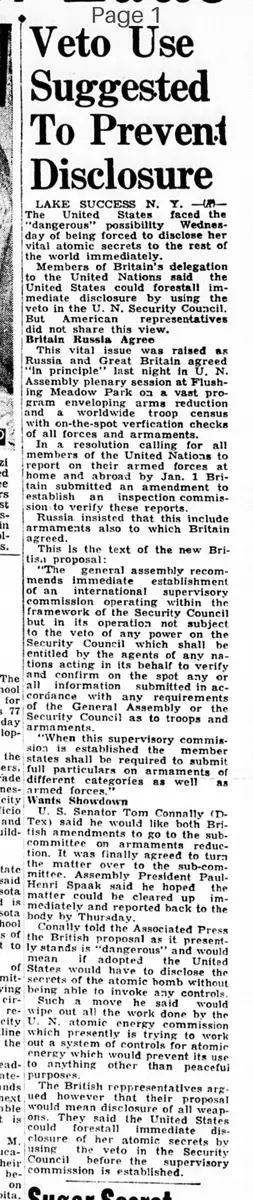
LAKE SUCCESS, N. Y. - The United States faced the "dangerous" possibility Wednesday of being forced to disclose her vital atomic secrets to the rest of the world immediately.
Members of Britain's delegation to the United Nations said the United States could forestall immediate disclosure by using the veto in the U. N. Security Council.
But American representatives did not share this view.
Britain Russia Agree
This vital issue was raised as Russia and Great Britain agreed "in principle" last night in U. N. Assembly plenary session at Flushing Meadow Park on a vast program enveloping arms reduction and a worldwide troop census with on-the-spot verification check of all forces and armaments.
In a resolution calling for all members of the United Nations to report on their armed forces at home and abroad by Jan. 1 Britain submitted an amendment to establish an inspection commission-to verify these reports.
Russia insisted that this include armaments also to which Britain agreed.
This is the text of the new British proposal:
"The general assembly recommends immediate establishment of an international supervisory commission operating within the framework of the Security Council but in its operation not subject to the veto of any power on the Security Council which shall be entitled by the agents of any nations acting in its behalf to verify and confirm on the spot any or all information submitted in accordance with any requirements of the General Assembly or the Security Council as to troops and armaments.
"When this supervisory commission is established the member states shall be required to submit full particulars on armaments of different categories as well as armed forces.
Wants Showdown
U. S. Senator Tom Connally (D. Tex) said he would like both British amendments to go to the subcommittee on armaments reduction. It was finally agreed to turn the matter over to the sub-committee. Assembly President Paul-Henri Spaak said he hoped the matter could be cleared up immediately and reported back to the body by Thursday.
Connally told the Associated Press the British proposal as it presently stands is "dangerous" and would mean if adopted the United States would have to disclose the secrets of the atomic bomb without being able to invoke any controls.
Such a move he said would wipe out all the work done by the U.N. atomic energy commission which presently is trying to work out a system of controls for atomic energy which would prevent its use to anything other than peaceful purposes.
The British representatives argued however that their proposal would mean disclosure of all weapons. They said the United States could forestall immediate disclosure of her atomic secrets by using the veto in the Security Council before the supervisory commission is established.
What sub-type of article is it?
What keywords are associated?
What entities or persons were involved?
Where did it happen?
Foreign News Details
Primary Location
Lake Success, N. Y.
Event Date
Wednesday
Key Persons
Outcome
russia and great britain agreed in principle on arms reduction program with troop census and verification; britain proposed supervisory commission not subject to veto; matter referred to subcommittee; us concerns over atomic secrets disclosure.
Event Details
Britain and Russia agreed in principle at UN Assembly plenary session on arms reduction and worldwide troop census with on-the-spot verification. Britain submitted amendment for inspection commission to verify reports on armed forces by Jan. 1, extended to armaments. Proposal text details commission operating under Security Council but not subject to veto, requiring full particulars on armaments and forces. US Senator Connally criticized it as dangerous, fearing atomic bomb secrets disclosure without controls, undermining UN atomic energy commission. British argued it covers all weapons and US could use veto to delay.