Thank you for visiting SNEWPapers!
Sign up free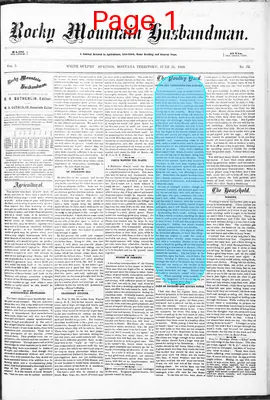
Story
June 24, 1880
Rocky Mountain Husbandman
Great Falls, Diamond City, White Sulphur Springs, Cascade County, Broadwater County, Meagher County, Montana
What is this article about?
Practical advice from a correspondent on treating common poultry diseases like roup, swelled head, enlarged wattles, black comb, and influenza in chickens and turkeys using iodine and turpentine applications.
Clipping
OCR Quality
95%
Excellent
Full Text
The Poultry Yard.
IODINE AND TURPENTINE FOR POULTRY.
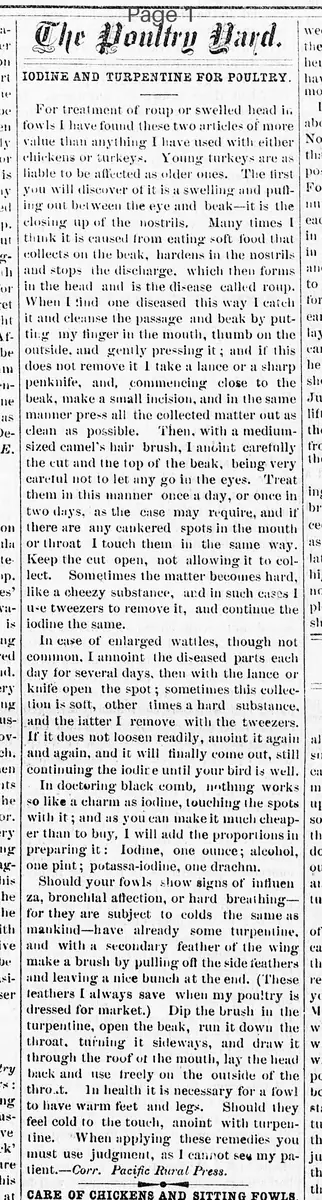
For treatment of roup or swelled head in fowls I have found these two articles of more value than anything I have used with either chickens or turkeys. Young turkeys are as liable to be affected as older ones. The first you will discover of it is a swelling and puffing out between the eye and beak-it is the closing up of the nostrils. Many times I think it is caused from eating soft food that collects on the beak, hardens in the nostrils and stops the discharge, which then forms in the head and is the disease called roup.
When I find one diseased this way I catch it and cleanse the passage and beak by putting my finger in the mouth, thumb on the outside, and gently pressing it; and if this does not remove it I take a lance or a sharp penknife, and, commencing close to the beak, make a small incision, and in the same manner press all the collected matter out as clean as possible. Then, with a medium-sized camel's hair brush, I anoint carefully the cut and the top of the beak, being very careful not to let any go in the eyes. Treat them in this manner once a day, or once in two days, as the case may require, and if there are any cankered spots in the mouth or throat I touch them in the same way. Keep the cut open, not allowing it to collect. Sometimes the matter becomes hard, like a cheesy substance, and in such cases I use tweezers to remove it, and continue the iodine the same.
In case of enlarged wattles, though not common, I anoint the diseased parts each day for several days, then with the lance or knife open the spot; sometimes this collection is soft, other times a hard substance, and the latter I remove with the tweezers. If it does not loosen readily, anoint it again and again, and it will finally come out, still continuing the iodine until your bird is well.
In doctoring black comb, nothing works so like a charm as iodine, touching the spots with it; and as you can make it much cheaper than to buy, I will add the proportions in preparing it: Iodine, one ounce; alcohol, one pint; potassa-iodine, one drachm.
Should your fowls show signs of influenza, bronchial affection, or hard breathing-for they are subject to colds the same as mankind-have already some turpentine, and with a secondary feather of the wing make a brush by pulling off the side feathers and leaving a nice bunch at the end. (These feathers I always save when my poultry is dressed for market.) Dip the brush in the turpentine, open the beak, run it down the throat, turning it sideways, and draw it through the roof of the mouth, lay the head back and use freely on the outside of the throat. In health it is necessary for a fowl to have warm feet and legs. Should they feel cold to the touch, anoint with turpentine. When applying these remedies you must use judgment, as I cannot see my patient.--Corr. Pacific Rural Press.
IODINE AND TURPENTINE FOR POULTRY.
For treatment of roup or swelled head in fowls I have found these two articles of more value than anything I have used with either chickens or turkeys. Young turkeys are as liable to be affected as older ones. The first you will discover of it is a swelling and puffing out between the eye and beak-it is the closing up of the nostrils. Many times I think it is caused from eating soft food that collects on the beak, hardens in the nostrils and stops the discharge, which then forms in the head and is the disease called roup.
When I find one diseased this way I catch it and cleanse the passage and beak by putting my finger in the mouth, thumb on the outside, and gently pressing it; and if this does not remove it I take a lance or a sharp penknife, and, commencing close to the beak, make a small incision, and in the same manner press all the collected matter out as clean as possible. Then, with a medium-sized camel's hair brush, I anoint carefully the cut and the top of the beak, being very careful not to let any go in the eyes. Treat them in this manner once a day, or once in two days, as the case may require, and if there are any cankered spots in the mouth or throat I touch them in the same way. Keep the cut open, not allowing it to collect. Sometimes the matter becomes hard, like a cheesy substance, and in such cases I use tweezers to remove it, and continue the iodine the same.
In case of enlarged wattles, though not common, I anoint the diseased parts each day for several days, then with the lance or knife open the spot; sometimes this collection is soft, other times a hard substance, and the latter I remove with the tweezers. If it does not loosen readily, anoint it again and again, and it will finally come out, still continuing the iodine until your bird is well.
In doctoring black comb, nothing works so like a charm as iodine, touching the spots with it; and as you can make it much cheaper than to buy, I will add the proportions in preparing it: Iodine, one ounce; alcohol, one pint; potassa-iodine, one drachm.
Should your fowls show signs of influenza, bronchial affection, or hard breathing-for they are subject to colds the same as mankind-have already some turpentine, and with a secondary feather of the wing make a brush by pulling off the side feathers and leaving a nice bunch at the end. (These feathers I always save when my poultry is dressed for market.) Dip the brush in the turpentine, open the beak, run it down the throat, turning it sideways, and draw it through the roof of the mouth, lay the head back and use freely on the outside of the throat. In health it is necessary for a fowl to have warm feet and legs. Should they feel cold to the touch, anoint with turpentine. When applying these remedies you must use judgment, as I cannot see my patient.--Corr. Pacific Rural Press.
What sub-type of article is it?
Veterinary Advice
Poultry Remedies
What themes does it cover?
Recovery
What keywords are associated?
Poultry Treatment
Roup Cure
Iodine Application
Turpentine Remedy
Fowl Diseases
Swelled Head
Black Comb
Story Details
Story Details
Detailed instructions for using iodine to treat roup, swelled head, enlarged wattles, and black comb in fowls by anointing, incising, and removing matter; turpentine for influenza and colds by brushing throat and anointing cold extremities.