Thank you for visiting SNEWPapers!
Sign up free
Literary
January 15, 1896
Waterbury Democrat
Waterbury, New Haven County, Connecticut
What is this article about?
Biographical sketch of Mrs. Billington, a renowned singer of the late 18th century, celebrated for her talent and beauty by figures like Haydn and Kelly, yet surrounded by scandals in the morally lax Georgian era. Despite controversies, her charm and artistry maintained her popularity.
Clipping
OCR Quality
98%
Excellent
Full Text
Mrs. Billington.
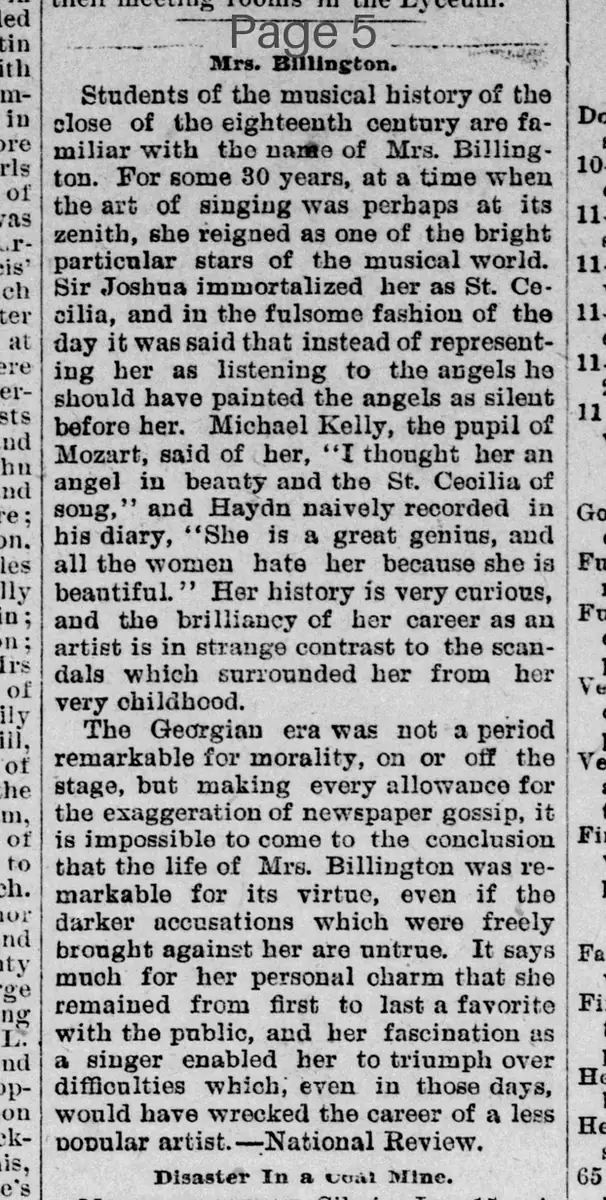
Students of the musical history of the close of the eighteenth century are familiar with the name of Mrs. Billington. For some 30 years, at a time when the art of singing was perhaps at its zenith, she reigned as one of the bright particular stars of the musical world. Sir Joshua immortalized her as St. Cecilia, and in the fulsome fashion of the day it was said that instead of representing her as listening to the angels he should have painted the angels as silent before her. Michael Kelly, the pupil of Mozart, said of her, "I thought her an angel in beauty and the St. Cecilia of song," and Haydn naively recorded in his diary, "She is a great genius, and all the women hate her because she is beautiful." Her history is very curious, and the brilliancy of her career as an artist is in strange contrast to the scandals which surrounded her from her very childhood.
The Georgian era was not a period remarkable for morality, on or off the stage, but making every allowance for the exaggeration of newspaper gossip, it is impossible to come to the conclusion that the life of Mrs. Billington was remarkable for its virtue, even if the darker accusations which were freely brought against her are untrue. It says much for her personal charm that she remained from first to last a favorite with the public, and her fascination as a singer enabled her to triumph over difficulties which, even in those days, would have wrecked the career of a less popular artist.—National Review.
Students of the musical history of the close of the eighteenth century are familiar with the name of Mrs. Billington. For some 30 years, at a time when the art of singing was perhaps at its zenith, she reigned as one of the bright particular stars of the musical world. Sir Joshua immortalized her as St. Cecilia, and in the fulsome fashion of the day it was said that instead of representing her as listening to the angels he should have painted the angels as silent before her. Michael Kelly, the pupil of Mozart, said of her, "I thought her an angel in beauty and the St. Cecilia of song," and Haydn naively recorded in his diary, "She is a great genius, and all the women hate her because she is beautiful." Her history is very curious, and the brilliancy of her career as an artist is in strange contrast to the scandals which surrounded her from her very childhood.
The Georgian era was not a period remarkable for morality, on or off the stage, but making every allowance for the exaggeration of newspaper gossip, it is impossible to come to the conclusion that the life of Mrs. Billington was remarkable for its virtue, even if the darker accusations which were freely brought against her are untrue. It says much for her personal charm that she remained from first to last a favorite with the public, and her fascination as a singer enabled her to triumph over difficulties which, even in those days, would have wrecked the career of a less popular artist.—National Review.
What sub-type of article is it?
Essay
What themes does it cover?
Social Manners
What keywords are associated?
Mrs Billington
Singer
Georgian Era
Scandals
Musical History
St Cecilia
Literary Details
Title
Mrs. Billington.
Subject
Biographical Account Of Singer Mrs. Billington's Career And Scandals
Key Lines
I Thought Her An Angel In Beauty And The St. Cecilia Of Song
She Is A Great Genius, And All The Women Hate Her Because She Is Beautiful.