Thank you for visiting SNEWPapers!
Sign up free
Daily Kennebec Journal
Augusta, Kennebec County, Maine
What is this article about?
Detailed report on the poultry exhibition at the Bangor fair, highlighting the building, superintendent M. P. Hawkins, and major exhibitors like A. J. Keniston with 150 pairs of birds, Dr. Twaddle's buff leghorns and white wyandottes, and others showcasing various breeds including Plymouth Rocks, geese, ducks, and turkeys.
Clipping
OCR Quality
Full Text
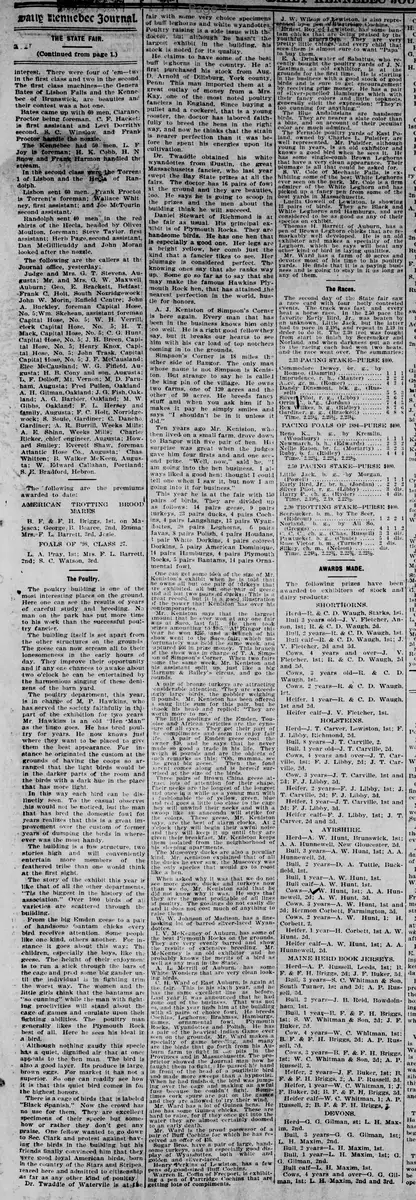
The poultry building is one of the most interesting places on the ground. Here one can see the results of years of careful study and breeding. No man on the park has put more time to his work than the successful poultry fancier.
The building itself is set apart from the other structures on the grounds. The geese can now scream all to their lonesomeness in the early hours of day. They improve their opportunity and if any one chances to awake about two o'clock he can be entertained by the harmonious singing of these denizens of the barnyard.
The poultry department, this year is in charge of M. P. Hawkins, who has served the society faithfully in this part of the exhibition for two years. Mr. Hawkins is an old "Hen Man" as the lingo goes. He has bred poultry for years. He now knows just where they want to be placed to give them the best appearance. For instance he originated the custom at the grounds of having the coops so arranged that the light birds would be in the darker parts of the room and the birds with a dark hue in the place that has more light.
In this way each bird can be distinctly seen. To the casual observer this would not be noticed, but the man that has bred the domestic fowl for years realizes that this is a great improvement over the custom of former years of dumping the birds in wherever was the most handy.
The building is a low structure, two stories high and will conveniently entertain more members of the feathered tribe than one would think at the first sight.
The story of the exhibit this year is like that of all the other departments. It is the biggest in the history of the association. Over 1000 birds of all varieties are scattered through the building.
From the big Emden geese to a pair of handsome bantam chicks every bird receives attention. Some people like one kind, others another. For instance it goes about this way: The children, especially the boys, like the geese. The height of their enjoyment is to run a stick through the bars of the cage and prod some big gander until the individual is in fighting trim the worst way. The women and the little girls think that the bantams are "so cunning" while the man with fighting proclivities will stand about the cage of games and emulate upon their fighting abilities. The poultry man generally likes the Plymouth Rock best of all. Here he sees his ideal in a bird.
Although nothing gaudy this species has a quiet, dignified air that at once appeals to the hen man. The bird is also a good layer. Its produce is large brown eggs. For market it has not a superior. So one can readily see how it is that this quiet bird comes in for the highest honors.
There is a cage of birds that is labeled "Black Spanish." Now the crowd has no use for them. They are excellent specimens of their specie but somehow or rather they don't get any praise. One fellow wanted to go down to Sec. Clark and protest against having the birds in the building but his friends finally convinced him that they were good loyal American birds, born in the country of the Stars and Stripes, reared here and admitted to citizenship as far as any other kind of poultry.
Dr. Twaddle of Waterville is at the fair with some very choice specimens of buff leghorns and white wyandottes. Poultry raising is a side issue with the doctor, but although he hasn't the largest exhibit in the building, his stock is noted for its quality. He claims to have some of the best buff leghorns in the country. He at first purchased his stock from Aus. D. Arnold of Dillsburg, York county, Penn. This man imported them at a great outlay of money from a Mrs. Kay, one of the most noted poultry fanciers in England. Since buying a pullet and a cockerel, that is a young rooster, the doctor has labored faithfully to breed the hens in the right way, and now he thinks that the strain is nearer perfection than it was before he spent his energies upon its cultivation.
Dr. Twaddle obtained his white wyandottes from Dustin, the great Massachusetts fancier, who last year swept the Bay State prizes at all the fairs. The doctor has 16 pairs of fowl at the ground and they are beauties too. He says he is going to scoop in the prizes and the men about the building think he will succeed.
Daniel Stewart of Richmond is at the fair as usual. His principal exhibit is of Plymouth Rocks. They are handsome birds. He has one hen that is especially a good one. Her legs are a bright yellow, her comb just the kind that a fancier likes to see. Her plumage is considered perfect. The knowing ones say that she ranks way up. Some go so far as to say that she may make the famous Hawkins Plymouth Rock hen, that has attained the nearest perfection in the world, hustle for honors.
A. J. Keniston of Simpson's Corner is here again. Every man that has been in the business knows him only too well. He is a right good fellow they say, but it breaks our hearts to see him with his car load of top notchers coming in to the grounds. Simpson's Corner is 18 miles the other side of Bangor. The only man whose name is not Simpson is Keniston. But strange to say he is called the king pin of the village. He owns two farms, one of 120 acres and the other of 30 acres. He breeds fancy stuff and when you ask him if he makes it pay he simply smiles and says "I shouldn't be in it unless it did."
Ten years ago Mr. Keniston, who then lived on a small farm, drove down to Bangor with five pair of hens. His surprise was great when the judges gave him four firsts and one second prize. "Well, now," said he, "I am going into the hen business. I always liked a good hen; thought I could tell one when I saw it, but now I am going into it for business."
This year he is at the fair with 150 pairs of birds. They are divided up as follows: 14 pairs geese, 9 pairs turkeys, 23 pairs ducks, 4 pairs Cochins, 4 pairs Langshans, 13 pairs Wyandottes, 20 pairs Leghorns, 5 pairs Javas, 8 pairs Polish, 4 pairs Houdans, 1 pair White Dorkings, 4 pairs colored Dorkings, 5 pairs American Dominique, 14 pairs Hamburgs, 4 pairs Plymouth Rocks, 5 pairs Bantams, 14 pairs Ornamental fowl.
One can get some idea of the size of Mr. Keniston's exhibit when he is told that he owns all but one pair of turkeys that are exhibited, all but one pair of geese and all but two pairs of ducks. This is a great record, but it is a good illustration of the power that Keniston has over his contemporaries.
Mr. Keniston says that the largest amount that he ever won at any one fair was at Saco, last fall. He then took prizes amounting to $105. At Bangor this year he won $20, and a branch of his show went to the Saco fair which unfortunately was held the same week, and captured $66 in prize money. This branch of the show was in charge of T. A. Simpson of Simpson's Corner. When two fairs come the same week, Mr. Keniston and his assistant split up, just like a big Barnum & Bailey's circus, and go the rounds.
A pair of bronze turkeys are attracting considerable attention. They are exceedingly large birds, the gobbler weighing 33 pounds. Mr. Keniston has been offered a snug little sum for this pair, but he shook his head and replied: "They are worth more to me."
The little goslings of the Emden, Toulouse and African varieties are the cynosure of all eyes. They get their part of the compliments and seem to enjoy fair life. A pair of Emden geese cost the owner $30, and he says that he never made so good a trade in his life. They weigh 46 pounds and are the objects of such remarks as this: "Oh, mamma, see the great big geese." Then the fond parent comes along and is herself surprised at the size of the birds.
Three pairs of Brown China geese attract lots of attention for their shape. Their necks are the longest of the longest and once in a while as a young man with a fashionable tie of yellow, green, blue and red goes a little too close to the cage they will unwind their necks and with a swoop like an anaconda will strike for the colors. These geese, Mr. Keniston says, are the best of alarm clocks. At 2 o'clock they will begin their awful noise and they will keep it up until they are given their breakfast. Mr. Keniston keeps them isolated from the neighborhood of his sleeping apartments.
The Muscovy ducks are also a peculiar kind. Mr. Keniston explained that of all the ducks he ever saw, the Muscovy was the only species that would go to roost like a hen.
When asked why it was that we do not see more geese, ducks and turkeys now than we do, Mr. Keniston said that he did not know why it was. He says that they are the most profitable of all lines of poultry. The goslings do not easily die and it does not cost much of anything to raise them.
W. W. Johnson of Madison, has a fine-looking lot of barred silver-laced Wyandottes.
I. V. McKenney of Auburn, has some of the best Plymouth Rocks on the grounds. They are very evenly barred and show the results of extensive breeding. Mr. McKenney is an old exhibitor and he probably knows the merits of a bird as well as any man in the State.
A. L. Merrill of Auburn, has some White Wonders that are very clean-looking birds.
C. H. Ward of East Auburn, is again at the fair. He has the same excellent line as before. Last year it was announced that he had sold out, and this year finds him at the building with his pairs of choice fowl. He breeds Cochins, Leghorns, Brahmas, Hamburgs, games, ornamental fowl, Plymouth Rocks, Wyandottes and Polish. He has a pair of the heaviest Indian Game ever seen on the grounds. Mr. Ward makes a specialty of game breeding, and many are the birds that go forth from his Auburn farm to fight in the pits in the Provinces and in Massachusetts. The proprietor showed the Journal man how he taught them to fight. He passed his hand in front of the head of a pugilistic bird and made more passes than a hypnotist. When he had finished, the bird was jumping over the cage and making an awful fuss because he couldn't fight. Sometimes cork spurs are put on the gants and they are allowed to try their wind.
Mr. Ward also has some Guinea chicks. These are hard to raise, for if they once get into the water they are almost certainly doomed to an early death.
Mr. Ward is the proud possessor of a pair of Buff Cochins for which he has received an offer of $15.
Sugar Bros. have a pair of large, handsome turkeys, and an especially good display of Wyandottes, both white and golden and silver-laced.
Henry Perkins of Lewiston, has a few pens of good-sized Buff Cochins.
Warren R. Coffin of Freeport, is exhibiting a pen of Partridge Cochins that are getting lots of compliments.
J. W. Wilson of Lewiston, is also represented by a pen of Partridge Cochins.
Ernest Roy of Lewiston, has some bantam chicks that are being praised by the youthful generation. They are very pretty little things, and every child that sees them is almost sure to want "Papa to buy them."
E. A. Drinkwater of Sabattus, who recently bought the poultry yards of J. N. Eastman, an old exhibitor, is at the grounds for the first time. He is starting in the business with a good stock of good birds and is sure to get encouragement by receiving prize money. He has a pair of silver-pencilled Hamburgs which with their fancy colors and little topknots, generally elicit the expression: "They're too cunning for anything."
The Blue Andalusians are handsome birds. They are nearer a slate color than a blue, and on account of their peculiar color are much admired.
The Fernside poultry yards of East Portland, owned by Charles L. Pulsifer, are well represented. Mr. Pulsifer, although young in years, is an old exhibitor and knows a good bird when he sees it. He has some single-comb Brown Leghorns that have a very clean appearance. Their plumage is all that could be asked for.
S. W. Cole of Mechanic Falls, is exhibiting some of the best White Leghorns ever seen on the park. Mr. Cole is a firm admirer of the White Leghorn and has picked up a fancy pen from some of the best yards in Massachusetts.
Luella Gowell of Lewiston, is showing 4 pairs of birds. They are Black and White Leghorns and Hamburgs, and are considered to be as good as any of their species on exhibit.
Thomas H. Barrett of Auburn, has a pen of Brown Leghorn chicks that are remarkably well developed. He is an old exhibitor and makes a specialty of the Leghorn, which he says will beat any other kind of bird in laying qualities.
Mr. Ward has a farm of 40 acres and devotes most of his time to his poultry yards. He finds that it is a paying business and is going to stay in it as long as any of them.
What sub-type of article is it?
What keywords are associated?
What entities or persons were involved?
Where did it happen?
Domestic News Details
Primary Location
Bangor
Key Persons
Outcome
exhibitors anticipate winning prizes; past prizes mentioned for some, e.g., a. j. keniston won $20 at bangor this year and $66 at saco.
Event Details
The poultry department at the fair, managed by M. P. Hawkins, features over 1000 birds of various breeds in a dedicated building. Exhibits include Plymouth Rocks, Leghorns, Wyandottes, geese, ducks, turkeys, and more from exhibitors across Maine and beyond. Highlights include A. J. Keniston's large display of 150 pairs dominating geese, ducks, and turkeys; Dr. Twaddle's quality buff leghorns and white wyandottes; and specialized breeds like fighting games by C. H. Ward.