Thank you for visiting SNEWPapers!
Sign up free
The Virginia Gazette
Richmond, Williamsburg, Richmond County, Virginia
What is this article about?
In the British House of Lords, a protest was entered against the Bill for better regulating the Government of Massachusetts Bay, citing seven reasons including procedural irregularities, lack of information on the colony's constitution, and threats to liberties. The bill passed 92-20, with listed dissenting lords.
Clipping
OCR Quality
Full Text
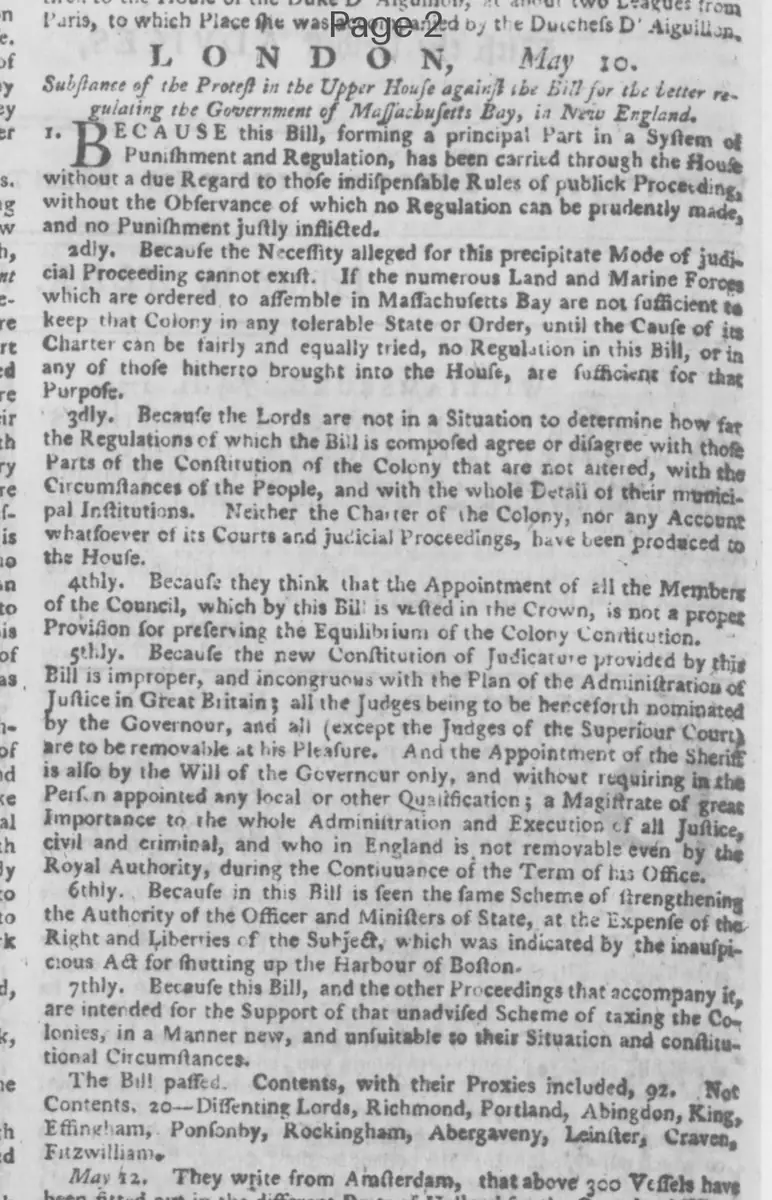
Substance of the Protest in the Upper House against the Bill for the better regulating the Government of Massachusetts Bay, in New England.
1. B E C A U S E this Bill, forming a principal Part in a System of Punishment and Regulation, has been carried through the House without a due Regard to those indispensable Rules of publick Proceeding, without the Observance of which no Regulation can be prudently made, and no Punishment justly inflicted.
2dly. Because the Necessity alleged for this precipitate Mode of judicial Proceeding cannot exist. If the numerous Land and Marine Forces which are ordered to assemble in Massachusetts Bay are not sufficient to keep that Colony in any tolerable State of Order, until the Cause of its Charter can be fairly and equally tried, no Regulation in this Bill, or in any of those hitherto brought into the House, are sufficient for that Purpose.
3dly. Because the Lords are not in a Situation to determine how far the Regulations of which the Bill is composed agree or disagree with those Parts of the Constitution of the Colony that are not altered, with the Circumstances of the People, and with the whole Detail of their municipal Institutions. Neither the Charter of the Colony, nor any Accounts whatsoever of its Courts and judicial Proceedings, have been produced to the House.
4thly. Because they think that the Appointment of all the Members of the Council, which by this Bill is vested in the Crown, is not a proper Provision for preserving the Equilibrium of the Colony Constitution.
5thly. Because the new Constitution of Judicature provided by this Bill is improper, and incongruous with the Plan of the Administration of Justice in Great Britain; all the Judges being to be henceforth nominated by the Governour, and all (except the Judges of the Superiour Court) are to be removable at his Pleasure. And the Appointment of the Sheriff is also by the Will of the Governour only, and without requiring in the Person appointed any local or other Qualification; a Magistrate of great Importance to the whole Administration and Execution of all Justice, civil and criminal, and who in England is not removable even by the Royal Authority, during the Continuance of the Term of his Office.
6thly. Because in this Bill is seen the same Scheme of strengthening the Authority of the Officer and Ministers of State, at the Expence of the Right and Liberties of the Subject, which was indicated by the inauspicious Act for shutting up the Harbour of Boston.
7thly. Because this Bill, and the other Proceedings that accompany it, are intended for the Support of that unadvised Scheme of taxing the Colonies, in a Manner new, and unsuitable to their Situation and constitutional Circumstances.
The Bill passed. Contents, with their Proxies included, 92. Not Contents, 20--Dissenting Lords, Richmond, Portland, Abingdon, King, Effingham, Ponsonby, Rockingham, Abergavenny, Leinster, Craven, Fitzwilliam.
What sub-type of article is it?
What keywords are associated?
What entities or persons were involved?
Where did it happen?
Domestic News Details
Primary Location
London
Event Date
May 10
Key Persons
Outcome
the bill passed. contents, with their proxies included, 92. not contents, 20
Event Details
Substance of the Protest in the Upper House against the Bill for the better regulating the Government of Massachusetts Bay, in New England, with seven reasons: 1. Carried through without due regard to rules of proceeding. 2dly. Precipitate mode unnecessary given forces assembled. 3dly. Insufficient information on colony's constitution and institutions. 4thly. Crown appointment of Council disrupts equilibrium. 5thly. New judicature improper, judges and sheriff appointed/removable by governor without qualifications. 6thly. Strengthens state authority at expense of subject liberties, akin to Boston Harbour Act. 7thly. Supports unwise scheme of taxing colonies.