Thank you for visiting SNEWPapers!
Sign up free
Literary
December 8, 1910
Iowa County Democrat
Mineral Point, Iowa County, Wisconsin
What is this article about?
The first chapter of Charles Dickens' 'A Christmas Carol' introduces Ebenezer Scrooge, a miserly businessman who scorns Christmas. On Christmas Eve, after dismissing his nephew's cheer and begrudging his clerk's holiday, Scrooge sees the ghost of his late partner Jacob Marley, who warns him of three upcoming spirits to prevent his own doomed fate.
Merged-components note: Images are illustrations accompanying the serialized Christmas Carol story.
Clipping
OCR Quality
95%
Excellent
Full Text
CHRISTMAS CAROL
BY
Charles Dickens
The famous Yuletide tale which, with its story of Tiny Tim, has touched millions of hearts and wrought for human kindliness.
Chapter One
MARLEY'S GHOST.
MARLEY was dead, to begin with. There is no doubt whatever about that. The register of his burial was signed by the clergyman, the clerk, the undertaker and the chief mourner. Scrooge signed it, and Scrooge's name was good upon 'change for anything he chose to put his hand to. Old Marley was as dead as a doornail.
Mind, I don't mean to say that I know of my own knowledge what there is particularly dead about a doornail. I might have been inclined myself to regard a coffin nail as the deadest piece of ironmongery in the trade. But the wisdom of our ancestors is in the simile, and my unhallowed hands shall not disturb it or the country's done for.
You will therefore permit me to repeat emphatically that Marley was as dead as a doornail.
Scrooge knew he was dead? Of course he did. How could it be otherwise? Scrooge and he were partners for I don't know how many years. Scrooge was his sole executor, his sole administrator, his sole assign, his sole residuary legatee, his sole friend and sole mourner.
Scrooge never painted out old Marley's name. There it stood years afterward above the warehouse door: Scrooge & Marley. The firm was known as Scrooge & Marley. Sometimes people new to the business called Scrooge Scrooge and sometimes Marley, but he answered to both names. It was all the same to him.
Oh, but he was a tight-fisted hand at the grindstone, Scrooge! A squeezing, wrenching, grasping, scraping, clutching, covetous old sinner. Hard and sharp as flint, from which no steel had ever struck out generous fire; secret and self-contained, and solitary as an oyster. The cold within him froze his old features, nipped his pointed nose, shriveled his cheek, stiffened his gait, made his eyes red, his thin lips blue and spoke out shrewdly in his grating voice. A frosty rime was on his head and on his eyebrows and his wiry chin. He carried his own low temperature always about with him. He iced his office in the dog days and didn't thaw it one degree at Christmas.
Once upon a time-of all the good days in the year, on Christmas Eve old Scrooge sat busy in his counting house. It was cold, bleak, biting weather, foggy withal, and he could hear the people in the court outside go wheezing up and down, beating their hands upon their breasts and stamping their feet upon the pavement stones to warm them. The city clocks had only just gone 3, but it was quite dark already.
The door of Scrooge's counting house was open that he might keep his eye upon his clerk, who in a dismal little cell beyond, a sort of tank, was copying letters. Scrooge had a very small fire, but the clerk's fire was so very much smaller that it looked like one coal. But he couldn't replenish it, for Scrooge kept the coal box in his own room, and so surely as the clerk came in with the shovel the master predicted that it would be necessary for them to part. Wherefore the clerk put on his white comforter and tried to warm himself at the candle, in which effort, not being a man of a strong imagination, he failed.
"A merry Christmas, uncle! God save you!" cried a cheerful voice. It was the voice of Scrooge's nephew, who came upon him so quickly that this was the first intimation he had of his approach.
"Bah!" said Scrooge. "Humbug!"
He had so heated himself with rapid walking in the fog and frost, this nephew of Scrooge's, that he was all in a glow. His face was ruddy and handsome.
"Christmas a humbug, uncle!" said Scrooge's nephew. "You don't mean that, I am sure?"
"I do," said Scrooge. "Merry Christmas! What right have you to be merry? What reason have you to be merry?"
"Come, then," returned the nephew gaily. "What right have you to be dismal?"
Scrooge, having no better answer ready, on the spur of the moment said "Bah!" again and followed it up with "Humbug!"
"Uncle!" pleaded the nephew.
"Nephew," returned the uncle sternly, "keep Christmas in your own way and let me keep it in mine."
"Keep it?" repeated Scrooge's nephew. "But you don't keep it."
"Let me leave it alone, then," said Scrooge. "Much good may it do you! Much good it has ever done you!"
"There are many things from which I might have derived good by which I have not profited, I dare say," returned the nephew. "Christmas among the rest. But I am sure I have always thought of Christmas time when it has come round-apart from the veneration due to its sacred name and origin, if anything belonging to it can be apart from that-as a good time; a kind, forgiving, charitable, pleasant time: the only time I know of in the long calendar of the year when men and women seem by one consent to open their shut-up hearts freely and to think of people below them as if they really were fellow-passengers to the grave, and not another race of creatures bound on other journeys. And therefore, uncle, though it has never put a scrap of gold or silver in my pocket, I believe that it has done me good and will do me good, and I say God bless it!"
The clerk in the tank involuntarily applauded. Becoming immediately sensible of the impropriety, he poked the fire and extinguished the last frail spark forever.
"Let me hear another sound from you," said Scrooge, "and you'll keep your Christmas by losing your situation."
"Don't be angry, uncle. Come; dine with us tomorrow."
Scrooge said that he would see him-Yes, indeed he did. He went the whole length of the expression and said that he would see him in that extremity first.
"But why?" cried Scrooge's nephew. "Why?"
"Good afternoon," said Scrooge.
"I am sorry with all my heart to find you so resolute. We have never had any quarrel to which I have been a party. But I have made the trial in homage to Christmas, and I'll keep my Christmas humor to the last. So a merry Christmas, uncle!"
"Good afternoon," said Scrooge.
"And a happy New Year!"
"Good afternoon," said Scrooge.
His nephew left the room without an angry word, notwithstanding. He stopped at the outer door to bestow the greetings of the season on the clerk, who, cold as he was, was warmer than Scrooge, for he returned them cordially.
At length the hour of shutting up the counting house arrived. With an ill will Scrooge dismounted from his stool and tacitly admitted the fact to the expectant clerk in the tank, who instantly snuffed his candle out and put on his hat.
"You'll want all day tomorrow, I suppose?" said Scrooge.
"If quite convenient, sir."
"It's not convenient," said Scrooge, "and it's not fair. If I was to stop half a crown for it you'd think yourself ill used, I'll be bound."
The clerk smiled faintly.
"And yet," said Scrooge, "you don't think me ill used when I pay a day's wages for no work."
The clerk observed that it was only once a year.
"A poor excuse for picking a man's pocket every 25th of December," said Scrooge, buttoning his greatcoat to the chin. "But I suppose you must have the whole day. Be here all the earlier next morning."
The clerk promised that he would, and Scrooge walked out with a growl.
Scrooge took his melancholy dinner in his usual melancholy tavern and, having read all the newspapers and beguiled the rest of the evening with his banker's book, went home to bed. He lived in chambers which had once belonged to his deceased partner. Now, it is a fact that there was nothing at all particular about the knocker on the door except that it was very large. And then let any man explain to me if he can how it happened that Scrooge, having his key in the lock of the door, saw in the knocker without its undergoing any intermediate process or change, not a knocker, but Marley's face.
Marley's face. It was not in impenetrable shadow, as the other objects in the yard were, but had a dismal light about it, like a bad lobster in a dark cellar. It was not angry or ferocious, but looked at Scrooge as Marley used to look-with ghostly spectacles turned up upon its ghostly forehead.
As Scrooge looked fixedly at this phenomenon it was a knocker again.
To say that he was not startled or that his blood was not conscious of a terrible sensation to which it had been a stranger from infancy would be untrue. But he put his hand upon the key he had relinquished, turned it sturdily, walked in and lighted his candle.
He did pause, with a moment's irresolution, before he shut the door, and he did look cautiously behind it first as if he half expected to be terrified with the sight of Marley's pigtail sticking out into the hall. But there was nothing on the back of the door except the screws and nuts that held the knocker on, so he said "Pooh, pooh!" and closed it with a bang.
The sound resounded through the house like thunder. Every room above and every cask in the wine merchant's cellar below appeared to have a separate peal of echoes of its own.
Scrooge was not a man to be frightened by echoes. He fastened the door and walked across the hall and up the stairs, slowly, too, trimming his candle as he went.
But before he shut his heavy door he walked through his rooms to see that all was right. He had just enough recollection of the face to desire to do that.
Quite satisfied, he closed his door and locked himself in, double-locked himself in, which was not his custom.
Thus secured against surprise, he took off his cravat, put on his dressing gown and slippers and his nightcap and sat down before the fire to take his gruel.
It was a very low fire indeed; nothing on such a bitter night. He was obliged to sit close to it and brood over it before he could extract the least sensation of warmth from such a handful of fuel. The fireplace was an old one built by some Dutch merchant long ago and paved all round with quaint Dutch tiles, designed to illustrate the Scriptures. There were Cains and Abels, Pharaoh's daughters, queens of Sheba, angelic messengers descending through the air on clouds like feather beds, Abrahams, Belshazzars, apostles putting off to sea in butter boats, hundreds of figures to attract his thoughts, and yet that face of Marley, seven years dead, came like the ancient prophet's rod and swallowed up the whole.
"Humbug!" said Scrooge and walked across the room.
After several turns he sat down again. As he threw his head back in the chair his glance happened to rest upon a bell, a disused bell, that hung in the room and communicated for some purpose now forgotten with a chamber in the highest story of the building. It was with great astonishment and with a strange, inexplicable dread that as he looked he saw this bell begin to swing. It swung so softly in the outset that it scarcely made a sound, but soon it rang out loudly, and so did every bell in the house.
This might have lasted half a minute or a minute, but it seemed an hour. The bells ceased as they had begun-together. They were succeeded by a clanking noise deep down below, as if some person were dragging a heavy chain over the casks in the wine merchant's cellar. The cellar door flew open with a booming sound, and then he heard the noise much louder on the floors below, then coming up the stairs, then coming straight toward his door.
"It's humbug still," said Scrooge. "I won't believe it."
His color changed, though, when without a pause it came on through the heavy door and passed into the room before his eyes.
The same face, the very same-Marley in his pigtail, usual waistcoat, tights and boots, the tassels on the latter bristling like his pigtail and his coat skirts and the hair upon his head. The chain he drew was clasped about his middle. It was long and wound about him like a tail, and it was made (for Scrooge observed it closely) of cash boxes, keys, padlocks, ledgers, deeds and heavy purses wrought in steel. His body was transparent, so that Scrooge, observing him and looking through his waistcoat, could see the two buttons on his coat behind.
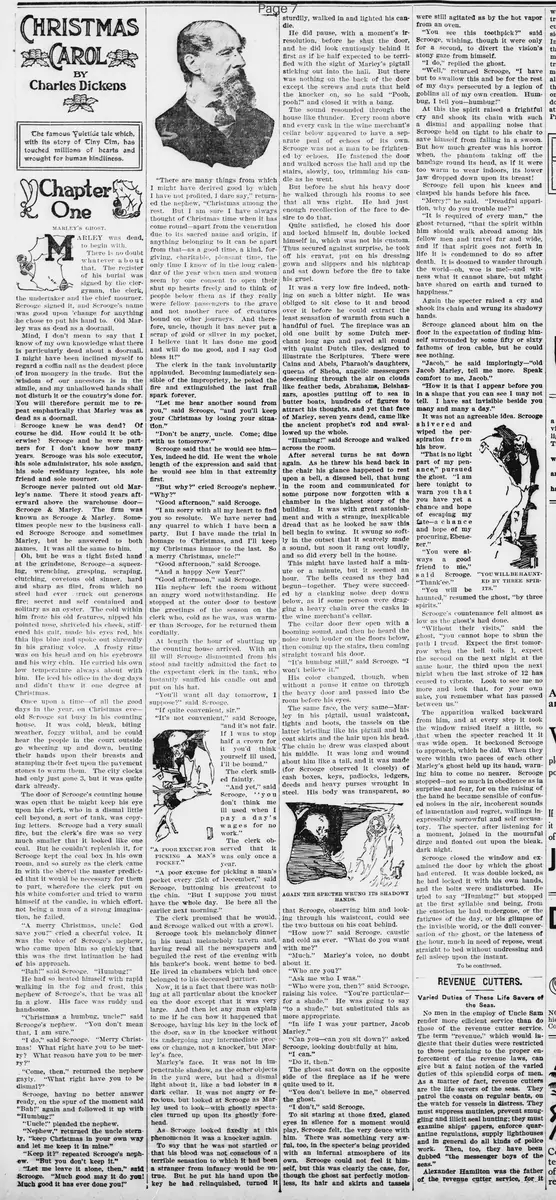
AGAIN THE SPECTER WRUNG ITS SHADOWY HANDS.
"How now?" said Scrooge, caustic and cold as ever. "What do you want with me?"
"Much." Marley's voice, no doubt about it.
"Who are you?"
"Ask me who I was."
"Who were you, then?" said Scrooge, raising his voice. "You're particular-for a shade." He was going to say "to a shade," but substituted this as more appropriate.
"In life I was your partner, Jacob Marley."
"Can you-can you sit down?" asked Scrooge, looking doubtfully at him.
"I can."
"Do it, then."
The ghost sat down on the opposite side of the fireplace as if he were quite used to it.
"You don't believe in me," observed the ghost.
"I don't," said Scrooge.
To sit staring at those fixed, glazed eyes in silence for a moment would play, Scrooge felt, the very deuce with him. There was something very awful, too, in the specter's being provided with an infernal atmosphere of its own. Scrooge could not feel it himself, but this was clearly the case, for though the ghost sat perfectly motionless, its hair and skirts and tassels were still agitated as by the hot vapor from an oven.
"You see this toothpick?" said Scrooge, wishing, though it were only for a second, to divert the vision's stony gaze from himself.
"I do," replied the ghost.
"Well," returned Scrooge, "I have but to swallow this and be for the rest of my days persecuted by a legion of goblins all of my own creation. Humbug, I tell you-humbug!"
At this the spirit raised a frightful cry and shook its chain with such a dismal and appalling noise that Scrooge held on tight to his chair to save himself from falling in a swoon. But how much greater was his horror when, the phantom taking off the bandage round its head, as if it were too warm to wear indoors, its lower jaw dropped down upon its breast!
Scrooge fell upon his knees and clasped his hands before his face.
"Mercy!" he said. "Dreadful apparition, why do you trouble me?"
"It is required of every man," the ghost returned, "that the spirit within him should walk abroad among his fellow men and travel far and wide; and if that spirit goes not forth in life it is condemned to do so after death. It is doomed to wander through the world-oh, woe is me!-and witness what it cannot share, but might have shared on earth and turned to happiness."
Again the specter raised a cry and shook its chain and wrung its shadowy hands.
Scrooge glanced about him on the floor in the expectation of finding himself surrounded by some fifty or sixty fathoms of iron cable, but he could see nothing.
"Jacob," he said imploringly. "Old Jacob Marley, tell me more. Speak comfort to me, Jacob."
"How it is that I appear before you in a shape that you can see I may not tell. I have sat invisible beside you many and many a day."
It was not an agreeable idea. Scrooge shivered and wiped the perspiration from his brow.
"That is no light part of my penance," pursued the ghost. "I am here tonight to warn you that you have yet a chance and hope of escaping my fate-a chance and hope of my procuring, Ebenezer."
"You were always a good friend to me," said Scrooge.
"Thank'ee."
"You will be haunted," resumed the ghost, "by three spirits."
Scrooge's countenance fell almost as low as the ghost's had done.
"Without their visits," said the ghost, "you cannot hope to shun the path I tread. Expect the first tomorrow when the bell tolls 1, expect the second on the next night at the same hour, the third upon the next night when the last stroke of 12 has ceased to vibrate. Look to see me no more and look that, for your own sake, you remember what has passed between us."
The apparition walked backward from him, and at every step it took the window raised itself a little, so that when the specter reached it it was wide open. It beckoned Scrooge to approach, which he did. When they were within two paces of each other Marley's ghost held up its hand, warning him to come no nearer. Scrooge stopped-not so much in obedience as in surprise and fear, for on the raising of the hand he became sensible of confused noises in the air; incoherent sounds of lamentation and regret, wailings inexpressibly sorrowful and self-accusatory. The specter, after listening for a moment, joined in the mournful dirge and floated out upon the bleak, dark night.
Scrooge closed the window and examined the door by which the ghost had entered. It was double-locked, as he had locked it with his own hands, and the bolts were undisturbed. He tried to say "Humbug!" but stopped at the first syllable and, being, from the emotion he had undergone, or the fatigues of the day, or his glimpse of the invisible world, or the dull conversation of the ghost, or the lateness of the hour, much in need of repose, went straight to bed without undressing and fell asleep upon the instant.
To be continued.
BY
Charles Dickens
The famous Yuletide tale which, with its story of Tiny Tim, has touched millions of hearts and wrought for human kindliness.
Chapter One
MARLEY'S GHOST.
MARLEY was dead, to begin with. There is no doubt whatever about that. The register of his burial was signed by the clergyman, the clerk, the undertaker and the chief mourner. Scrooge signed it, and Scrooge's name was good upon 'change for anything he chose to put his hand to. Old Marley was as dead as a doornail.
Mind, I don't mean to say that I know of my own knowledge what there is particularly dead about a doornail. I might have been inclined myself to regard a coffin nail as the deadest piece of ironmongery in the trade. But the wisdom of our ancestors is in the simile, and my unhallowed hands shall not disturb it or the country's done for.
You will therefore permit me to repeat emphatically that Marley was as dead as a doornail.
Scrooge knew he was dead? Of course he did. How could it be otherwise? Scrooge and he were partners for I don't know how many years. Scrooge was his sole executor, his sole administrator, his sole assign, his sole residuary legatee, his sole friend and sole mourner.
Scrooge never painted out old Marley's name. There it stood years afterward above the warehouse door: Scrooge & Marley. The firm was known as Scrooge & Marley. Sometimes people new to the business called Scrooge Scrooge and sometimes Marley, but he answered to both names. It was all the same to him.
Oh, but he was a tight-fisted hand at the grindstone, Scrooge! A squeezing, wrenching, grasping, scraping, clutching, covetous old sinner. Hard and sharp as flint, from which no steel had ever struck out generous fire; secret and self-contained, and solitary as an oyster. The cold within him froze his old features, nipped his pointed nose, shriveled his cheek, stiffened his gait, made his eyes red, his thin lips blue and spoke out shrewdly in his grating voice. A frosty rime was on his head and on his eyebrows and his wiry chin. He carried his own low temperature always about with him. He iced his office in the dog days and didn't thaw it one degree at Christmas.
Once upon a time-of all the good days in the year, on Christmas Eve old Scrooge sat busy in his counting house. It was cold, bleak, biting weather, foggy withal, and he could hear the people in the court outside go wheezing up and down, beating their hands upon their breasts and stamping their feet upon the pavement stones to warm them. The city clocks had only just gone 3, but it was quite dark already.
The door of Scrooge's counting house was open that he might keep his eye upon his clerk, who in a dismal little cell beyond, a sort of tank, was copying letters. Scrooge had a very small fire, but the clerk's fire was so very much smaller that it looked like one coal. But he couldn't replenish it, for Scrooge kept the coal box in his own room, and so surely as the clerk came in with the shovel the master predicted that it would be necessary for them to part. Wherefore the clerk put on his white comforter and tried to warm himself at the candle, in which effort, not being a man of a strong imagination, he failed.
"A merry Christmas, uncle! God save you!" cried a cheerful voice. It was the voice of Scrooge's nephew, who came upon him so quickly that this was the first intimation he had of his approach.
"Bah!" said Scrooge. "Humbug!"
He had so heated himself with rapid walking in the fog and frost, this nephew of Scrooge's, that he was all in a glow. His face was ruddy and handsome.
"Christmas a humbug, uncle!" said Scrooge's nephew. "You don't mean that, I am sure?"
"I do," said Scrooge. "Merry Christmas! What right have you to be merry? What reason have you to be merry?"
"Come, then," returned the nephew gaily. "What right have you to be dismal?"
Scrooge, having no better answer ready, on the spur of the moment said "Bah!" again and followed it up with "Humbug!"
"Uncle!" pleaded the nephew.
"Nephew," returned the uncle sternly, "keep Christmas in your own way and let me keep it in mine."
"Keep it?" repeated Scrooge's nephew. "But you don't keep it."
"Let me leave it alone, then," said Scrooge. "Much good may it do you! Much good it has ever done you!"
"There are many things from which I might have derived good by which I have not profited, I dare say," returned the nephew. "Christmas among the rest. But I am sure I have always thought of Christmas time when it has come round-apart from the veneration due to its sacred name and origin, if anything belonging to it can be apart from that-as a good time; a kind, forgiving, charitable, pleasant time: the only time I know of in the long calendar of the year when men and women seem by one consent to open their shut-up hearts freely and to think of people below them as if they really were fellow-passengers to the grave, and not another race of creatures bound on other journeys. And therefore, uncle, though it has never put a scrap of gold or silver in my pocket, I believe that it has done me good and will do me good, and I say God bless it!"
The clerk in the tank involuntarily applauded. Becoming immediately sensible of the impropriety, he poked the fire and extinguished the last frail spark forever.
"Let me hear another sound from you," said Scrooge, "and you'll keep your Christmas by losing your situation."
"Don't be angry, uncle. Come; dine with us tomorrow."
Scrooge said that he would see him-Yes, indeed he did. He went the whole length of the expression and said that he would see him in that extremity first.
"But why?" cried Scrooge's nephew. "Why?"
"Good afternoon," said Scrooge.
"I am sorry with all my heart to find you so resolute. We have never had any quarrel to which I have been a party. But I have made the trial in homage to Christmas, and I'll keep my Christmas humor to the last. So a merry Christmas, uncle!"
"Good afternoon," said Scrooge.
"And a happy New Year!"
"Good afternoon," said Scrooge.
His nephew left the room without an angry word, notwithstanding. He stopped at the outer door to bestow the greetings of the season on the clerk, who, cold as he was, was warmer than Scrooge, for he returned them cordially.
At length the hour of shutting up the counting house arrived. With an ill will Scrooge dismounted from his stool and tacitly admitted the fact to the expectant clerk in the tank, who instantly snuffed his candle out and put on his hat.
"You'll want all day tomorrow, I suppose?" said Scrooge.
"If quite convenient, sir."
"It's not convenient," said Scrooge, "and it's not fair. If I was to stop half a crown for it you'd think yourself ill used, I'll be bound."
The clerk smiled faintly.
"And yet," said Scrooge, "you don't think me ill used when I pay a day's wages for no work."
The clerk observed that it was only once a year.
"A poor excuse for picking a man's pocket every 25th of December," said Scrooge, buttoning his greatcoat to the chin. "But I suppose you must have the whole day. Be here all the earlier next morning."
The clerk promised that he would, and Scrooge walked out with a growl.
Scrooge took his melancholy dinner in his usual melancholy tavern and, having read all the newspapers and beguiled the rest of the evening with his banker's book, went home to bed. He lived in chambers which had once belonged to his deceased partner. Now, it is a fact that there was nothing at all particular about the knocker on the door except that it was very large. And then let any man explain to me if he can how it happened that Scrooge, having his key in the lock of the door, saw in the knocker without its undergoing any intermediate process or change, not a knocker, but Marley's face.
Marley's face. It was not in impenetrable shadow, as the other objects in the yard were, but had a dismal light about it, like a bad lobster in a dark cellar. It was not angry or ferocious, but looked at Scrooge as Marley used to look-with ghostly spectacles turned up upon its ghostly forehead.
As Scrooge looked fixedly at this phenomenon it was a knocker again.
To say that he was not startled or that his blood was not conscious of a terrible sensation to which it had been a stranger from infancy would be untrue. But he put his hand upon the key he had relinquished, turned it sturdily, walked in and lighted his candle.
He did pause, with a moment's irresolution, before he shut the door, and he did look cautiously behind it first as if he half expected to be terrified with the sight of Marley's pigtail sticking out into the hall. But there was nothing on the back of the door except the screws and nuts that held the knocker on, so he said "Pooh, pooh!" and closed it with a bang.
The sound resounded through the house like thunder. Every room above and every cask in the wine merchant's cellar below appeared to have a separate peal of echoes of its own.
Scrooge was not a man to be frightened by echoes. He fastened the door and walked across the hall and up the stairs, slowly, too, trimming his candle as he went.
But before he shut his heavy door he walked through his rooms to see that all was right. He had just enough recollection of the face to desire to do that.
Quite satisfied, he closed his door and locked himself in, double-locked himself in, which was not his custom.
Thus secured against surprise, he took off his cravat, put on his dressing gown and slippers and his nightcap and sat down before the fire to take his gruel.
It was a very low fire indeed; nothing on such a bitter night. He was obliged to sit close to it and brood over it before he could extract the least sensation of warmth from such a handful of fuel. The fireplace was an old one built by some Dutch merchant long ago and paved all round with quaint Dutch tiles, designed to illustrate the Scriptures. There were Cains and Abels, Pharaoh's daughters, queens of Sheba, angelic messengers descending through the air on clouds like feather beds, Abrahams, Belshazzars, apostles putting off to sea in butter boats, hundreds of figures to attract his thoughts, and yet that face of Marley, seven years dead, came like the ancient prophet's rod and swallowed up the whole.
"Humbug!" said Scrooge and walked across the room.
After several turns he sat down again. As he threw his head back in the chair his glance happened to rest upon a bell, a disused bell, that hung in the room and communicated for some purpose now forgotten with a chamber in the highest story of the building. It was with great astonishment and with a strange, inexplicable dread that as he looked he saw this bell begin to swing. It swung so softly in the outset that it scarcely made a sound, but soon it rang out loudly, and so did every bell in the house.
This might have lasted half a minute or a minute, but it seemed an hour. The bells ceased as they had begun-together. They were succeeded by a clanking noise deep down below, as if some person were dragging a heavy chain over the casks in the wine merchant's cellar. The cellar door flew open with a booming sound, and then he heard the noise much louder on the floors below, then coming up the stairs, then coming straight toward his door.
"It's humbug still," said Scrooge. "I won't believe it."
His color changed, though, when without a pause it came on through the heavy door and passed into the room before his eyes.
The same face, the very same-Marley in his pigtail, usual waistcoat, tights and boots, the tassels on the latter bristling like his pigtail and his coat skirts and the hair upon his head. The chain he drew was clasped about his middle. It was long and wound about him like a tail, and it was made (for Scrooge observed it closely) of cash boxes, keys, padlocks, ledgers, deeds and heavy purses wrought in steel. His body was transparent, so that Scrooge, observing him and looking through his waistcoat, could see the two buttons on his coat behind.
AGAIN THE SPECTER WRUNG ITS SHADOWY HANDS.
"How now?" said Scrooge, caustic and cold as ever. "What do you want with me?"
"Much." Marley's voice, no doubt about it.
"Who are you?"
"Ask me who I was."
"Who were you, then?" said Scrooge, raising his voice. "You're particular-for a shade." He was going to say "to a shade," but substituted this as more appropriate.
"In life I was your partner, Jacob Marley."
"Can you-can you sit down?" asked Scrooge, looking doubtfully at him.
"I can."
"Do it, then."
The ghost sat down on the opposite side of the fireplace as if he were quite used to it.
"You don't believe in me," observed the ghost.
"I don't," said Scrooge.
To sit staring at those fixed, glazed eyes in silence for a moment would play, Scrooge felt, the very deuce with him. There was something very awful, too, in the specter's being provided with an infernal atmosphere of its own. Scrooge could not feel it himself, but this was clearly the case, for though the ghost sat perfectly motionless, its hair and skirts and tassels were still agitated as by the hot vapor from an oven.
"You see this toothpick?" said Scrooge, wishing, though it were only for a second, to divert the vision's stony gaze from himself.
"I do," replied the ghost.
"Well," returned Scrooge, "I have but to swallow this and be for the rest of my days persecuted by a legion of goblins all of my own creation. Humbug, I tell you-humbug!"
At this the spirit raised a frightful cry and shook its chain with such a dismal and appalling noise that Scrooge held on tight to his chair to save himself from falling in a swoon. But how much greater was his horror when, the phantom taking off the bandage round its head, as if it were too warm to wear indoors, its lower jaw dropped down upon its breast!
Scrooge fell upon his knees and clasped his hands before his face.
"Mercy!" he said. "Dreadful apparition, why do you trouble me?"
"It is required of every man," the ghost returned, "that the spirit within him should walk abroad among his fellow men and travel far and wide; and if that spirit goes not forth in life it is condemned to do so after death. It is doomed to wander through the world-oh, woe is me!-and witness what it cannot share, but might have shared on earth and turned to happiness."
Again the specter raised a cry and shook its chain and wrung its shadowy hands.
Scrooge glanced about him on the floor in the expectation of finding himself surrounded by some fifty or sixty fathoms of iron cable, but he could see nothing.
"Jacob," he said imploringly. "Old Jacob Marley, tell me more. Speak comfort to me, Jacob."
"How it is that I appear before you in a shape that you can see I may not tell. I have sat invisible beside you many and many a day."
It was not an agreeable idea. Scrooge shivered and wiped the perspiration from his brow.
"That is no light part of my penance," pursued the ghost. "I am here tonight to warn you that you have yet a chance and hope of escaping my fate-a chance and hope of my procuring, Ebenezer."
"You were always a good friend to me," said Scrooge.
"Thank'ee."
"You will be haunted," resumed the ghost, "by three spirits."
Scrooge's countenance fell almost as low as the ghost's had done.
"Without their visits," said the ghost, "you cannot hope to shun the path I tread. Expect the first tomorrow when the bell tolls 1, expect the second on the next night at the same hour, the third upon the next night when the last stroke of 12 has ceased to vibrate. Look to see me no more and look that, for your own sake, you remember what has passed between us."
The apparition walked backward from him, and at every step it took the window raised itself a little, so that when the specter reached it it was wide open. It beckoned Scrooge to approach, which he did. When they were within two paces of each other Marley's ghost held up its hand, warning him to come no nearer. Scrooge stopped-not so much in obedience as in surprise and fear, for on the raising of the hand he became sensible of confused noises in the air; incoherent sounds of lamentation and regret, wailings inexpressibly sorrowful and self-accusatory. The specter, after listening for a moment, joined in the mournful dirge and floated out upon the bleak, dark night.
Scrooge closed the window and examined the door by which the ghost had entered. It was double-locked, as he had locked it with his own hands, and the bolts were undisturbed. He tried to say "Humbug!" but stopped at the first syllable and, being, from the emotion he had undergone, or the fatigues of the day, or his glimpse of the invisible world, or the dull conversation of the ghost, or the lateness of the hour, much in need of repose, went straight to bed without undressing and fell asleep upon the instant.
To be continued.
What sub-type of article is it?
Prose Fiction
What themes does it cover?
Moral Virtue
Commerce Trade
Religious
What keywords are associated?
Christmas Carol
Ebenezer Scrooge
Jacob Marley
Ghost
Redemption
Miser
Kindness
Humbug
What entities or persons were involved?
Charles Dickens
Literary Details
Title
Chapter One Marley's Ghost
Author
Charles Dickens
Subject
A Christmas Tale Of Redemption And Human Kindliness
Key Lines
Marley Was Dead, To Begin With. There Is No Doubt Whatever About That.
"Bah!" Said Scrooge. "Humbug!"
"Christmas Among The Rest. But I Am Sure I Have Always Thought Of Christmas Time When It Has Come Round... God Bless It!"
"It Is Required Of Every Man," The Ghost Returned, "That The Spirit Within Him Should Walk Abroad Among His Fellow Men..."
"You Will Be Haunted," Resumed The Ghost, "By Three Spirits."