Thank you for visiting SNEWPapers!
Sign up free
Edwardsville Spectator
Edwardsville, Madison County, Illinois
What is this article about?
The recent U.S. Congress session, lasting five to six months, concluded without significant advancements. The primary focus was the Missouri question, debating slavery's extension into new territories. Despite opposition, Congress approved it with a future restriction on Missouri's state constitution.
Clipping
OCR Quality
Full Text
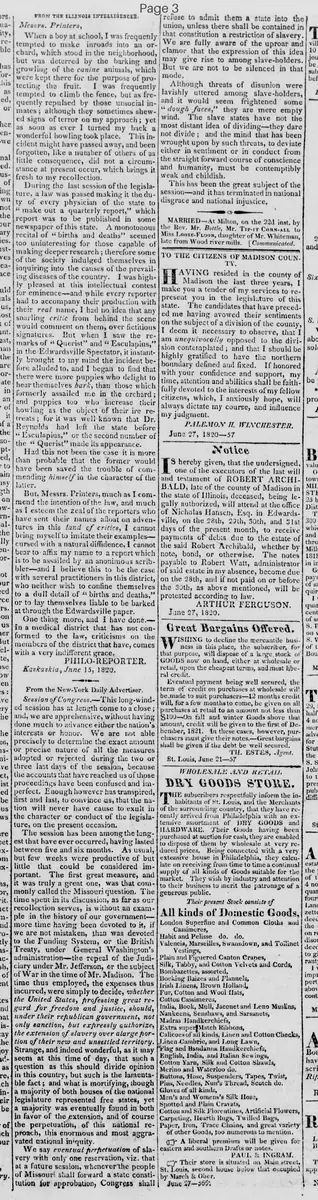
Session of Congress.—This long-winded session has at length come to a close; and, we are apprehensive, without having done much to advance either the nation's interests or honor. We are not able precisely to determine the exact amount or precise nature of all the measures adopted or rejected during the two or three last days of the session, because the accounts that have reached us of those proceedings have been confused and imperfect. Enough however has transpired, first and last, to convince us, that the nation will never have cause to exult in the character or conduct of the legislature, on the present occasion.
The session has been among the longest that have ever occurred, having lasted between five and six months. As usual, but few weeks were productive of but little that could be considered important. The first great measure, and it was truly a great one, was that commonly called the Missouri question. The time spent in its discussion, as far as our recollection serves, is without an example in the history of our government—more time having been devoted to it, if we are not mistaken, than was devoted to the Funding System, or the British Treaty, under General Washington's administration; the repeal of the Judiciary under Mr. Jefferson, or the subject of War in the time of Mr. Madison. The time thus employed, the expenses thus incurred, were simply to decide, whether the United States, professing great regard for freedom and justice, should, under their republican government, not only sanction, but expressly authorize, the extension of slavery over a large portion of their new and unsettled territory.
Strange, and indeed wonderful, as it may seem at this time of day, that such a question as this should divide opinion in this country, but such is the lamentable fact; and what is mortifying, though a majority of both houses of the national legislature represented free states, yet a majority was eventually found in both in favor of the extension, and of course the perpetuation, of this national reproach, this enormous and most aggravated national iniquity.
We say eventual perpetuation of slavery with only one reservation, viz. that at a future session, whenever the people of Missouri shall forward a state constitution or approbation, Congress shall refuse to admit them a state into the union, unless there shall be contained in that constitution a restriction of slavery.
We are fully aware of the uproar and clamor that the expression of this idea may give rise to among slave-holders. But we are not to be silenced in that mode.
Although threats of disunion were lavishly uttered among slave-holders, and it would seem frightened some "dough faces," they are mere empty wind. The slave states have not the most distant idea of dividing—they dare not divide; and the mind that has been wrought upon by such threats, to deviate either in sentiment or in conduct from the straight forward course of conscience and humanity, must be contemptibly weak and childish.
This has been the great subject of the session—and it has terminated in national disgrace and national injustice.
What sub-type of article is it?
What keywords are associated?
What entities or persons were involved?
Domestic News Details
Key Persons
Outcome
congress approved the extension of slavery into new territories with a reservation that missouri's future state constitution must restrict slavery; session ended in perceived national disgrace and injustice.
Event Details
The congressional session, lasting five to six months, focused extensively on the Missouri question, debating whether to authorize slavery's extension into unsettled U.S. territories. Despite representing free states, majorities in both houses favored the extension, perpetuating slavery nationally.