Thank you for visiting SNEWPapers!
Sign up free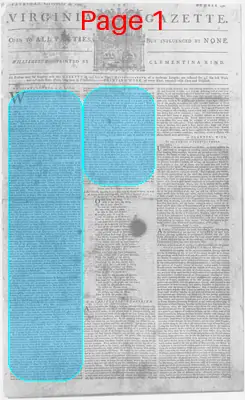
Letter to Editor
September 15, 1774
The Virginia Gazette
Williamsburg, Virginia
What is this article about?
An anonymous American subject addresses King George III, criticizing his endorsement of oppressive policies like the Boston Port Bill and revenue acts, arguing they betray royal duty, endanger the empire, and risk rebellion by loyal subjects seeking their rights.
Clipping
OCR Quality
95%
Excellent
Full Text
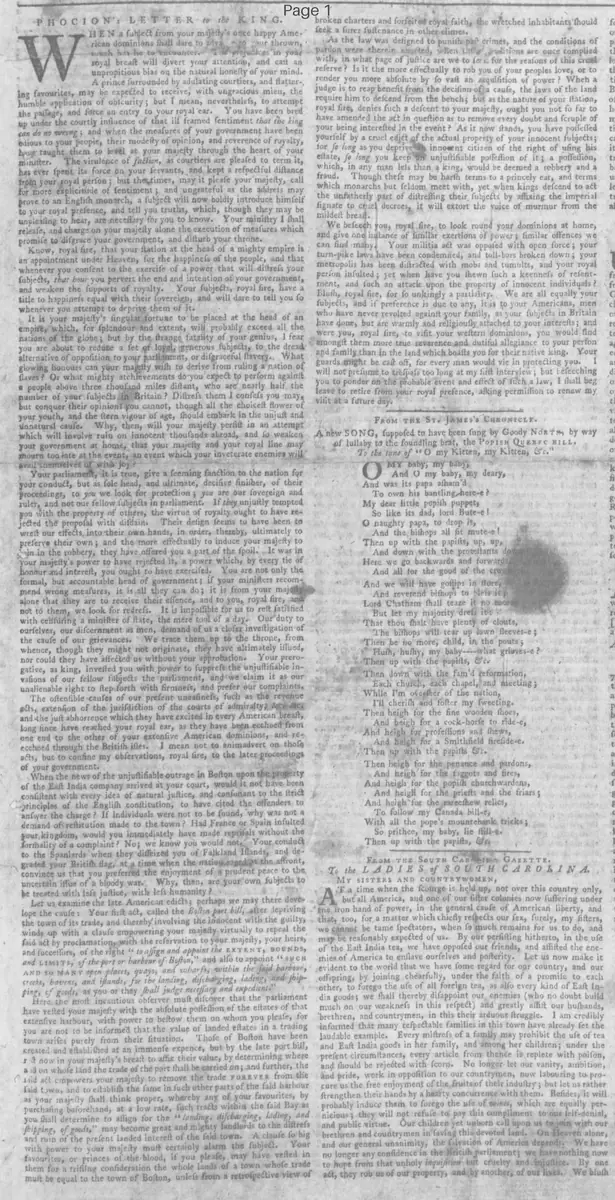
I, a subject from your majesty's once happy American dominions, shall dare to advise your throne, much has he to encounter. I wish prejudices in your royal breast will divert your attention, and cast an unpropitious bias on the natural honesty of your mind. A prince surrounded by adulating courtiers, and flattering favourites, may be expected to receive, with ungracious mien, the humble application of obscurity; but I mean, nevertheless, to attempt the passage, and force an entry to your royal ear.
You have been bred up under the courtly influence of that ill framed sentiment that the king can do no wrong; and when the measures of your government have been odious to your people, their modesty of opinion, and reverence of royalty, have taught them to level at your majesty through the heart of your minister. The virulence of faction, as courtiers are pleased to term it, has ever spent its force on your servants, and kept a respectful distance from your royal person; but the times, may it please your majesty, call for more explicitness of sentiment; and ungrateful as the address may prove to an English monarch, a subject will now boldly introduce himself to your royal presence, and tell you truths, which, though they may be unpleasing to hear, are necessary for you to know.
Your ministry I shall release, and charge on your majesty alone the execution of measures which promise to disgrace your government, and disturb your throne. Know, royal sire, that your station at the head of a mighty empire is an appointment under Heaven, for the happiness of the people, and that whenever you consent to the exercise of a power that will distress your subjects, that hour you pervert the end and intention of your government, and weaken the supports of royalty. Your subjects, royal sire, have a title to happiness equal with their sovereign, and will dare to tell you so whenever you attempt to deprive them of it.
It is your majesty's singular fortune to be placed at the head of an empire, which, for splendour and extent, will probably exceed all the nations of the globe; but by the strange fatality of your genius, I fear you are about to reduce a set of loyal, generous subjects, to the dread alternative of opposition to your parliament, or disgraceful slavery. What glowing honours can your majesty wish to derive from ruling a nation of slaves? Or what mighty achievements do you expect to perform against people above three thousand miles distant, who are nearly half the number of your subjects in Britain? Distress them I confess you may, but conquer their opinions you cannot, though all the choicest flower of your youth, and the stern vigour of age, should embark in the unjust and unnatural cause.
Why, then, will your majesty persist in an attempt which will involve ruin on innocent thousands abroad, and so weaken your government at home, that your majesty and your royal line may mourn too late at the event, an event which your inveterate enemies will avail themselves of with joy. Your parliament, it is true, give a seeming sanction to the nation for your conduct, but as sole head, and ultimate, decisive arbiter, of their proceedings, to you we look for protection; you are our sovereign and ruler, and not our fellow subjects in parliament. If they unjustly tempted you with the property of others, the virtue of royalty ought to have rejected the proposal with disdain.
Their design seems to have been to wrest our effects into their own hands, in order, thereby, ultimately to preserve their own; and the more effectually to induce your majesty to join in the robbery, they have offered you a part of the spoil. It was in your majesty's power to have rejected it, a power which, by every tie of honour and interest, you ought to have exercised. You are not only the formal, but accountable head of government; if your ministers recommend wrong measures, it is all they can do; it is from your majesty alone that they are to receive their sentence, and to you, royal sire, and not to them, we look for redress.
It is impossible for us to rest satisfied with censuring a minister of state, the mere tool of a day. Our duty to ourselves, our discernment as men, demand of us a closer investigation of the cause of our grievances. We trace them up to the throne, from whence, though they might not originate, they have ultimately issued, nor could they have affected us without your approbation. Your prerogative, as king, invested you with power to suppress the unjustifiable invasions of our fellow subjects the parliament, and we claim it as our unalienable right to step forth with firmness, and prefer our complaints.
The ostensible causes of our present uneasiness, such as the revenue acts, extension of the jurisdiction of the courts of admiralty; &c. &c. and the just abhorrence which they have excited in every American breast, long since have reached your royal ear, as they have been echoed from one end to the other of your extensive American dominions, and re-echoed through the British isles. I mean not to animadvert on those acts, but to confine my observations, royal sire, to the later proceedings of your government.
When the news of the unjustifiable outrage in Boston upon the property of the East India company arrived at your court, would it not have been consistent with every idea of natural justice, and consonant to the strict principles of the English constitution, to have cited the offenders to answer the charge? If individuals were not to be found, why was not a demand of restitution made to the town? Had France or Spain insulted your kingdom, would you immediately have made reprisals without the formality of a complaint? No; we know you would not. Your conduct to the Spaniards when they seized you of Falkland Islands, and degraded your British flag, at a time when the nation groaned at the affront, convince us that you preferred the enjoyment of a prudent peace to the uncertain issue of a bloody war.
Why, then, are your own subjects to be treated with less justice, with less humanity? Let us examine the late American edicts; perhaps we may there develop the cause: Your first act, called the Boston port bill, after depriving the town of its trade, and thereby involving the innocent with the guilty, winds up with a clause empowering your majesty virtually to repeal the said act by proclamation, with the reservation to your majesty, your heirs, and successors, of the right "to assign and appoint the EXTENT, BOUNDS, and LIMITS, of the port or harbour of Boston," and also to appoint "such AND so MANY open places, quays, and wharfs, within the said harbour, creeks, bays, and islands, for the landing, discharging, lading, and shipping, of goods, as you or they shall judge necessary and expedient."
Have vested your majesty with the absolute possession of the estates of that extensive harbour, with power to bestow them on whom you please, for you are not to be informed that the value of landed estates in a trading town arises purely from their situation. Those of Boston have been created and established at an immense expense, but by the late port bill, it is now in your majesty's breast to affix their value, by determining where and on whose land the trade of the port shall be carried on; and further, the said act empowers your majesty to remove the trade even from the said town, and to establish the same in such other parts of the said harbour as your majesty shall think proper, whereby any of your favourites, by purchasing beforehand, at a low rate, such tracts within the said Bay as you shall determine to assign for the "loading, discharging, lading, and shipping, of goods," may become great and mighty landlords to the distress and ruin of the present landed interest of the said town. A clause so big with power to your majesty must certainly alarm the subject. Your favourites, or princes of the blood, if you please, may have vested in them for a trifling consideration the whole lands of a town whose trade must be equal to the town of Boston, unless from a retrospective view of broken charters and forfeited royal faith, the wretched inhabitants should seek a sure continuance of their estates.
You have been bred up under the courtly influence of that ill framed sentiment that the king can do no wrong; and when the measures of your government have been odious to your people, their modesty of opinion, and reverence of royalty, have taught them to level at your majesty through the heart of your minister. The virulence of faction, as courtiers are pleased to term it, has ever spent its force on your servants, and kept a respectful distance from your royal person; but the times, may it please your majesty, call for more explicitness of sentiment; and ungrateful as the address may prove to an English monarch, a subject will now boldly introduce himself to your royal presence, and tell you truths, which, though they may be unpleasing to hear, are necessary for you to know.
Your ministry I shall release, and charge on your majesty alone the execution of measures which promise to disgrace your government, and disturb your throne. Know, royal sire, that your station at the head of a mighty empire is an appointment under Heaven, for the happiness of the people, and that whenever you consent to the exercise of a power that will distress your subjects, that hour you pervert the end and intention of your government, and weaken the supports of royalty. Your subjects, royal sire, have a title to happiness equal with their sovereign, and will dare to tell you so whenever you attempt to deprive them of it.
It is your majesty's singular fortune to be placed at the head of an empire, which, for splendour and extent, will probably exceed all the nations of the globe; but by the strange fatality of your genius, I fear you are about to reduce a set of loyal, generous subjects, to the dread alternative of opposition to your parliament, or disgraceful slavery. What glowing honours can your majesty wish to derive from ruling a nation of slaves? Or what mighty achievements do you expect to perform against people above three thousand miles distant, who are nearly half the number of your subjects in Britain? Distress them I confess you may, but conquer their opinions you cannot, though all the choicest flower of your youth, and the stern vigour of age, should embark in the unjust and unnatural cause.
Why, then, will your majesty persist in an attempt which will involve ruin on innocent thousands abroad, and so weaken your government at home, that your majesty and your royal line may mourn too late at the event, an event which your inveterate enemies will avail themselves of with joy. Your parliament, it is true, give a seeming sanction to the nation for your conduct, but as sole head, and ultimate, decisive arbiter, of their proceedings, to you we look for protection; you are our sovereign and ruler, and not our fellow subjects in parliament. If they unjustly tempted you with the property of others, the virtue of royalty ought to have rejected the proposal with disdain.
Their design seems to have been to wrest our effects into their own hands, in order, thereby, ultimately to preserve their own; and the more effectually to induce your majesty to join in the robbery, they have offered you a part of the spoil. It was in your majesty's power to have rejected it, a power which, by every tie of honour and interest, you ought to have exercised. You are not only the formal, but accountable head of government; if your ministers recommend wrong measures, it is all they can do; it is from your majesty alone that they are to receive their sentence, and to you, royal sire, and not to them, we look for redress.
It is impossible for us to rest satisfied with censuring a minister of state, the mere tool of a day. Our duty to ourselves, our discernment as men, demand of us a closer investigation of the cause of our grievances. We trace them up to the throne, from whence, though they might not originate, they have ultimately issued, nor could they have affected us without your approbation. Your prerogative, as king, invested you with power to suppress the unjustifiable invasions of our fellow subjects the parliament, and we claim it as our unalienable right to step forth with firmness, and prefer our complaints.
The ostensible causes of our present uneasiness, such as the revenue acts, extension of the jurisdiction of the courts of admiralty; &c. &c. and the just abhorrence which they have excited in every American breast, long since have reached your royal ear, as they have been echoed from one end to the other of your extensive American dominions, and re-echoed through the British isles. I mean not to animadvert on those acts, but to confine my observations, royal sire, to the later proceedings of your government.
When the news of the unjustifiable outrage in Boston upon the property of the East India company arrived at your court, would it not have been consistent with every idea of natural justice, and consonant to the strict principles of the English constitution, to have cited the offenders to answer the charge? If individuals were not to be found, why was not a demand of restitution made to the town? Had France or Spain insulted your kingdom, would you immediately have made reprisals without the formality of a complaint? No; we know you would not. Your conduct to the Spaniards when they seized you of Falkland Islands, and degraded your British flag, at a time when the nation groaned at the affront, convince us that you preferred the enjoyment of a prudent peace to the uncertain issue of a bloody war.
Why, then, are your own subjects to be treated with less justice, with less humanity? Let us examine the late American edicts; perhaps we may there develop the cause: Your first act, called the Boston port bill, after depriving the town of its trade, and thereby involving the innocent with the guilty, winds up with a clause empowering your majesty virtually to repeal the said act by proclamation, with the reservation to your majesty, your heirs, and successors, of the right "to assign and appoint the EXTENT, BOUNDS, and LIMITS, of the port or harbour of Boston," and also to appoint "such AND so MANY open places, quays, and wharfs, within the said harbour, creeks, bays, and islands, for the landing, discharging, lading, and shipping, of goods, as you or they shall judge necessary and expedient."
Have vested your majesty with the absolute possession of the estates of that extensive harbour, with power to bestow them on whom you please, for you are not to be informed that the value of landed estates in a trading town arises purely from their situation. Those of Boston have been created and established at an immense expense, but by the late port bill, it is now in your majesty's breast to affix their value, by determining where and on whose land the trade of the port shall be carried on; and further, the said act empowers your majesty to remove the trade even from the said town, and to establish the same in such other parts of the said harbour as your majesty shall think proper, whereby any of your favourites, by purchasing beforehand, at a low rate, such tracts within the said Bay as you shall determine to assign for the "loading, discharging, lading, and shipping, of goods," may become great and mighty landlords to the distress and ruin of the present landed interest of the said town. A clause so big with power to your majesty must certainly alarm the subject. Your favourites, or princes of the blood, if you please, may have vested in them for a trifling consideration the whole lands of a town whose trade must be equal to the town of Boston, unless from a retrospective view of broken charters and forfeited royal faith, the wretched inhabitants should seek a sure continuance of their estates.
What sub-type of article is it?
Persuasive
Political
Provocative
What themes does it cover?
Politics
Constitutional Rights
Economic Policy
What keywords are associated?
Boston Port Bill
American Grievances
Royal Prerogative
Colonial Rights
Revenue Acts
East India Company
Parliamentary Overreach
What entities or persons were involved?
Your Majesty
Letter to Editor Details
Recipient
Your Majesty
Main Argument
the king bears responsibility for unjust colonial policies like the boston port bill, which violate subjects' rights to happiness and property; he should reject parliamentary temptations and use his prerogative to protect americans from oppression to preserve the empire.
Notable Details
Criticizes 'King Can Do No Wrong' Doctrine
References Boston Tea Party As 'Outrage In Boston Upon The Property Of The East India Company'
Analyzes Boston Port Bill's Clause Granting Royal Control Over Harbor Lands
Compares Treatment Of American Subjects To Foreign Nations Like Spain