Thank you for visiting SNEWPapers!
Sign up free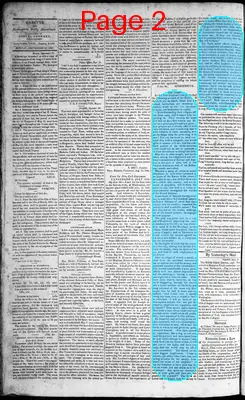
Alexandria Gazette & Daily Advertiser
Alexandria, Virginia
What is this article about?
An account in the New-England Galaxy praises Turkish honesty and religious practices, contrasting them favorably with Christian societies. It recounts a porters honest delivery of gold despite deception and describes Turks' resignation to Providence in commerce.
Clipping
OCR Quality
Full Text
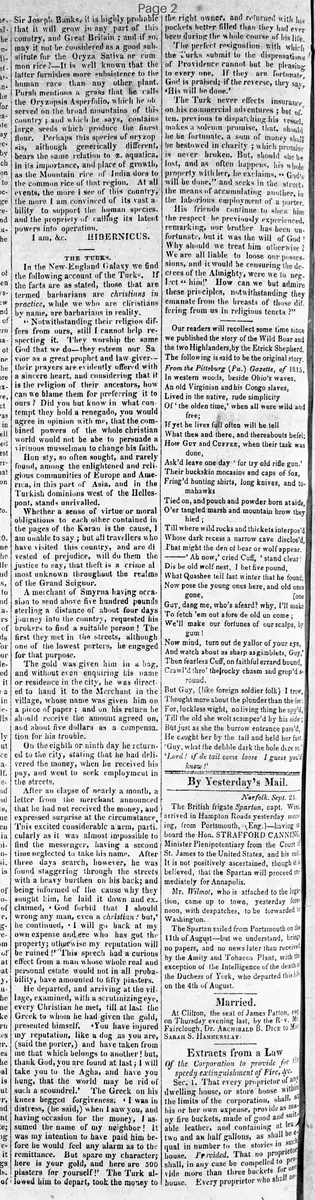
In the New-England Galaxy we find the following account of the Turks. If the facts are as stated, those that are termed barbarians are christians in practice, while we who are christians by name, are barbarians in reality.
"Notwithstanding their religion differs from ours, still I cannot help respecting it. They worship the same God that we do—they esteem our Savior as a great prophet and law giver—their prayers are evidently offered with a sincere heart, and considering that it is the religion of their ancestors, how can we blame them for preferring it to ours? Did you but know in what contempt they hold a renegado, you would agree in opinion with me, that the combined powers of the whole christian world would not be able to persuade a virtuous musselman to change his faith. Honesty, so often sought, and rarely found, among the enlightened and religious Communities of Europe and America, in this part of Asia, and in the Turkish dominions west of the Hellespont, stands unrivalled.
Whether a sense of virtue or moral obligations to each other contained in the pages of the Koran is the cause, I am unable to say; but all travellers who have visited this country, and are divested of prejudice, will do them the justice to say, that theft is a crime almost unknown throughout the realms of the Grand Seignor.
A merchant of Smyrna having occasion to send above five hundred pounds sterling a distance of about four days journey into the country, requested his brokers to find a suitable person. The first they met in the streets, although one of the lowest porters, he engaged for that purpose. The gold was given him in a bag, and without even enquiring his name or residence in the city, he was directed to hand it to the Merchant in the village, whose name was given him on a piece of paper; and on his return he should receive the amount agreed on, and about five dollars as a compensation for his trouble.
On the eighth or ninth day he returned to the city, stating that he had delivered the money, when he received his pay, and went to seek employment in the streets.
After an elapse of nearly a month, a letter from the merchant announced that he had not received the money, and expressed surprise at the circumstance. This excited considerable alarm, particularly as it was almost impossible to find the messenger, having a second time neglected to take his name. After three days search, however, he was found staggering through the streets with a heavy burthen on his back; and being informed of the cause why they sought him, he laid it down and exclaimed, God forbid that I should wrong any man, even a christian! but, he continued, I will go back at my own expense and see who has got the property; otherwise my reputation will be ruined!" This speech had a curious effect from a man whose whole real and personal estate would not in all probability, have amounted to fifty piasters.
He departed, and arriving at the village, examined, with a scrutinizing eye, every Christian he met, till at last the Greek to whom he had given the gold, presented himself. "You have injured my reputation, like a dog as you are," said the porter, "and have taken from me that which belongs to another! but, thank God, you are found at last; I will take you to the Agha, and have you hung, that the world may be rid of such a scoundrel.' The Greek on his knees begged forgiveness: I was in distress, (he said,) when I saw you, and having occasion for the money, I assumed the name of my neighbor! It was my intention to have paid him before he would feel any alarm as to the remittance. But spare my character; here is your gold, and here are 500 piasters for yourself!' The Turk allowed him to depart, took the money to the right owner, and returned with his pockets better filled than they had ever been during the whole course of his life.
The perfect resignation with which the Turks submit to the dispensations of Providence cannot but be pleasing to every one. If they are fortunate, God is praised;—if the reverse, they say, His will be done.'
The Turk never effects insurance on his commercial adventures; but often, previous to dispatching his vessel, makes a solemn promise, that, should he be fortunate, a sum of money shall be bestowed in charity; which promise is never broken. But, should she be lost, and as often happens, his whole property with her, he exclaims, "God's will be done." and seeks in the streets the means of accumulating another, in the laborious employment of a porter.
His friends continue to show him the respect he previously experienced, remarking, our brother has been unfortunate, but it was the will of God! Why should we treat him otherwise? We are all liable to lose our possessions, and it would be censuring the decrees of the Almighty, were we to neglect him! How can we but admire these principles, notwithstanding they emanate from the breasts of those differing from us in religious tenets?"
What sub-type of article is it?
What keywords are associated?
Where did it happen?
Foreign News Details
Primary Location
Smyrna
Outcome
the porter recovered the gold and received 500 piasters; the greek was spared punishment.
Event Details
An account praises Turkish religion, honesty, and resignation to Providence. A Smyrna merchant sends gold via a porter who delivers it to a deceptive Greek, later recovers it at his own expense, confronts the Greek, returns the gold plus reward, and illustrates low theft and faithful charity promises in Turkish society.