Thank you for visiting SNEWPapers!
Sign up free
Gazette Of The United States, & Philadelphia Daily Advertiser
Philadelphia, Philadelphia County, Pennsylvania
What is this article about?
A noble emigrant provides an overview of influential classes in various countries, followed by a detailed account of France's pre-Revolutionary ecclesiastical structure, including archbishoprics, bishoprics, parishes, clergy numbers, and revenues, noting its destruction by the Revolution causing misery to the clergy.
Clipping
OCR Quality
Full Text
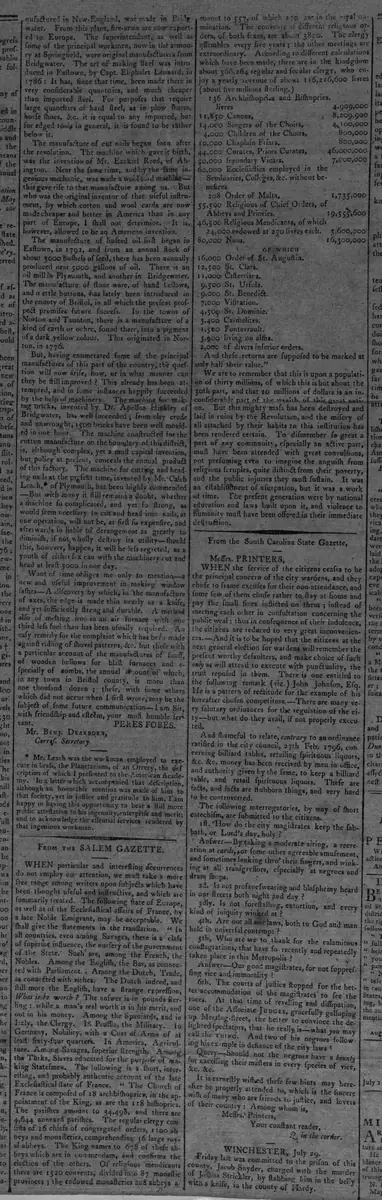
WHEN particular and interesting occurrences do not employ our attention, we must take a more free range among writers upon subjects which have been thought useful and instructive, and which are summarily treated. The following state of Europe, as well as of the Ecclesiastical affairs of France, by a late Noble Emigrant, may be acceptable. We shall give the statements in the translation. "In all countries, even among Savages, there is a class of superior influence, the nursery of the government of the State. Such are, among the French, the Nobles. Among the English, the Bar, as connected with Parliament. Among the Dutch, Trade, as connected with riches. The Dutch indeed, and still more the English, have a strange expression, What is he worth? The answer is in pounds sterling: while a man's real worth is in his merit, and not in his money. Among the Spaniards, and in Italy, the Clergy. In Prussia, the Military. In Germany, Nobility, with a Coat of Arms of at least sixty-four quarters. In America, Agriculture. Among Savages, superior strength. Among the Turks, Slaves educated for the purpose of making Statesmen. The following is a short, interesting, and probably authentic account of the late Ecclesiastical state of France. "The Church of France is composed of 18 archbishoprics, in the appointment of the King, as are the 118 bishopries. The parishes amount to 34,498, and there are 4,644 annexed parishes. The regular clergy consists of 16 chiefs of congregated orders, 1100 abbeys and monasteries, comprehending 16 large royal abbeys. The King names to 678 of these abbeys which are in commendam, and confirms the election of the others. Of religious mendicants there are 1520 convents, divided into 87 monastic provinces; the endowed monasteries and abbeys amount to 557, of which 430 are in the royal nomination. The convents of different religious orders, of both sexes, are about 3800. The clergy assembles every five years; the other meetings are extraordinary. According to different calculations which have been made, there are in the kingdom about 366,264 regular and secular clergy, who enjoy a yearly revenue of about 116,216,600 livres (about five millions sterling.)
We are to remember that this is upon a population of thirty millions, of which this is but about the 30th part, and that 20 millions of dollars is an inconsiderable part of the wealth of this great nation. But this mighty mass has been destroyed and laid in ruins by the Revolution, and the misery of all attached by their habits to this institution has been rendered certain. To dismember so great a part of any community, especially an active part, must have been attended with great convulsions, not presuming even to imagine the anguish from religious scruples, quite distinct from their poverty, and the public injuries they must sustain. It was an establishment of usurpation, but it was a work of time. The present generation were by national education and laws built upon it, and violence to humanity must have been offered in their immediate destruction.
What sub-type of article is it?
What keywords are associated?
Where did it happen?
Foreign News Details
Primary Location
France
Outcome
this mighty mass has been destroyed and laid in ruins by the revolution, and the misery of all attached by their habits to this institution has been rendered certain
Event Details
The Church of France is composed of 18 archbishoprics, in the appointment of the King, as are the 118 bishopries. The parishes amount to 34,498, and there are 4,644 annexed parishes. The regular clergy consists of 16 chiefs of congregated orders, 1100 abbeys and monasteries, comprehending 16 large royal abbeys. The King names to 678 of these abbeys which are in commendam, and confirms the election of the others. Of religious mendicants there are 1520 convents, divided into 87 monastic provinces; the endowed monasteries and abbeys amount to 557, of which 430 are in the royal nomination. The convents of different religious orders, of both sexes, are about 3800. The clergy assembles every five years; the other meetings are extraordinary. According to different calculations which have been made, there are in the kingdom about 366,264 regular and secular clergy, who enjoy a yearly revenue of about 116,216,600 livres (about five millions sterling.)