Thank you for visiting SNEWPapers!
Sign up free
Vermont Phœnix
Brattleboro, Bellows Falls, Ludlow, Windham County, Windsor County, Vermont
What is this article about?
Biographical sketch of the Pepperell family's rise and fall due to loyalty to Britain during the American Revolution, leading to banishment, confiscation of property, and extinction of the line. Extends to similar fates of other colonial aristocratic families like Fairfaxes, Vassals, and Wentworths.
Clipping
OCR Quality
Full Text
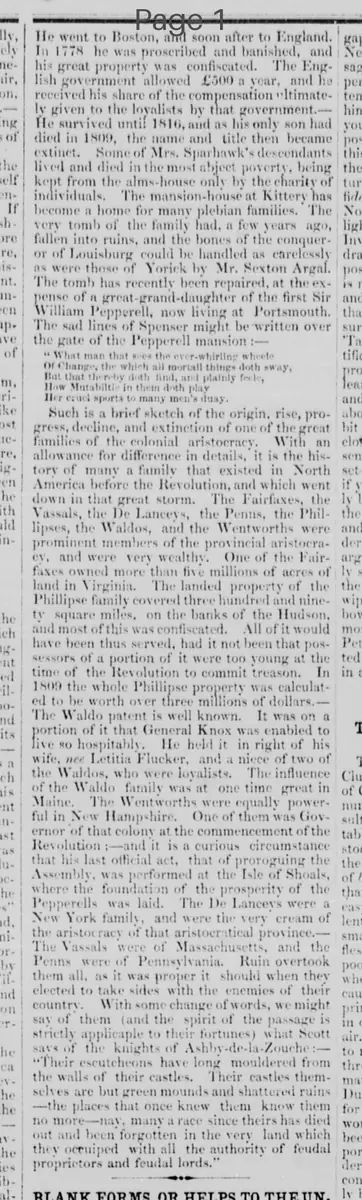
In 1778 he was proscribed and banished, and
his great property was confiscated. The English
government allowed £500 a year, and he
received his share of the compensation ultimately
given to the loyalists by that government.—
He survived until 1816, and as his only son had
died in 1800, the name and title then became
extinct. Some of Mrs. Sparhawk's descendants
lived and died in the most abject poverty, being
kept from the alms-house only by the charity of
individuals. The mansion-house at Kittery has
become a home for many plebian families. The
very tomb of the family had, a few years ago
fallen into ruins, and the bones of the conqueror
of Louisburg could be handled as carelessly
as were those of Yorick by Mr. Sexton Argal.
The tomb has recently been repaired, at the expense
of a great-grand-daughter of the first Sir
William Pepperell, now living at Portsmouth.
The sad lines of Spenser might be written over
the gate of the Pepperell mansion:-
“What man that sees the ever-whirling wheel
Of Change, the which all mortal things doth sway.
But that thereby doth find, and plainly feel,
How Mutability in them doth play
Her cruel sports to many men's decay.”
Such is a brief sketch of the origin, rise, progress,
decline, and extinction of one of the great
families of the colonial aristocracy. With an
allowance for difference in details, it is the history
of many a family that existed in North
America before the Revolution, and which went
down in that great storm. The Fairfaxes, the
Vassals, the De Lanceys, the Penns, the Philipses,
the Waldos, and the Wentworths were
prominent members of the provincial aristocracy,
and were very wealthy. One of the Fairfaxes
owned more than five millions of acres of
land in Virginia. The landed property of the
Philipse family covered three hundred and ninety
square miles, on the banks of the Hudson
and most of this was confiscated. All of it would
have been thus served, had it not been that possessors
of a portion of it were too young at the
time of the Revolution to commit treason. In
1809 the whole Phillipse property was calculated
to be worth over three millions of dollars.—
The Waldo patent is well known. It was on a
portion of it that General Knox was enabled to
live so hospitably. He held it in right of his
wife, nee Letitia Flucker, and a niece of two of
the Waldos, who were loyalists. The influence
of the Waldo family was at one time great in
Maine. The Wentworths were equally powerful
in New Hampshire. One of them was Governor
of that colony at the commencement of the
Revolution;—and it is a curious circumstance
that his last official act, that of proroguing the
Assembly, was performed at the Isle of Shoals,
where the foundation of the prosperity of the
Pepperells was laid. The De Lanceys were a
New York family, and were the very cream of
the aristocracy of that aristocratical province.—
The Vassals were of Massachusetts, and the
Penns were of Pennsylvania. Ruin overtook
them all, as it was proper it should when they
elected to take sides with the enemies of their
country. With some change of words, we might
say of them (and the spirit of the passage is
strictly applicable to their fortunes) what Scott
says of the knights of Ashby-de-la-Zouche:-
“Their escutcheons have long mouldered from
the walls of their castles. Their castles themselves
are but green mounds and shattered ruins
—the places that once knew them know them
no more—nay, many a race since theirs has died
out and been forgotten in the very land which
they occupied with all the authority of feudal
proprietors and feudal lords.”
What sub-type of article is it?
What themes does it cover?
What keywords are associated?
What entities or persons were involved?
Where did it happen?
Story Details
Key Persons
Location
North America, Boston, England, Kittery, Virginia, Hudson River, Maine, New Hampshire, New York, Massachusetts, Pennsylvania
Event Date
1778 1816
Story Details
The Pepperell family, loyal to Britain, faced proscription, banishment, property confiscation in 1778, leading to poverty and extinction by 1816; similar ruin befell other wealthy colonial families like the Fairfaxes and Wentworths due to their allegiance during the Revolution.