Thank you for visiting SNEWPapers!
Sign up free
Letter to Editor
May 2, 1836
The Daily Cincinnati Republican, And Commercial Register
Cincinnati, Hamilton County, Ohio
What is this article about?
Daniel Drake submits to the Charleston Mercury a letter refuting E. S. Thomas's claim to originating the Cincinnati-Charleston Railroad idea, asserting his own independent proposal in August 1835 and role in sparking public and interstate action, dated March 1, 1836.
Clipping
OCR Quality
95%
Excellent
Full Text
From the Charleston Mercury,
CINCINNATI, (Ohio,) March 14.
To John A. Stewart, Esq., Editor of the Mercury.
SIR,—I herewith transmit for insertion in your paper, if agreeable to you, a copy of a letter to E. S. Thomas, Esq., Editor of the Evening Post, in this city, on the origin of the Cincinnati and Charleston Rail Road project, which letter Mr Thomas has declined publishing in his paper. I hope you will find nothing either in its letter or spirit, that will prevent your giving it an insertion in connexion with this note.
Respectfully your ob't. servant,
DANIEL DRAKE.
To E.S. Thomas, Esq., Editor of the Cincinnati Evening Post.
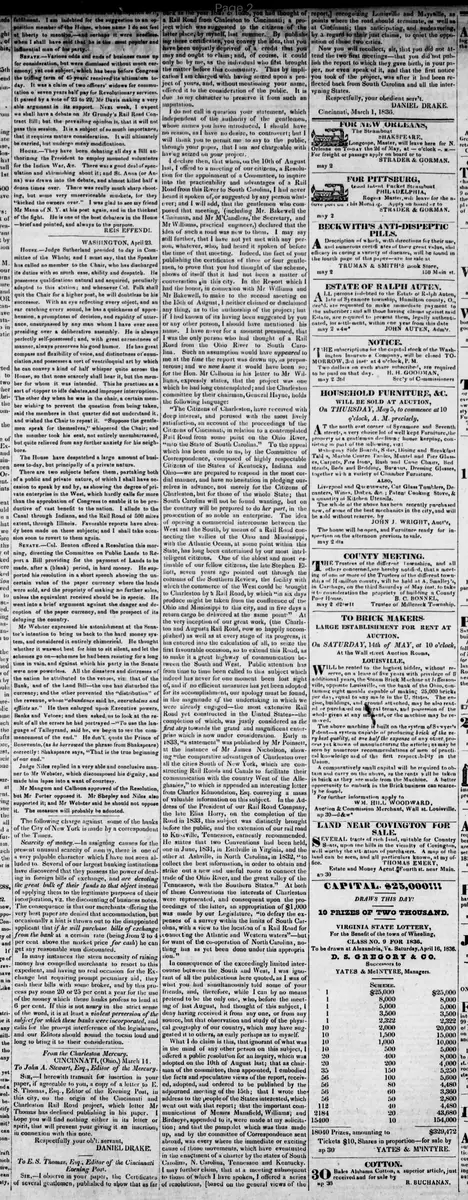
Sir,—I observe in your paper, the Certificates of several gentlemen, published to show that as far back as last summer, you had suggested to them the practicability and utility of a Rail Road from Charleston to Cincinnati; a project which was suggested to the citizens of the latter place, by myself, last summer. By publishing these certificates, you convey the idea, that you have been unjustly deprived of a credit that you may and ought to claim; and, of course, it could only be by me, as the individual who first brought the matter before this community. Thus by implication I am charged with having seized upon a project of yours, and, without mentioning your name, offered it to the consideration of the public. It is due to my character to preserve it from such an imputation.
I do not call in question your statement, which independent of the authority of the gentlemen, whose names you have introduced, I should have no reason, as I have no desire, to controvert; but I will thank you to permit me to say to the public, through your paper, that I am not chargeable with having seized on your project.
I declare then, that when, on the 10th of August last, I offered to a meeting of our citizens, a Resolution for the appointment of a Committee, to inquire into the practicability and advantages of a Rail Road from this River to South Carolina, I had never heard it spoken of, or suggested by any person whatever; and I will add, that the gentlemen who composed that meeting, (including Mr. Bakewell the Chairman, and Mr M'Candless, the Secretary, and Mr Williams, practical engineer,) declared that the idea of such a road was new to them. I may say still further, that I have not yet met with any person, whatever, who, had heard it spoken of before the time of that meeting. Indeed, the fact of your publishing the certificates of three or four gentlemen, to prove that you had thought of the scheme, shows of itself that it had not been a matter of conversation in this city. In the Report which I had the honor, in connexion with Mr Williams and Mr Bakewell, to make to the second meeting on the 15th of August, I neither claimed or disclaimed any thing, as to the authorship of the project; but if I had known of its having been suggested by you or any other person, I should have mentioned his name. I have never for a moment presumed, that I was the only person who had thought of a Rail Road from the Ohio River to South Carolina. Such an assumption would have appeared to me at the time the report was drawn up, as preposterous; and we now know it would have been so; for the Hon. Mr Calhoun in his letter to Mr Williams, expressly states, that the project was one which he had long contemplated; and the Charleston committee by their chairman, General Hayne, holds the following language:
"The Citizens of Charleston, have received with deep interest, and perused with the most lively satisfaction, an account of the proceedings of the Citizens of Cincinnati, in relation to a contemplated Rail Road from some point on the Ohio River, "into the State of South Carolina." To the appeal which has been made to us, by the Committee of Correspondence, composed of highly respectable Citizens of the States of Kentucky, Indiana and Ohio—we are prepared to respond in the most cordial manner, and have no hesitation in pledging ourselves in advance, not merely for the Citizens of Charleston, but for those of the whole State; that South Carolina will not be found wanting, but on the contrary will be prepared to do her part, in the prosecution of so noble an enterprise." The idea of opening a commercial intercourse between the West and the South, by means of a Rail Road connecting the vallies of the Ohio and Mississippi, with the Atlantic Ocean, at some point within this State, has long been entertained by our most intelligent citizens. One of the ablest and most estimable of our fellow citizens, the late Stephen Elliott, seven years ago pointed out through the columns of the Southern Review, the facility with which the commerce of the West could be brought to Charleston by a Rail Road, by which "in six days produce might be taken from the confluence of the Ohio and Mississippi to this city, and in five days a return cargo be delivered at the same point:" At the very inception of our great work, (the Charleston and Augusta Rail Road, now so happily accomplished) as well as at every stage of its progress, it has entered into the calculation of all, to seize the first favourable occasion, so to extend this Road, as to make it a great highway of communication between the South and West. Public attention has from time to time been called to this subject which indeed has never for one moment been lost sight of, and if no efficient measures has yet been adopted for its accomplishment, our apology must be found, in the magnitude of the undertaking in which we were already engaged—the most extensive Rail Road yet constructed in the United States—the completion of which, was justly considered as the first step towards the grand and magnificent enterprise which is now under consideration. Early in 1833, "a statement" was published by Mr Poinsett, at the instance of Mr James Nicholson, showing "the comparative advantages of Charleston over all the cities South of New York, which are constructing Rail Roads and Canals to facilitate their communication with the country West of the Alleghanies," to which is appended an interesting letter from Charles Edmondston, Esq. conveying a mass of valuable information on this subject. In the Address of the President of our Rail Road Company, the late Elias Horry, on the completion of the Road in 1833, this subject was distinctly brought before the public, and the extension of our rail road to Knoxville, Tennessee, earnestly recommended. He states that two Conventions had been held, one in June, 1831, in Estillville in Virginia, and the other at Asheville, in North Carolina, in 1832, "to collect the best information, in order to obtain and strike out a new and useful route to connect the trade of the Ohio River, and the great valley of the Tennessee, with the Southern States." At both of these Conventions the interests of Charleston were represented, and consequent upon the proceedings of the latter, an appropriation of $1,000 was made by our Legislature, "to defray the expenses of a survey within the limits of South Carolina, with a view to the location of a Rail Road for connecting the Atlantic and Western waters"—but for want of the co-operation of North Carolina, nothing has as yet been done under this appropriation.
In consequence of the exceedingly limited intercourse between the South and West, I was ignorant of all the publications here quoted, as I was of what you had simultaneously told some of your friends, and, therefore, while I can by no means pretend to be the only one, who, before the meeting of last August, had thought of this subject, I deny having received it from any one, or from any source, but that observation and study of the physical geography of our country, which may have suggested it to others, as early perhaps as to myself.
What I do claim is this, that ignorant of what was in the mind of any other person on this subject, I offered a public resolution for an inquiry, which was adopted on the 10th of August last; that as chairman of the committee, then appointed, I embodied the facts and speculative views of the report, received, adopted, and ordered to be published by the adjourned meeting of the 15th; that I wrote the address to the people of the States interested, which went out with that report; that the important communications of Messrs Mansfield, Williams, and Birdseye, appended to it, were made at my solicitation; and that the pamphlet which was thus made up, and by the committee of Correspondence sent abroad, was every where the immediate or exciting cause of those movements, which have eventuated in the enactment of a charter by the states of South Carolina, N. Carolina, Tennessee and Kentucky.
I may further claim, that at a meeting subsequent to those of which I have spoken, I offered a series of resolutions, based on the general views of the report, recognizing Louisville and Nashville, as points where the road should terminate, as well as at Cincinnati: thus anticipating, and endeavoring by a regard to their just claims, to quiet the opposition of those two cities.
Now you will recollect, sir, that you did not attend the two first meetings—that you did not publish the report to which they gave birth, in your paper, nor even speak of it, and that the first notice you took of the project, was after it had been reflected back from South Carolina and all the intervening States.
Respectfully, your obedient serv't.
DANIEL DRAKE.
Cincinnati, March 1, 1836.
CINCINNATI, (Ohio,) March 14.
To John A. Stewart, Esq., Editor of the Mercury.
SIR,—I herewith transmit for insertion in your paper, if agreeable to you, a copy of a letter to E. S. Thomas, Esq., Editor of the Evening Post, in this city, on the origin of the Cincinnati and Charleston Rail Road project, which letter Mr Thomas has declined publishing in his paper. I hope you will find nothing either in its letter or spirit, that will prevent your giving it an insertion in connexion with this note.
Respectfully your ob't. servant,
DANIEL DRAKE.
To E.S. Thomas, Esq., Editor of the Cincinnati Evening Post.
Sir,—I observe in your paper, the Certificates of several gentlemen, published to show that as far back as last summer, you had suggested to them the practicability and utility of a Rail Road from Charleston to Cincinnati; a project which was suggested to the citizens of the latter place, by myself, last summer. By publishing these certificates, you convey the idea, that you have been unjustly deprived of a credit that you may and ought to claim; and, of course, it could only be by me, as the individual who first brought the matter before this community. Thus by implication I am charged with having seized upon a project of yours, and, without mentioning your name, offered it to the consideration of the public. It is due to my character to preserve it from such an imputation.
I do not call in question your statement, which independent of the authority of the gentlemen, whose names you have introduced, I should have no reason, as I have no desire, to controvert; but I will thank you to permit me to say to the public, through your paper, that I am not chargeable with having seized on your project.
I declare then, that when, on the 10th of August last, I offered to a meeting of our citizens, a Resolution for the appointment of a Committee, to inquire into the practicability and advantages of a Rail Road from this River to South Carolina, I had never heard it spoken of, or suggested by any person whatever; and I will add, that the gentlemen who composed that meeting, (including Mr. Bakewell the Chairman, and Mr M'Candless, the Secretary, and Mr Williams, practical engineer,) declared that the idea of such a road was new to them. I may say still further, that I have not yet met with any person, whatever, who, had heard it spoken of before the time of that meeting. Indeed, the fact of your publishing the certificates of three or four gentlemen, to prove that you had thought of the scheme, shows of itself that it had not been a matter of conversation in this city. In the Report which I had the honor, in connexion with Mr Williams and Mr Bakewell, to make to the second meeting on the 15th of August, I neither claimed or disclaimed any thing, as to the authorship of the project; but if I had known of its having been suggested by you or any other person, I should have mentioned his name. I have never for a moment presumed, that I was the only person who had thought of a Rail Road from the Ohio River to South Carolina. Such an assumption would have appeared to me at the time the report was drawn up, as preposterous; and we now know it would have been so; for the Hon. Mr Calhoun in his letter to Mr Williams, expressly states, that the project was one which he had long contemplated; and the Charleston committee by their chairman, General Hayne, holds the following language:
"The Citizens of Charleston, have received with deep interest, and perused with the most lively satisfaction, an account of the proceedings of the Citizens of Cincinnati, in relation to a contemplated Rail Road from some point on the Ohio River, "into the State of South Carolina." To the appeal which has been made to us, by the Committee of Correspondence, composed of highly respectable Citizens of the States of Kentucky, Indiana and Ohio—we are prepared to respond in the most cordial manner, and have no hesitation in pledging ourselves in advance, not merely for the Citizens of Charleston, but for those of the whole State; that South Carolina will not be found wanting, but on the contrary will be prepared to do her part, in the prosecution of so noble an enterprise." The idea of opening a commercial intercourse between the West and the South, by means of a Rail Road connecting the vallies of the Ohio and Mississippi, with the Atlantic Ocean, at some point within this State, has long been entertained by our most intelligent citizens. One of the ablest and most estimable of our fellow citizens, the late Stephen Elliott, seven years ago pointed out through the columns of the Southern Review, the facility with which the commerce of the West could be brought to Charleston by a Rail Road, by which "in six days produce might be taken from the confluence of the Ohio and Mississippi to this city, and in five days a return cargo be delivered at the same point:" At the very inception of our great work, (the Charleston and Augusta Rail Road, now so happily accomplished) as well as at every stage of its progress, it has entered into the calculation of all, to seize the first favourable occasion, so to extend this Road, as to make it a great highway of communication between the South and West. Public attention has from time to time been called to this subject which indeed has never for one moment been lost sight of, and if no efficient measures has yet been adopted for its accomplishment, our apology must be found, in the magnitude of the undertaking in which we were already engaged—the most extensive Rail Road yet constructed in the United States—the completion of which, was justly considered as the first step towards the grand and magnificent enterprise which is now under consideration. Early in 1833, "a statement" was published by Mr Poinsett, at the instance of Mr James Nicholson, showing "the comparative advantages of Charleston over all the cities South of New York, which are constructing Rail Roads and Canals to facilitate their communication with the country West of the Alleghanies," to which is appended an interesting letter from Charles Edmondston, Esq. conveying a mass of valuable information on this subject. In the Address of the President of our Rail Road Company, the late Elias Horry, on the completion of the Road in 1833, this subject was distinctly brought before the public, and the extension of our rail road to Knoxville, Tennessee, earnestly recommended. He states that two Conventions had been held, one in June, 1831, in Estillville in Virginia, and the other at Asheville, in North Carolina, in 1832, "to collect the best information, in order to obtain and strike out a new and useful route to connect the trade of the Ohio River, and the great valley of the Tennessee, with the Southern States." At both of these Conventions the interests of Charleston were represented, and consequent upon the proceedings of the latter, an appropriation of $1,000 was made by our Legislature, "to defray the expenses of a survey within the limits of South Carolina, with a view to the location of a Rail Road for connecting the Atlantic and Western waters"—but for want of the co-operation of North Carolina, nothing has as yet been done under this appropriation.
In consequence of the exceedingly limited intercourse between the South and West, I was ignorant of all the publications here quoted, as I was of what you had simultaneously told some of your friends, and, therefore, while I can by no means pretend to be the only one, who, before the meeting of last August, had thought of this subject, I deny having received it from any one, or from any source, but that observation and study of the physical geography of our country, which may have suggested it to others, as early perhaps as to myself.
What I do claim is this, that ignorant of what was in the mind of any other person on this subject, I offered a public resolution for an inquiry, which was adopted on the 10th of August last; that as chairman of the committee, then appointed, I embodied the facts and speculative views of the report, received, adopted, and ordered to be published by the adjourned meeting of the 15th; that I wrote the address to the people of the States interested, which went out with that report; that the important communications of Messrs Mansfield, Williams, and Birdseye, appended to it, were made at my solicitation; and that the pamphlet which was thus made up, and by the committee of Correspondence sent abroad, was every where the immediate or exciting cause of those movements, which have eventuated in the enactment of a charter by the states of South Carolina, N. Carolina, Tennessee and Kentucky.
I may further claim, that at a meeting subsequent to those of which I have spoken, I offered a series of resolutions, based on the general views of the report, recognizing Louisville and Nashville, as points where the road should terminate, as well as at Cincinnati: thus anticipating, and endeavoring by a regard to their just claims, to quiet the opposition of those two cities.
Now you will recollect, sir, that you did not attend the two first meetings—that you did not publish the report to which they gave birth, in your paper, nor even speak of it, and that the first notice you took of the project, was after it had been reflected back from South Carolina and all the intervening States.
Respectfully, your obedient serv't.
DANIEL DRAKE.
Cincinnati, March 1, 1836.
What sub-type of article is it?
Persuasive
Informative
Historical
What themes does it cover?
Infrastructure
Commerce Trade
What keywords are associated?
Cincinnati Charleston Railroad
Project Origin
Daniel Drake
E S Thomas
Public Meetings
Railroad Proposal
Western Commerce
South Carolina Connection
What entities or persons were involved?
Daniel Drake
John A. Stewart, Esq., Editor Of The Charleston Mercury
Letter to Editor Details
Author
Daniel Drake
Recipient
John A. Stewart, Esq., Editor Of The Charleston Mercury
Main Argument
daniel drake defends his independent origination of the cincinnati and charleston rail road project, proposed publicly on august 10, 1835, denying any knowledge of e. s. thomas's prior suggestions and claiming credit for initiating public inquiry and action on the idea.
Notable Details
Meeting On August 10, 1835, For Appointing Committee
Adjourned Meeting On August 15, 1835, Adopting Report
References To Hon. Mr. Calhoun's Long Contemplation
Quote From General Hayne On Charleston's Interest
Stephen Elliott's 1829 Article In Southern Review
Conventions In Estillville 1831 And Asheville 1832
Mr. Poinsett's 1833 Statement
Elias Horry's 1833 Address Recommending Extension