Thank you for visiting SNEWPapers!
Sign up free
Alexandria Gazette
Alexandria, Alexandria County, District Of Columbia
What is this article about?
A citizen defends General Harrison against accusations of voting in Ohio's Senate to sell white men for debt, clarifying the law revised the criminal code for misdemeanors, offering alternatives like fines, insolvency oaths, public work, or temporary servitude only for the unwilling, and notes its humane aspects compared to jail. Harrison also advocated abolishing imprisonment for debt.
Clipping
OCR Quality
Full Text
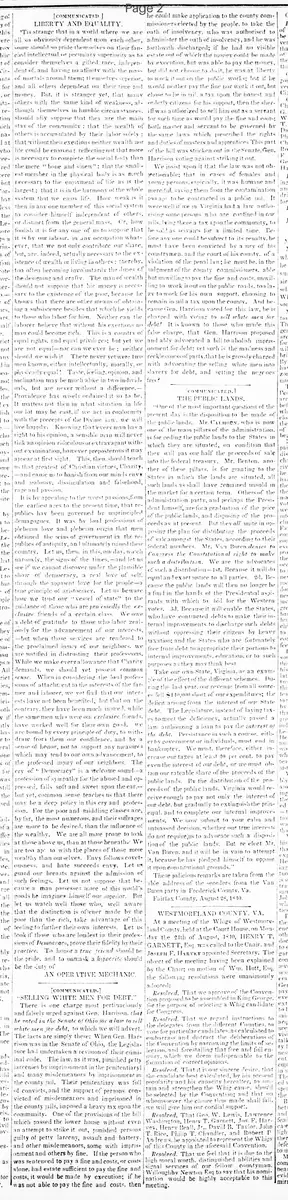
"SELLING WHITE MEN FOR DEBT."
There is one charge most pertinaciously and falsely urged against Gen. Harrison, that he voted in the Senate of Ohio for a law to sell white men for debt, to which we will advert.
The facts are simply these: When Gen. Harrison was in the Senate of Ohio, the Legislature had undertaken a revision of their criminal code. The law, as it was, punished petty larcenies by imprisonment in the penitentiary! and many misdemeanors by imprisonment in the county jail. Their penitentiary was full of convicts, and the support of persons convicted of misdemeanors and imprisoned in the county jails, imposed a heavy tax upon the community.
One of the provisions of the bill which passed the lower house without even an attempt to strike it out, punished persons guilty of petty larceny, assault and battery, and other misdemeanors, some with imprisonment and others by fine. If the person who was sentenced to pay a fine and costs, or costs alone, had estate sufficient to pay the fine and costs, it would be made by execution; if he was not able to pay the fine and costs, then he could make application to the county commissioners elected by the people, to take the oath of insolvency, who was authorized to administer the oath of insolvency, and he was forthwith discharged: if he had no visible estate out of which the money could be made by execution, but was able to pay the money, but did not choose to do it, he was at liberty to work it out on the public works; but if he would neither pay the fine nor work it out, but chose to be in jail, a tax upon the honest and orderly citizens for his support, then the sheriff was authorized to sell him out as a servant for such time as would pay the fine and costs: both master and servant to be governed by the same laws which prescribed the rights and duties of masters and apprentices. This part of the bill was stricken out in the Senate, Gen. Harrison voting against striking it out.
We insist upon it that the law was not objectionable: that in cases of females and young persons, especially, it was humane and merciful, saving them from the contamination too apt to be contracted in a public jail. It were well if we in Virginia had a law authorizing some persons who are confined in our jails, lying there a tax upon the community, to be sold as servants for a limited time. Before any one could be subject to its penalty, he must have been convicted by a jury of his countrymen, and the court of his county, of a violation of the penal law; he must be, in the judgment of the county commissioners, able but unwilling to pay the fine and costs, unwilling to work it out on the public roads, too lazy to work for his own support, choosing to remain in jail a tax upon the county. And because Gen. Harrison voted for this law, he is charged with voting to sell white men for debt? It is known to those who made this false charge, that Gen. Harrison proposed and ably advocated a bill to abolish imprisonment for debt: yet such is the madness and recklessness of party, that he is grossly charged with advocating the selling white men into slavery for debt, and setting the negroes free?
A CITIZEN.
What sub-type of article is it?
What themes does it cover?
What keywords are associated?
What entities or persons were involved?
Letter to Editor Details
Author
A Citizen
Main Argument
general harrison did not vote to sell white men for debt; the law he supported revised ohio's criminal code for misdemeanors, providing humane alternatives to indefinite jail time for those unwilling to pay fines or work them off, and he advocated against imprisonment for debt.
Notable Details