Thank you for visiting SNEWPapers!
Sign up free
Richmond Enquirer
Richmond, Richmond County, Virginia
What is this article about?
Medical report on James Cann's fatal hydrophobia relapse in February after June rabid dog bite. Doctors Stillwell, Robeson, and Cooper detail symptoms like swallowing difficulties and convulsions, scullcap tea treatment's initial success, neglect leading to worsening, and death despite efforts. Aimed at public information.
Clipping
OCR Quality
Full Text
Sir,—Agreeably to our promise, we now send you for publication the statement of the particulars attending the case of James Cann, as drawn up from our fresh recollections, assisted by a diary kept by one of us, during his illness:
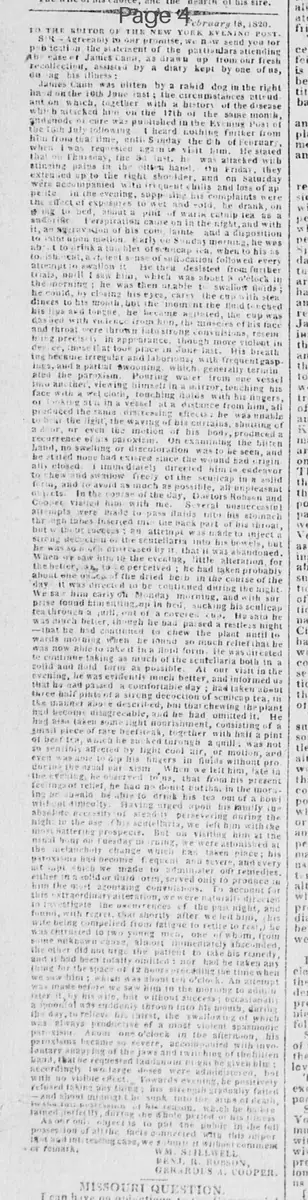
James Cann was bitten by a rabid dog in the right hand on the 20th June last; the circumstances attending which, together with a history of the disease which attacked him on the 17th of the same month and mode of cure was published in the Evening Post of the 20th July following. I heard nothing further from him from that time, until Sunday the 6th of February, when I was requested again to visit him. He stated that on Thursday, the 3d inst. he was attacked with stinging pains in his bitten hand. On Friday, they extended up to the right shoulder, and on Saturday were accompanied with frequent chills and loss of appetite. In the evening, supposing his complaints were the effect of exposure to wet and cold, he drank, on going to bed, about a pint of warm catnip tea as a sudorific. Perspiration came on in the night, and with it, an aggravation of his complaints and a disposition to faint upon motion. Early on Sunday morning, he was about drinking a tumbler of scullcap tea, when to his astonishment a fit of suffocation followed every attempt to swallow it. He then desisted from further trials, but I saw him, which was about 10 o'clock in the morning; he was then unable to swallow fluids; he could, by closing his eyes, carry the cup with steadiness to his mouth, but the moment the liquid touched his lips and tongue he became agitated, the cup was dashed with violence from him, the muscles of his face and throat were drawn into frightful or strong convulsions, resembling precisely those that took place in June last. His breathing became irregular and laborious, with frequent gasps, and a partial swooning which generally terminated the paroxysm. Pouring water from one vessel into another, viewing himself in a mirror, touching his face with a wet cloth, touching nails with his fingers, or looking at it in a vessel at a distance from him, all produced the same distressing effects. He was unable to bear the light, the waving of the curtains, shining of a door, or even the motion of his body, produced a recurrence of his paroxysm. On examining the bitten hand, no swelling or discoloration was to be seen, and he stated none had existed since the wound had originally closed. I immediately directed him to endeavor to chew and swallow freely at the scullcap in a solid form, and to avoid as much as possible, all unpleasant objects. In the course of the day, Doctors Robeson and Cooper visited him with me. Several unsuccessful attempts were made to pass liquids to his stomach through tubes inserted in the back part of his throat, but without success; an attempt was made to inject a strong decoction of the scutellaria into his bowels, but he was so exceedingly oppressed by it that it was abandoned. When we saw him again in the evening, little alteration, for the better, was to be perceived; he had taken probably about one ounce of the dried herb in the course of the day; it was directed to be continued during the night. We saw him early on Monday morning, and with surprise found him sitting up in bed, sucking his scullcap tea through a quill, out of a covered cup. He said he was much better, though he had passed a restless night—that he had continued to chew the plant until towards morning when he found so much relief that he was now able to take it in a fluid form. He was directed to continue taking as much of the scutellaria both in a solid and fluid form as he could conveniently swallow. In the evening, he was evidently much better, and informed us that he had passed a comfortable day; had taken about three half pints of a strong decoction of scullcap tea, in the manner above described, but that chewing the plant had become disagreeable, and he had omitted it. He had also taken some light nourishment, consisting of a small piece of rare beefsteak, together with half a pint of beer tea, which he sucked through a quill. He was not so sensitively affected by light, cool air, or motion, and even able to dip his fingers in fluids without producing the usual paroxysm. When we left him at the evening, he observed to us, that from his present feelings of relief, he had no doubt but that in the morning he would be able to drink his tea out of a bowl without agony. Having urged upon his family the absolute necessity of steadily persevering during the night in the use of his scutellaria, we left him with the most flattering prospects. But on visiting him at the noon hour on Tuesday morning, we were astonished at the melancholy change which had taken place; his paroxysms had become frequent and severe, and every attempt which we made to administer our remedies, either in a solid or fluid form, served only to produce in him the most agonizing convulsions. To account for this extraordinary alteration, we were naturally directed to investigate the occurrences of the past night, and found, with regret, that shortly after we left him, (his wife being compelled from fatigue to retire to rest,) he was entrusted to two young men, one of whom, from some unknown cause, almost immediately absconded, the other did not urge the patient to take his remedy, and it had been totally omitted: nor had he taken anything for the space of 12 hours preceding the time when we saw him; which was about ten o'clock. An attempt was made before we saw him in the forenoon to administer it under his tongue, but without success; occasionally a spoonful was suddenly thrown into his mouth, during the day, to relieve his thirst, the swallowing of which was always productive of a most violent spasmodic paroxysm. About one o'clock in the afternoon, his paroxysms became so severe, accompanied with involuntary snapping of the jaws and twisting of the bitten hand, that he requested laudanum might be given him: accordingly two large doses were administered, but with no visible effect. Towards evening, he positively refused taking any longer, his strength gradually failed—and about midnight he sank into the sleep of death. It was a lamentable circumstance that in his last hours he was in possession of his faculties, and took his tea which he had used perfectly during the whole period of his illness. As our object is to put the public in the full possession of all the facts connected with the above interesting case, we give it without comment or remark.
WM STILLWELL
PENL R ROESON.
GRKARDIS A.COOPER.
What sub-type of article is it?
What themes does it cover?
What keywords are associated?
What entities or persons were involved?
Letter to Editor Details
Author
Wm Stillwell, Penl R Roeson, Grkardis A.Cooper
Recipient
The Editor Of The New York Evening Post
Main Argument
the letter provides a detailed account of james cann's recurrence of hydrophobia symptoms after a rabid dog bite, the attempted treatment with scullcap tea, initial improvement, subsequent relapse due to neglect of the remedy, and his eventual death, to inform the public of all facts in the case.
Notable Details