Thank you for visiting SNEWPapers!
Sign up free
Gazette Of The United States, & Philadelphia Daily Advertiser
Philadelphia, Philadelphia County, Pennsylvania
What is this article about?
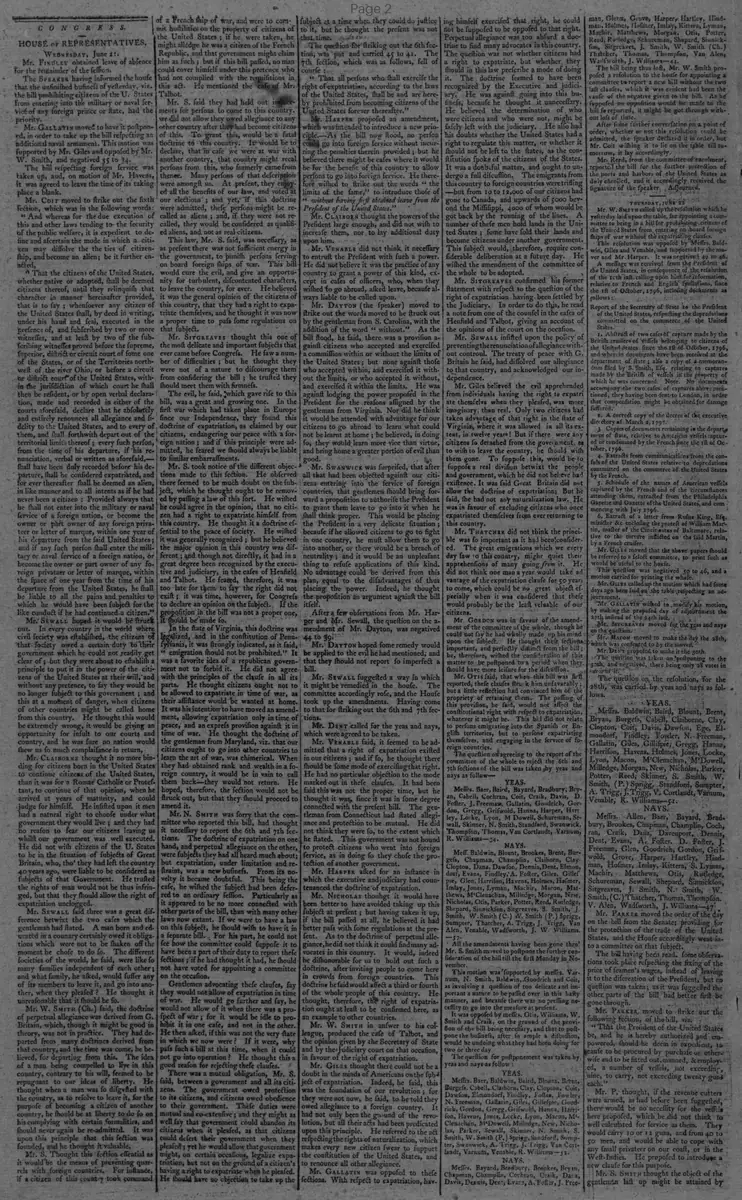
Proceedings of the U.S. House of Representatives on June 21-22: Debate on bill prohibiting citizens from foreign military/naval service, striking expatriation sections (45-41 yeas); bill fails on postponement (52-44 yeas). Discussion on Senate bill for naval protection of trade, striking clauses on frigate employment and authorizing revenue cutters instead.
Merged-components note: Sequential reading order across pages 2 and 3 with continuous text flow of the House of Representatives debate forms a single coherent story.
Clippings
1 of 2
OCR Quality
Full Text
Wednesday, June 21
Mr. Findley obtained leave of absence for the remainder of the session.
The Speaker having informed the house that the unfinished business of yesterday, viz. the bill prohibiting citizens of the United States from entering into the military or naval service of any foreign prince or state, had the priority.
Mr. Gallatin moved to have it postponed, in order to take up the bill respecting an additional naval armament. This motion was supported by Mr. Giles and opposed by Mr. W. Smith, and negatived 35 to 34.
The bill respecting foreign service was taken up, and, on motion of Mr. Havens, it was agreed to leave the time of its taking place a blank.
Mr. Coit moved to strike out the sixth section, which was in the following words:
"And whereas for the due execution of this and other laws tending to the security of the public welfare, it is expedient to define and ascertain the mode in which a citizen may dissolve the ties of citizenship, and become an alien; be it further enacted, That the citizens of the United States, whether native or adopted, shall be deemed citizens thereof, until they relinquish that character in manner hereinafter provided, that is to say; whenever any citizen of the United States shall, by deed in writing, under his hand and seal, executed in the presence of, and subscribed by two or more witnesses, and at least by two of the subscribing witnesses proved before the supreme, superior, district or circuit court of some one of the States, or of the Territories northwest of the river Ohio, or before a circuit or district court of the United States, within the jurisdiction of which court he shall then be resident, or by open verbal declaration, made and recorded in either of the courts aforesaid, declare that he absolutely and entirely renounces all allegiance and fidelity to the United States, and to every of them, and shall forthwith depart out of the territorial limits thereof; every such person, from the time of his departure, if his renunciation, verbal or written as aforesaid, shall have been duly recorded before his departure, shall be considered expatriated, and for ever thereafter shall be deemed an alien, in like manner and to all intents as if he had never been a citizen: Provided always that he shall not enter into the military or naval service of a foreign nation, or become the owner or part owner of any foreign privateer or letter of marque, within one year of his departure from the said United States: and if any such person shall enter the military or naval service of a foreign nation, or become the owner or part owner of any foreign privateer or letter of marque, within the space of one year from the time of his departure from the United States, he shall be liable to all the pains and penalties to which he would have been subject for the like conduct if he had continued a citizen."
Mr. Sewall hoped it would be struck out. In every country in the world where civil society was established, the citizens of that society owed a certain duty to their government which he could not readily get clear of; but they were about to establish a principle to put it in the power of the citizens of the United States at their will, and without any pretence, to say they would be no longer subject to this government; and this at a moment of danger, when citizens of other countries might be called home from this country. He thought this would be extremely wrong, it would be giving an opportunity for insult to our courts and country, and he was sure no nation would show us so much complaisance in return.
Mr. Claiborne thought it no more binding for citizens born in the United States to continue citizens of the United States, than it was for a Roman Catholic or Protestant, to continue of that opinion, when he arrived at years of maturity, and could judge for himself. He insisted upon it men had a natural right to choose under what government they would live; and they had no reason to fear our citizens leaving us whilst our government was well executed. He did not wish citizens of the U. States to be in the situation of subjects of Great Britain, who, tho' they had left the country 40 years ago, were liable to be considered as subjects of that Government. He trusted the rights of man would not be thus infringed, but that they should allow the right of expatriation unclogged.
Mr. Sewall said there was a great difference betwixt the two cases which the gentleman had stated. A man born and educated in a country certainly owed it obligations which were not to be shaken off the moment he chose to do so. The different societies of the world, he said, were like so many families independent of each other; and what family, he asked, would suffer any of its members to leave it, and go into another, when they pleased? He thought it unreasonable that it should be so.
Mr. W. Smith (Ch.) said, the doctrine of perpetual allegiance was derived from G. Britain, which, though it might be good in theory, was not in practice. They had departed from many doctrines derived from that country, and the time was come, he believed, for departing from this. The idea of a man being compelled to live in this country, contrary to his will, seemed to be repugnant to our ideas of liberty. He thought when a man was so disgusted with the country, as to resolve to leave it, or the purpose of becoming a citizen of another country, he should be at liberty to do so on his complying with certain formalities, and should never again be re-admitted. It was upon this principle that this section was founded, and he thought it valuable.
Mr. S. thought this section essential as it would be the means of preventing quarrels with foreign countries. For instance, if a citizen of this country took command of a French ship of war, and were to commit hostilities on the property of citizens of the United States; if he were taken, he might allege he was a citizen of the French Republic, and that government might claim him as such; but if this bill passed, no man could cover himself under this pretence who had not complied with the requisitions in this act. He mentioned the case of Mr. Talbot.
Mr. S. said they had held out inducements for persons to come to this country. We did not allow they owed allegiance to any other country after they had become citizens of this. To grant this, would be a fatal doctrine to this country. It would be to declare, that in case we were at war with another country, that country might recall persons from this, who formerly came from thence. Many persons of that description were amongst us. At present, they enjoyed all the benefits of our law, and voted at our elections; and yet, if this doctrine were admitted, these persons might be recalled as aliens; and, if they were not recalled, they would be considered as qualified aliens, and not as real citizens.
This law, Mr. S. said, was necessary, as at present there was not sufficient energy in the government, to punish persons serving on board foreign ships of war. This bill would cure the evil, and give an opportunity for turbulent, discontented characters, to leave the country, for ever. He believed it was the general opinion of the citizens of this country, that they had a right to expatriate themselves, and he thought it was now a proper time to pass some regulations on that subject.
Mr. Sitgreaves thought this one of the most delicate and important subjects that ever came before Congress. He saw a number of difficulties; but he thought they were not of a nature to discourage them from considering the bill; he trusted they should meet them with firmness.
The evil, he said, "which gave rise to this bill, was a great and growing one. In the first war which had taken place in Europe since our Independence, they found this doctrine of expatriation, as claimed by our citizens, endangering our peace with a foreign nation; and if this principle were admitted, he feared we should always be liable to similar embarrassments."
Mr. S. took notice of these different objections made to this section. He observed there seemed to be much doubt on the subject, which he thought ought to be removed by passing a law of this sort. He wished he could agree in the opinion, that no citizen had a right to expatriate himself from this country. He thought it a doctrine essential to the peace of society. He wished it was generally recognized: but he believed the major opinion in this country was different; and though not directly, it had in a great degree been recognized by the executive and judiciary, in the cases of Henfield and Talbot. He feared, therefore, it was too late for them to say the right did not exist; it was time, however, for Congress to declare an opinion on the subject. If the proposition in the bill was not a proper one, it should be made so.
In the state of Virginia, this doctrine was legalized, and in the constitution of Pennsylvania, it was strongly indicated, as it said, "emigration should not be prohibited." It was a favorite idea of a republican government not to forbid it. He did not agree with the principles of the clause in all its parts. He thought citizens ought not to be allowed to expatriate in time of war, as their assistance would be wanted at home. It was his intention to have moved an amendment, allowing expatriation only in time of peace, and an express provision against it in time of war. He thought the doctrine of the gentleman from Maryland, viz. that our citizens ought to go into other countries to learn the art of war, was chimerical. When they had obtained rank and wealth in a foreign country, it would be in vain to call them back they would not return. He hoped, therefore, the section would not be struck out, but that they should proceed to amend it.
Mr. N. Smith was sorry that the committee who reported this bill, had thought it necessary to report the 6th and 7th sections. The doctrine of expatriation on one hand, and perpetual allegiance on the other, were subjects they had all heard much about; but expatriation, under limitation and restraint, was a new business. From its novelty it became doubtful. This being the case, he wished the subject had been deferred to an ordinary session. Particularly as it appeared to be no more connected with other parts of the bill, than with many other laws now extant. If we were to have a law on this subject, he should wish to have it in a separate bill. For his part, he could not see how the committee could suppose it to have been a part of their duty to report these sections: if he had thought it had, he should not have voted for appointing a committee on the occasion.
Gentlemen advocating these clauses, say they would not allow of expatriation in time of war. He would go further and say, he would not allow of it when there was a prospect of war; for it would be idle to prohibit it in one case, and not in the other. He then asked, if this was not the very state in which we now were? If it were, why pass such a bill at this time, when it could not go into operation? He thought this a good reason for rejecting these clauses.
There was a mutual obligation, Mr. S. said, between a government and all its citizens. The government owed protection to its citizens, and citizens owed obedience to their government. These duties were mutual and co-extensive; and they might as well say that government could abandon its citizens when it pleased, as that citizens could desert their government when they pleased; yet he would allow that government might, on certain occasions, legalize expatriation, but not on the ground of a citizen's having a right to expatriate when he pleased. He should have no objection to take up the subject at a time when they could do justice to it, but he thought the present was not that time.
The question for striking out the 6th section, was put and carried 45 to 41. The 7th section, which was as follows, fell of course:
"That all persons who shall exercise the right of expatriation, according to the laws of the United States, shall be and are hereby prohibited from becoming citizens of the United States forever thereafter."
Mr. Harper proposed an amendment, which was intended to introduce a new principle. As the bill now stood, no person could go into foreign service without incurring the penalties therein provided; but he believed there might be cases where it would be for the benefit of this country to allow persons to go into foreign service. He therefore wished to strike out the words "the limits of the same," to introduce those of "without having first obtained leave from the President of the United States."
Mr. Claiborne thought the powers of the President large enough, and did not wish to increase them, nor to lay additional duty upon him.
Mr. Venable did not think it necessary to entrust the President with such a power. He did not believe it was the practice of any country to grant a power of this kind, except in cases of officers, who, when they wished to go abroad, asked leave, because always liable to be called upon.
Mr. Dayton (the Speaker) moved to strike out the words moved to be struck out by the gentleman from S. Carolina, with the addition of the word "without." As the bill stood, he said, there was a provision against citizens who accepted and exercised a commission within or without the limits of the United States: but none against those who accepted within, and exercised it without the limits, or who accepted it without, and exercised it within the limits. He was against lodging the power proposed in the President for the reasons assigned by the gentleman from Virginia. Nor did he think it would be attended with advantage for our citizens to go abroad to learn what could not be learnt at home; he believed, in doing so, they would learn more vice than virtue, and bring home a greater portion of evil than good.
Mr. Swanwick was surprised, that after all that had been objected against our citizens entering into the service of foreign countries, that gentlemen should bring forward a proposition to authorize the President to grant them leave to go into it when he shall think proper. This would be placing the President in a very delicate situation; because if he allowed citizens to go to fight in one country, he must allow them to go into another, or there would be a breach of neutrality; and it would be an unpleasant thing to refuse applications of this kind. No advantage could be derived from this plan, equal to the disadvantages of thus placing the power. Indeed, he thought the proposition an argument against the bill itself.
After a few observations from Mr. Harper and Mr. Sewall, the question on the amendment of Mr. Dayton, was negatived 44 to 39.
Mr. Dayton hoped some remedy would be applied to the evil he had mentioned; and that they should not report so imperfect a bill.
Mr. Sewall suggested a way in which it might be remedied in the house. The committee accordingly rose, and the House took up the amendments. Having come to that for striking out the 6th and 7th sections.
Mr. Dent called for the yeas and nays, which were agreed to be taken.
Mr. Venable said, it seemed to be admitted that a right of expatriation existed in our citizens; and if so, he thought there should be some mode of exercising that right. He had no particular objection to the mode marked out in these clauses. It had been said this was not the proper time, but he thought it was, since it was in some degree connected with the present bill. The gentleman from Connecticut had stated allegiance and protection to be mutual. He did not think they were so, to the extent which he stated. This government was not bound to protect citizens who went into foreign service, as in doing so they chose the protection of another government.
Mr. Harper asked for an instance in which the executive and judiciary had countenanced the doctrine of expatriation.
Mr. Nicholas thought it would have been better to have avoided taking up this subject at present; but having taken it up, if the bill passed at all, he believed it had better pass with some regulations at the present. As to the doctrine of perpetual allegiance, he did not think it could find many advocates in this country. It would, indeed be dishonorable for us to hold out such a doctrine, after inviting people to come here in crowds from foreign countries. This doctrine he said would affect a third or fourth of the whole people of this country. He thought, therefore, the right of expatriation ought at least to be confirmed here, as an example to other countries.
Mr. W. Smith in answer to his colleague, produced the case of Talbot, and the opinion given by the Secretary of State and by the Judiciary court on that occasion, in favour of the right of expatriation.
Mr. Giles thought there could not be a doubt in the minds of Americans on the subject of expatriation. Indeed, he said, this was the foundation of our revolution; for they were not now, he said, to be told they owed allegiance to a foreign country. It had not only been the ground of the revolution, but all their acts had been predicated upon this principle. He referred to the act respecting the rights of naturalization, which makes every new citizen swear to support the constitution of the United States, and to renounce all other allegiance.
Mr. Gallatin was opposed to these sections. With respect to expatriation, having himself exercised that right, he could not be supposed to be opposed to that right. Perpetual allegiance was too absurd a doctrine to find many advocates in this country. The question was not whether citizens had a right to expatriate, but whether they should in this law prescribe a mode of doing it. The doctrine seemed to have been recognized by the Executive and judiciary. He was against going into this business, because he thought it unnecessary. He believed the determination of who were citizens and who were not, might be safely left with the judiciary. He also had his doubts whether the United States had a right to regulate this matter, or whether it should not be left to the states, as the constitution spoke of the citizens of the States. It was a doubtful matter, and ought to undergo a full discussion. The emigrants from this country to foreign countries were trifling but from 10 to 12,000 of our citizens had gone to Canada, and upwards of 2000 beyond the Mississippi, 4000 of whom would be got back by the running of the lines. A number of these men hold lands in the United States; some have sold their lands and become citizens under another government. This subject would, therefore, require considerable deliberation at a future day. He wished the amendment of the committee of the whole to be adopted.
Mr. Sitgreaves confirmed his former statement with respect to the question of the right of expatriation having been settled by the Judiciary. In order to do this, he read a note from one of the counsel in the cases of Henfield and Talbot, giving an account of the opinions of the court on the occasion.
Mr. Sewall insisted upon the policy of preventing the renunciation of allegiance without controul. The treaty of peace with G. Britain he said, had dissolved our allegiance to that country, and acknowledged our independence.
Mr. Giles believed the evil apprehended from individuals having the right to expatriate themselves when they pleased, was more imaginary, than real. Only two citizens had taken advantage of that right in the state of Virginia, where it was allowed in all its extent, in twelve years! But if there were any citizens so detached from the government, as to wish to leave the country, he should wish them gone. To suppose this, would be to suppose a real division betwixt the people and government, which he did not believe had existence. It was said Great Britain did not allow the doctrine of expatriation; But he said, she had not any naturalization law. He was in favour of excluding citizens who once expatriated themselves from ever returning to this country.
Mr. Thatcher did not think the principle was so important as it had been considered. The great emigrations which we every day saw to this country, might quiet their apprehensions of many going from it. He did not think one man a year would take advantage of the expatriation clause for 50 years to come, which could be no great object especially when it was considered that these would probably be the least valuable of our citizens.
Mr. Gordon was in favour of the amendment of the committee of the whole, though he could not say he had wholly made up his mind upon the subject. He thought these sections important and perfectly distinct from the bill; he, therefore, wished the consideration of this matter to be postponed to a period when they should have more leisure for the discussion.
Mr. Otis said, that when this bill was first reported, these clauses struck him unfavorably; but a little reflection had convinced him of the propriety of retaining them. The passing of this provision, he said, would not affect the constitutional right with respect to expatriation, whatever it might be. This bill did not relate to persons emigrating into the Spanish or English territories, but to persons expatriating themselves, and engaging in the service of foreign countries.
The question on agreeing to the report of the committee of the whole to reject the 6th and 7th sections of the bill was taken by yeas and nays as follow—
YEAS. Mess. Baer, Baird, Bayard, Bradbury, Bryan, Cabell, Cochran, Coit, Craik, Davis, D. Foster, J. Freeman, Gallatin, Goodrich, Gordon, Gregg, Griswold, Hanna, Harper, Hartley, Locke, Lyon, M'Dowell, Schureman, Sewall, Skinner, N. Smith, Standford, Swanwick, Thompson, Thomas, Van Cortlandt, Varnum, R. Williams—34.
NAYS. Mess. Baldwin, Blount, Brookes, Brent, Burgess, Chapman, Champlin, Claiborne, Clay, Clopton, Dana, Dawson, Dennis, Dent, Elmondorf, Evans, Findley, A. Foster, Giles, Gillespie, Glen, Harrison, Havens, Holmes, Homer, Imlay, Jones, Lyman, Machir, Macon, Matthews, M'Clenachan, Milledge, Morgan, New, Nicholas, Otis, Parker, Potter, Reed, Rutledge, Shepard, Sinnickson, Sitgreaves, S. Smith, J. Smith, W. Smith (C.) W. Smith (P.) Sprigg, Sumpter, Thatcher, A. Trigg, I. Trigg, Van Allen, Venable, Wadsworth, J. W. Williams.—57.
All the amendments having been gone thro' Mr. S. Smith moved to postpone the further consideration of the bill till the first Monday in November.
This motion was supported by messrs. Varnum, N. Smith, Baldwin, Goodrich and Coit, as involving a question of too delicate and important a nature to be passed over in this hasty manner, and because there was no pressing necessity to go into the measure at present.
It was opposed by messrs. Otis, Williams, W. Smith and Craik, on the ground of the provision of the bill being necessary, and that to postpone the business, after so ample a discussion, would be undoing what they had been doing for two or three days
The question for postponement was taken by yeas and nays as follow:
YEAS. Mess. Baer, Baldwin, Baird, Blount, Brent, Burgess, Cabell, Claiborne, Clay, Clopton, Coit, Dawson, Elmondorf, Findlay, Foster, Fowler; N. Freeman, Gallatin, Giles, Gillespie, Goodrich, Gordon, Gregg, Griswold, Hanna, Harrison, Havens, Jones, Locke, Lyon, Macon, M'Clenachan, M'Dowell, Milledge, New, Nicholas, Parker, Sewall, Skinner, N. Smith, S. Smith, W. Smith (P.) Sprigg, Sandford, Sumpter, Swanwick, A. Trigg, J. Trigg, Van Cortlandt, Varnum, Venable, R. Williams—52.
NAYS. Mess. Bayard, Bradbury, Brookes, Bryan, Chapman, Champlin, Cochran, Craik, Dana, Davis, Dennis, Dent, Evans, A. Foster, J. Freeman, Glen, Goodrich, Gordon, Griswold, Grove, Harper, Hartley, Hindman, Homer, Imlay, Kittera, Lyman, Machir, Matthews, Otis, Potter, Reed, Rutledge, Schureman, Shepard, Sinnickson, Sitgreaves, J. Smith, N. Smith, W. Smith (Ch.) Thatcher, Thomas, Thompson, Van Allen, Wadsworth, J. Williams—44.
The bill being thus lost, Mr. W. Smith proposed a resolution to the house for appointing a committee to report a new bill without the two last clauses, which it was evident had been the cause of the negative given to the bill. As he supposed no opposition would be made to the bill so reported, it might be got through without loss of time.
After some further conversation on a point of order, whether or not this resolution could be admitted, the Speaker declared it in order, but Mr. Coit wishing it to lie on the table till to-morrow, it lay accordingly.
Mr. Reed, from the committee of enrolment, reported the bill for the further protection of the ports and harbors of the United States as duly enrolled, and it accordingly received the signature of the Speaker. Adjourned.
THURSDAY, JUNE 22
Mr. W. Smith called up the resolution which he yesterday laid upon the table, for appointing a committee to bring in a bill for prohibiting citizens of the United States from entering on board foreign ships of war without the expatriating clauses.
This resolution was opposed by Messrs. Baldwin, Giles and Venable, and supported by the mover and Mr. Harper. It was negatived 49 to 46.
A message was received from the President of the United States, in consequence of the resolution of the 5th inst. calling upon him for information, relative to French and English depredations, since the 1st of October, 1796, enclosing documents as follows:
Report of the Secretary of State to the President of the United States, respecting the depredations committed on the commerce of the United States.
I. Abstract of two cases of capture made by the British cruisers of vessels belonging to citizens of the United States since the 1st of October, 1796, and wherein documents have been received at the department of state; also a copy of a memorandum filed by S. Smith, Esq. relating to captures made by the British of vessels in the property of which he was concerned. Note. No documents accompany the two cases of captures above mentioned, they having been sent to London, in order that compensation might be obtained for damage suffered.
A correct copy of the decree of the executive directory of March 2, 1797.
3. Copies of documents remaining in the department of state, relative to American vessels captured or condemned by the French since the 1st of October, 1796.
4. Extracts from communications from the consuls of the United States relative to depredations committed on the commerce of the United States by the French.
5. Schedule of the names of American vessels captured by the French and of the circumstances attending them, extracted from the Philadelphia Gazette and Gazette of the United States, and commencing with July 1796.
6. Extract of a letter from Rufus King, Esq. minister &c enclosing the protest of William Martin, master of the Cincinnatus of Baltimore, relative to the torture inflicted on the said Martin, by a French cruiser.
Mr. Giles moved that the above papers should be referred to a select committee, to print such as would be useful to the house.
This question was negatived 50 to 46, and a motion carried for printing the whole.
Mr. Giles called up the motion which had some days ago been laid on the table respecting an adjournment.
Mr. Gallatin wished to modify his motion by making the proposed day of adjournment the 27th instead of the 24th inst.
Mr. Sitgreaves moved for the yeas and nays on the question.
Mr. Macon moved to make the day the 28th, which was consented to by the mover.
Mr. Dent proposed, to make it the 30th.
The question was taken on postponing to the 30th, and negatived, there being only 28 votes in favor of it.
The question on the resolution, for the 28th, was carried by yeas and nays as follows.
YEAS. Mess. Baldwin, Baird, Blount, Brent, Bryan, Burgess, Cabell, Claiborne, Clay, Clopton, Coit, Davis, Dawson, Ege, Elmondorf, Findley, Fowler, N. Freeman, Gallatin, Giles, Gillespie, Gregg, Hanna, Harrison, Havens, Holmes, Jones, Locke, Lyon, Macon, M'Clenachan, M'Dowell, Milledge, Morgan, New, Nicholas, Parker, Potter, Reed, Skinner, S. Smith, W. Smith (P.) Sprigg, Standford, Sumpter, A. Trigg, J. Trigg, V. Cortlandt, Varnum, Venable, R. Williams—51.
NAYS. Mess. Allen, Baer, Bayard, Bradbury, Brookes, Chapman, Champlin, Cochran, Craik, Dana, Davenport, Dennis, Dent, Evans, A. Foster, D. Foster, J. Freeman, Glen, Goodrich, Gordon, Griswold, Grove, Harper, Hartley, Hindman, Homer, Imlay, Kittera, S. Lyman, Machir, Matthews, Otis, Rutledge, Schureman, Sewall, Shepard, Sinnickson, Sitgreaves, J. Smith, N. Smith, W. Smith (C.) Thatcher, Thomas, Thompson, V. Allen, Wadsworth, J. Williams—47
Mr. Parker moved the order of the day on the bill from the Senate; providing for the protection of the trade of the United States, and the House accordingly went into a committee on that subject.
The bill having been read, some observations took place respecting the fixing of the price of seamen's wages, instead of leaving it to the discretion of the President, but no question was taken; as it was suggested the other parts of the bill had better first be gone through.
Mr. Parker, moved to strike out the following section, of the bill, viz.?
"That the President of the United States be, and he is hereby authorized and empowered, should he deem it expedient, to cause to be procured by purchase or otherwise and to be fitted out, manned, & employed, a number of vessels, not exceeding, nine, to carry, not exceeding twenty guns each."
Mr. P. thought, if the revenue cutters were armed, as had before been suggested, there would be no necessity for the vessels here proposed, which he did not think too well calculated for service as them. They would carry 10 or 12 guns, and from 40 to 50 men, and would be able to cope with any small privateer on our coast, or in the West-Indies. He proposed to introduce a new clause for this purpose.
Mr. S. Smith thought the object of the gentleman last up might be attained by amending this clause. He was wholly in favor of the cutters, as they would not only serve as a defence for our coast, but as tenders to the frigates. Nine vessels of 20 guns, he said, would require 674 seamen to man them, and the frigates would require 432 able and 300 ordinary seamen, which he did not believe would be very readily raised. Besides vessels which would be purchased for this purpose, would not be calculated for the service, not being sufficiently swift sailors, whilst these cutters would outsail most privateers, and half the seamen would be sufficient. They might be ready in a fortnight, whilst the others could not be fit for sea for three months.
Mr. Parker had thought of amending the bill in the way proposed: but he found some objections to that mode. It would be necessary that the cutters should be employed in the protection of our revenue, as well as to guard our coast; and, on that account he believed it would be better not to include them under the naval establishment, as they would not, in that case, be so much at the command of the Secretary of the treasury.
The question was carried without a division; the clause following, which respected the officers and crew to be employed, fell of course.
Mr. Giles moved to strike out the following clause, for the purpose of inserting a similar one to that agreed to in the bill for the galleys, viz. to confine their use within the jurisdiction of the United States:
"That the President of the United States may employ the said frigates and the said vessels, to protect the ships and cargoes belonging solely to citizens of the United States, and also the harbors and sea-coast of the United States, in such manner and under such regulations as shall in no wise contravene either the laws of nations, or any existing treaties between the United States and foreign nations."
Mr. W. Smith hoped this amendment would not be agreed to. He believed it was never intended to confine the frigates within so narrow a sphere. He believed the latter part of the clause proposed to be struck out would prevent any mischief. The Commanders of these vessels, he said, would be men of abilities and Character, well instructed as to their duty with respect to the Law of Nations. If the Frigates were to be thus confined in their operations, they would be of no real use.
Mr. Giles wished to know to what other purpose, besides the protection of our coast, the gentlemen wished to employ these vessels. It seemed to be thought the Frigates could be of no use, except as convoys; but he denied that they were equal to that object if it were agreed that they should be so employed. It was said the cutters to be employed were to act as Tenders to the Frigates; yet they were to be kept at home; it would therefore be curious to send the frigates abroad, and keep the tenders at home. To employ the frigates in any other way than for the protection of our coast, would, in his opinion, hazard the Peace of the country, without producing any good; for if he was a merchant (and he believed the merchants were generally of that opinion), he would sooner send his vessel unprotected, than with the proposed convoy.
Mr. Sewall argued against the absurdity of confining the operations of our maritime force to the narrow limits proposed by the amendment. It was the object of the bill to defend our commerce from the unjust attacks of the belligerent powers, and it surely would not be pretended that these attacks were confined to our coasts. To render the protection efficient, it should be co-extensive with the danger—and should the frigates not be permitted to operate beyond the imaginary line which limits our maritime jurisdiction on the sea coast, it would frequently happen that they would be obliged to submit to the capture of their convoys within the reach of their guns. It would be infinitely preferable to dismantle our ships of war, and save the expense of their equipment, than to hold out to our trade an illusory protection, which would only lead them into danger. The picaroons which infest the American seas would sufficiently understand the restriction which it proposed, and would be rather incited by it than discouraged. He was therefore decidedly against the amendment, but neither did he like the clause as it stood in the bill. He did not comprehend the propriety of limiting the protection of the frigates to the case of "vessels and cargoes owned solely by American citizens"—In some instances it ought not to be extended so far, in others it ought to go farther. Vessels and cargoes owned entirely by our own citizens might be employed in a contraband trade and ought not to be protected; although this construction perhaps was corrected by the latter part of the clause, yet there was an opposite evil which would necessarily arise from it in its present form. Ships owned by American citizens are entitled to the protection of the government against French cruisers, while engaged in a lawful trade, let their cargoes belong to whom they might. It is one stipulation of our commercial treaty with France that free ships make free goods—and whatever might be the opinion of this house as to the expediency of relinquishing this stipulation by a new compact, yet until this could be effected in a course of negotiation, we cannot abandon the advantages it gives to our citizens—The rights growing out of treaty are as much objects of protection as those arising from the law of nations—and he could never consent to such an abandonment of them, until the relations of the two countries in this respect should be legitimately changed. If the present amendment therefore should not prevail, it was his intention to move to substitute for the words "ships and cargoes belonging solely to citizens of the United States" the expression "the lawful commerce of the citizens of the United States."
Mr. Nicholas concluded the gentleman was not in the House when this subject was formerly under discussion, as he seemed to have stumbled upon all the objections, which were then abandoned. Those gentlemen who had advocated convoys completely gave them up, [Mr. Smith denied that he had ever gave them up.] Mr. N. believed he never did, on any other account than because every body about him gave them up, and a clause directly the reverse of his was agreed to. Mr. N. then went over the arguments which were gone into on a former occasion. He showed that this force was inadequate to the protection of our commerce, and that or being taken into a foreign port, for trial, on the ground of a cargo being bona fide neutral; would produce war. And should we, he asked, while a negociation was pending, run the risk of again involving ourselves in difficulties? He trusted we should not. He denied that the effect of the amendment could be to confine the frigates within the jurisdiction of the United States, as the commerce within the jurisdiction might be defended by their going without it. He trusted the amendment would be agreed to.
Mr. Barton (the speaker) wished to strike out the section, and insert nothing. He was not prepared to say the frigates should or should not be employed as convoys; nor was he ready to say they should be confined within the jurisdiction of the United States. He was willing to leave this business to the President of the United States, as commander in chief. He was sure that confidence would not be abused; and he believed he would have better opportunities than they had, of determining the best manner of employing them.
Mr. Parker seconded the motion. He thought it would be highly improper in them to dictate to the President how he should use these vessels. He wished that to rest on the broad basis of the President's responsibility.
Mr. W. Smith had no objection to the business taking this course. As Commander in Chief, there was no doubt the President would employ this naval force in a manner which, in his opinion, would be most conducive to the public good. If the negociation failed, and there should be a necessity for employing it in a manner differently from what they at present contemplated, he would of course do so. Mr. S. took notice of what had fallen from Mr. Nicholas; he denied that what had been determined relative to the galleys, had any connection with the frigates. He said, in our treaty with Holland and Sweden, convoys for our trade in time of peace were positively stipulated for, and the word of the commander of our convoy was always to be taken, as to the description of our cargoes; therefore the arguments of that gentleman fell to the ground, when he said our vessels could not go out to sea without endangering our peace. It was true there was no such article in our treaty with France, but it was stipulated in what manner search should be made. The Swedish treaty, he said, was made by Dr. Franklin, at Versailles, under the eye of the French Government. It was to be supposed, therefore, it met with their full approbation, especially as it had never been complained against.
Mr. Nicholas said, that there being stipulations of the kind mentioned by the gentleman last up, provided that no such right existed without a treaty; and as to the manner in which a search should be made being laid down, it was no security against the evil he dreaded. He denied the right of the President to apply the naval force of the United States to any object he pleased. When a force was raised for a particular object, he agreed that it was his business to direct the manner in which this force should be used; but to say that he had a right to apply it at his discretion was to make him master of the United States, if that were the case, he said, the powers of that House were gone. When they raised men for the protection of the frontier, would the President, he asked, send them to any other place? He insisted upon it that they had a right to say the vessels should be kept in the river Delaware, if they pleased;—the President might afterwards direct their conduct. If a contrary doctrine were to prevail, if they did not give up the right of declaring war, they gave up a power which would inevitably lead to war.
Mr. Brookes did not apprehend any danger from leaving it in the power of the President to make use of the frigates as he pleased.
Mr. Gallatin said, that after having determined that the three frigates should be got ready for sea, it became necessary to say upon what business they should be employed. There might be different opinions on the subject, but it was necessary to define the object. If not, they had reason to apprehend, from his Speech, that the President would employ them as convoys. The difficulties attending such an employ, had been shewn when the subject of galleys were under consideration; they were so many that the peace of the country would be greatly endangered by such an employment of the frigates. The danger was greatly increased by the disputed articles of our treaty with France, which the President would be under the necessity of enforcing. In ordinary times, he said, the principle of the gentlemen from New-Jersey was a good one. If we had frigates in service, they were not from day to day to say how they should be employed; but, under our present circumstances, he thought the object ought to be defined, and that they ought to depart from the maxim laid down by that gentleman.
Mr. Sewall was in favor of striking out the clause. If the President were to be limited at all he should have no objection to limit him with respect to convoys, from the incompetency of three vessels to that end; but these frigates were to be considered as the public force, as the navy of the United States. It was true it was a small one, but it was such as congress had thought proper to raise, and put in the power of the President. And why should this power be limited? It seemed as if they supposed, from his natural disposition, or from some other cause, he would abuse it, by employing the vessels contrary to law, and thereby involve the country in a war.
The constitution, Mr. S. said, had defined him to be commander in chief of the navy, and having a navy, the command of course devolved upon him. If those vessels were built for a particular purpose, they might designate their object, but they were begun in 1794, and the act gave the President authority to "equip and employ these vessels." If at that period when, in the opinion of many gentlemen, there was a greater prospect of war than at present, no object was pointed out for the vessels, he did not see why any should now be pointed out. With respect to the disputed articles in the French treaty, they had already expressed an opinion to the President, "which he doubted not would have its effect."
Mr. Williams thought that having given the President a discretionary power in the first section of the bill they ought not now to take it from him; because, if he did not see occasion to man the frigates, he would never do it; but if he did see occasion for manning them, they ought not to take from him the power of employing them as he pleased. He was therefore in favor of the motion of the gentleman from New Jersey.
Mr. Giles asked, whether to ascertain the object upon which these vessels should be employed, was a legislative or an executive act? It was certainly a legislative. They ought to say to the President, "Here is the force, and there is the object." It was said they had already given an opinion to the President, with respect to the disputed articles in the French treaty? They now wished a law to be passed in conformity to that opinion.
They were often charged, Mr. Giles said, with a want of confidence in the President. He was free to own he had not much confidence in the present President. His speech, at the opening of the session, had destroyed all his confidence; but, however high their opinion might be of the Executive, they ought not to lodge improper powers in his hands.
Mr. Harper was in favor of the motion. He wished to provide force, and not to direct the use of it, he believed this was the object for which they were called together. He was willing to leave the use of this force to the president because he could employ it in a manner only applicable to peace; to employ it otherwise would be a breach of his power. He therefore could not repel any violation of our rights by force, except previously authorized by Congress.
This gentleman from Virginia, Mr. Harper, said, need not to have told them he had no confidence in the present executive. He might have said in no executive; for it was well known he never missed going out of the way to say rude things of the late president; but he did not believe this was the best way of discharging their duty. He believed the public cared little what his opinion of the President was; he thought they ought to do their duty, and leave the president to his. Mr. Harper denied that they had the right to direct the public force. If we were at war with Great-Britain, they should have no right to say to the president attack Canada or the Islands. The use of this force must be left with the president; if he abuses it, upon his own head would lie the responsibility, and not upon them.
Mr. S. Smith had not made up his mind on the subject. If the power of employing the frigates was wholly left with the President, though he had not the power of declaring war, yet he might so employ them as to lead to war, particularly with respect to the French treaty articles. On this other hand, it seemed to be a poor employment for these frigates, after all the expense which they had cost, to keep them within the jurisdiction of the United States. They could not cruise there, indeed, without danger of running on the shoals. Understanding, as he did, that by voting for the striking out of this clause, he should not be precluded from voting for the amendment of the gentleman from Virginia, if he should conclude to do so, he should vote for striking out the section in question.
Mr. Macon proposed a clause similar in effect to that proposed by the gentleman from Virginia, to be inserted in place of the one struck out—but the chairman declared it not in order.
Mr. Barton said, that those gentlemen who were not prepared to vote for retaining the sixth section, must be prepared to say these frigates shall be employed as convoys. It was to avoid this, that he had moved to strike it out. He again expressed his wish that the direction of this force might be left with the President.
Mr. Giles declared his intention of voting for striking out the section, and to risk the insertion of another afterwards.
The question for striking out was carried without a division.
Mr. Giles then moved to insert the section before proposed by Mr. Macon, to confine the use of our frigates to the protection of our coasts, and commerce within the jurisdiction of the United States.
To be concluded to-morrow.
What sub-type of article is it?
What themes does it cover?
What keywords are associated?
What entities or persons were involved?
Where did it happen?
Story Details
Key Persons
Location
House Of Representatives
Event Date
Wednesday, June 21; Thursday, June 22
Story Details
The House debates a bill prohibiting U.S. citizens from entering foreign military or naval service, including sections on expatriation which are struck out (45-41); the bill fails on a motion to postpone (52-44). Proceedings include receiving presidential message on depredations, printing documents, setting adjournment to June 28 (51-47), and debating Senate bill on trade protection, striking sections on additional vessels and frigate employment limits.