Thank you for visiting SNEWPapers!
Sign up free
Letter to Editor
August 22, 1842
The Daily Madisonian
Washington, District Of Columbia
What is this article about?
Washington correspondent exposes Whig party conspiracy to oust President Tyler over bank vetoes, defends his actions on fiscal bills, and details cabinet resignations as forced retaliation, emphasizing Tyler's integrity amid political intrigue.
Clipping
OCR Quality
85%
Good
Full Text
From the N. Y. Union,
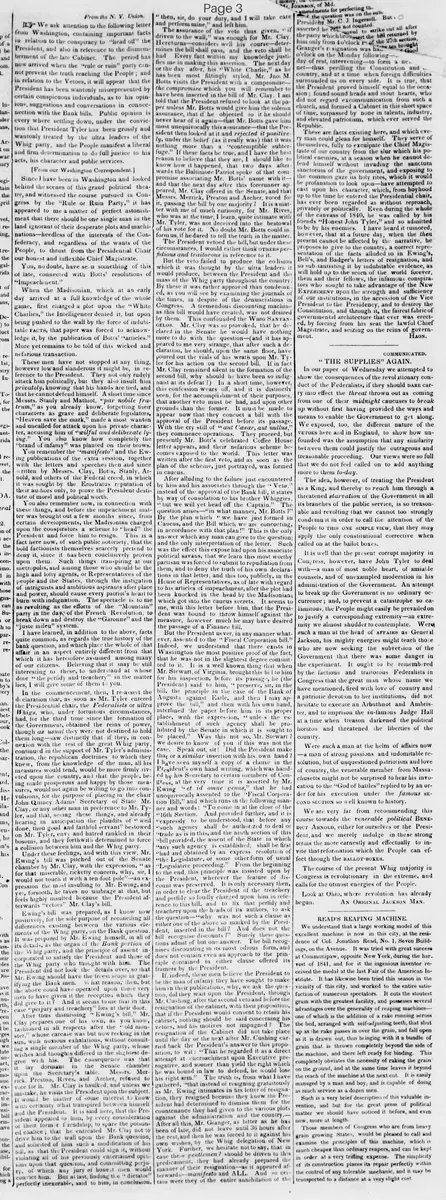
We ask attention to the following letter from Washington, containing important facts in relation to the conspiracy to "head off" the President, and also in reference to the dismemberment of the late Cabinet. The period has now arrived when the "rule or ruin" party cannot prevent the truth reaching the People; and in relation to the Vetoes, it will appear that the President has been wantonly misrepresented by certain conspicuous individuals, as to his opinions, suggestions and conversations in connection with the Bank bills. Public opinion is every where settling down, under the conviction that President Tyler has been grossly and wantonly treated by the ultra leaders of the Whig party, and the People manifest a liberal and firm determination to do full justice to his acts, his character and public services.
[From our Washington Correspondent.]
Since I have been in Washington and looked behind the scenes of this grand political theatre, and witnessed the course pursued in Congress by the "Rule or Ruin Party," it has appeared to me a matter of perfect astonishment that there should be one single man in the land ignorant of their desperate plots and machinations—heedless of the interests of the Confederacy, and regardless of the wants of the People, to thrust from the Presidential Chair our honest and inflexible Chief Magistrate.
You, no doubt, have seen something of this of late, connected with Botts' resolutions of "Impeachment."
When the Madisonian, which at an early day arrived at a full knowledge of the whole game, first charged a plot upon the "White Charlies," the Intelligencer denied it, but upon being pushed to the wall by the force of indubitable Facts, that paper was forced to acknowledge it, by the publication of Botts' articles.
More yet remains to be told of this wicked and nefarious transaction.
These men have not stopped at any thing, however low and slanderous it might be, in reference to the President. They not only rudely attack him politically, but they also insult him privately, knowing that his hands are tied, and that he cannot defend himself. A short time since Messrs. Stanly and Mathiot, par nobile fratrum, as you already know, forgetting their characters as grave and deliberate legislators, "Heaven save the mark," made a most wanton and uncalled-for attack upon his private character, accusing him of "wilful and deliberate lying." You also know how completely the "brand of infamy" was planted on their brows.
You remember the "manifesto" and the Ewing publications of the extra session, together with the letters and speeches then and since written by Messrs. Clay, Botts, Stanly, Arnold, and others of the Federal creed, in which it was sought by the Erostratus reputation of their authors only, to prove the President destitute of moral and political worth.
You also remember how, in connection with these things, and before the impeachment matter was brought out a few months since, from certain developments, the Madisonian charged upon the conspirators a scheme to "head" the President and force him to resign. This is a fact here now, of such public notoriety, that the bold factionists themselves scarcely pretend to deny it, since it has been conclusively proven upon them. Such things transpiring at our metropolis, and among those who should be the high and lofty agents, or Representatives of the people and the States, through the instigation of intriguists and ambitious aspirants after place and power, should cause every patriot's heart to burn with indignation. The spectacle is to me as revolting as the efforts of the "Mountain" party in the day of the French Revolution, to break down and destroy the "Gironne" and the "juste milieu" system.
I have learned, in addition to the above, facts quite common, as regards the true history of the bank question, and which place the whole of that affair in an aspect entirely different from that which it has heretofore assumed among many of our citizens. Believing that it may be still interesting to these, to understand at whose door "the perfidy and treachery" in the matter lies, I will give some of them to you.
In the commencement, then, I re-assert the declaration that, as soon as Mr. Tyler entered the Presidential chair, the Federalists or ultra Whigs, who, under fortuitous circumstances, had, for the third time since the formation of the Government, obtained the reins of power, though as usual they were not destined to hold them long—saw distinctly that if they, in connexion with the rest of the great Whig party, continued in the support of Mr. Tyler's administration, the republican doctrines to which they knew, from the knowledge of the man, all his measures would tend, would be more firmly riveted upon the country, and that the people, being made prosperous and happy by those measures, would not again be willing to go into convulsions, for the purpose of placing in the chair John Quincy Adams' Secretary of State Mr. Clay, or any other man in preference to Mr. Tyler, and that, seeing these things, and already hearing in anticipation the plaudits of "well done, thou good and faithful servant" bestowed on Mr. Tyler, envy and hatred rankled in their bosoms, and they forthwith determined to force a collision between him and the Whig party.
Under these feelings, and with this view, Mr. Ewing's bill was pitched out of the Senate chamber by Mr. Clay, with the expression, "as for that miserable, ricketty concern, why, sir, I would not touch it with a ten-foot pole"—an expression the most insulting to Mr. Ewing, and yet, forsooth, he takes no umbrage at that, but feels highly insulted because the President afterwards "vetoes" Mr. Clay's bill.
Ewing's bill was prepared, as I know now positively, for the sole purpose of reconciling all differences existing between the various elements of the Whig party, on the Bank question. It was prepared by Mr. Ewing himself, in all of its details, as the organ of the Bank portion of the Whig party, and the principle of assent incorporated to satisfy the President and those of the Whig party who thought with him. The President did not look the details over, so that Mr. Ewing should have the freest scope in gratifying the Bank men. What reason, then, but the above could have operated upon those very men to have given it the reception which they did give to it? And it seems to me that in this case "perjury and treachery" lies at their door.
After thus dismissing "Ewing's bill," Mr. Clay prepares one of his own, fashioned in all respects after the "old monster," whose carcase was but now reeking in the sun, with noxious exhalations, without consulting a single member of the Whig party, whose wishes and thoughts differed in the slightest degree with his. The consequence was that it lay dormant in the Senate chamber upon the Secretary's table. Messrs. Merrick, Preston, Rives, and Archer, refused to vote for it. Mr. Clay is baulked, and unless we mistake, he visits the President upon the subject. It would be matter of some interest to know with certainty what transpired between himself and the President. It is said here, that the President appealed to him, by every consideration of their former friendship, to spare the poisoned chalice; that he entreated Mr. Clay not to drive him to the wall upon the Bank question, and solicited of him such a modification of his bill, as that the President could sign it, without violating all of his previously entertained opinions upon that question, and committing perjury, of which any jury of honest men would convict him. But at last, finding the "dictator" perfectly inexorable, said to him, in conclusion,
"then, sir, do your duty, and I will take care and perform mine," and left him.
The assurance of the veto thus given, "if driven to the wall," was enough for Mr. Clay. He returns—considers well his course—determines the bill shall pass, and the veto shall be had. Every fact within my knowledge justifies me in making this assertion. The next day or the day after, his "White Charlie," as he has been most fittingly styled, Mr. Jno. M. Botts visits the President with a compromise—the compromise which you will remember to have been inserted in the bill of Mr. Clay. I am told that the President refused to look at the paper unless Mr. Botts would give him the solemn assurance, that if he objected to it he should never hear of it again—that Mr. Botts gave him most unequivocally this assurance—that the President then looked at it and rejected it positively, under the belief (as it really was) that it was nothing more than a "contemptible subterfuge." If these facts be true, and I have the best reason to believe that they are, I should like to know how it happened, that two days afterwards the Baltimore Patriot spoke of that compromise associating Mr. Botts' name with it—and that the next day after this forerunner appeared, Mr. Clay offered in the Senate, and that Messrs. Merrick, Preston and Archer, voted for it, passing the bill by one majority? It is a matter with me of much curiosity, for Mr. Rives who was at the time, I learn, quite intimate with Mr. Tyler, was not deceived into the bestowal of his vote for it. No doubt Mr. Botts could inform us, if he dared to tell the truth in the matter.
The President vetoed the bill, but under these circumstances, I would rather think others perfidious and traitorous in reference to it.
But the veto failed to produce the collision which it was thought by the ultra leaders it would produce, between the President and the mass of the Whig party throughout the country. By these it was rather approved than condemned, as you will see by examining the journals of the times, in despite of the denunciations in Congress. A tremendous discounting machine as this bill would have created, was not desired by them. This confounded the Whig Santangelos. Mr. Clay was so provoked, that he declared in the Senate he "would have nothing more to do with the question"—(and it has appeared to me very strange, that after such a declaration, he should, upon the same floor, have poured out the vials of his wrath upon Mr. Tyler for his action on the second bill. If in fact Mr. Clay remained silent in the formation of the second bill, why should he have been so indignant at its defeat?) In a short time, however, this confession wears off, and it is distinctly seen, for the accomplishment of their purposes, that another veto must be had, and upon other grounds than the former. It must be made to appear now that they concoct a bill with the approval of the President before its passage. With the cry still of "aut Cæsar, aut nullus," they commence operations. They proceed, but presently Mr. Botts' celebrated Coffee House letter appears, and their nefarious scheme becomes exposed to the world. This letter was written after the first veto, and as soon as the plan of the scheme, just portrayed, was formed in caucus.
After alluding to the failure just encountered by him and his associates through the "Veto," instead of the approval of the Bank bill, it states by way of consolation to his brother Whiggies, "but we will yet head off the Captain." The question arises—"in what manner, Mr. Botts?" By the plan which "we have just formed in Caucus, and the Bill which we are concocting, in accordance with that plan!" This is the only answer which any man can give to the question; and the only interpretation of the letter. Such was the effect this expose had upon his associate political savans, that we learn this most worthy partisan was forced to submit to repudiation from them, and to deny the truth of his own declarations in that letter, and this too, publicly, in the House of Representatives, as of late with regard to his articles of impeachment, after the plot had been knocked in the head by the Madisonian; which got into the caucus secrets. It seems to me, with this letter before him, that the President was bound to throw himself against the measure, however much he may have desired the passage of a Finance bill.
But the President never, in any manner whatever, assented to the "Fiscal Corporation bill." Indeed, we understand that there exists in Washington the most positive proof of the fact, that he was not in the slightest degree committed to it. It is a well known thing that when Mr. Stewart, of Virginia, brought this bill to him for his inspection, before its passage, he (the President) said to him, "preserve, sir, in the bill, the principle in the case of the Bank of Augusta against Earle, and then I may approve the bill," and then with his own hand, interlined the paper before him in its proper place, with the expression, "unless the establishment of such agency shall be prohibited by the State in which it is sought to be placed." Was this not so, Mr. Stewart? we desire to know of you if this was not the case. Speak out, sir! Did the President make that or a similar insertion with his own hand?
I have seen myself a copy of a clause in the President's own hand writing, which was handed by his Secretary to certain members of Congress, at the very time it is asserted by Mr. Ewing "et id omne genus," that he had unequivocally assented to the "Fiscal Corporation Bill," and which runs in the following manner and words: "To come in at the close of the 16th Section. And provided further, and it is expressly to be understood, that before any such agency shall be authorized to deal or trade as is in this, and the ninth section of this bill provided, the assent of the State in which any such agency is established, shall be first had and obtained by an express resolution of the Legislature, or some other form of usual Legislative proceeding." From the beginning to the end, this principle was insisted upon by the President, wherever the feature of discount was preserved. It is only necessary then, in order to clear the President of the treachery and perfidy so loudly charged upon him in reference to this bill, and to fix that perfidy and treachery upon the heads of its authors, to ask the question—"why was not such a clause as either one of the above so marked by the President, inserted in the bill? And does not the bill recognise discounts?" Surely these questions admit of but one answer. The bill recognises discounting in its most odious form, and does not contain even an approach to the principle contained in either clause offered its framers by the President.
If, indeed, these men believe the President to be the man of infamy they have sought to make him in their publications, why, we ask the question, did they wait upon the President, through Mr. Cushing, after the second veto and before the resignation of the cabinet, with their proposition, that if the President would consent to retain his cabinet, nothing should be said concerning his vetoes, and his motives not impugned? The resignation of the Cabinet did not take place until the day or the next after Mr. Cushing carried back the President's answer to this proposition, to wit: "That he regarded it as a direct attempt at encroachment upon Executive prerogative, and sooner than yield the right which he was bound in law to defend, he would lose his right arm." The truth is, from what I have gathered, "that instead of resigning gratuitously as Mr. Ewing intimates in his letter of resignation, they resigned because they knew the President had determined to dismiss them for the countenance they had given to the various plots against the administration and the country.—After all this, Mr. Granger, as bitter as he has been of late, did not leave until 36 hours after the rest, and then he was forced to it against his own wishes, by the Whig delegation of New York. Further, we hesitate not to say, that in case these gentlemen should be driven to this predicament, they had already prepared the manner of their resignation—as it appeared afterwards—manifesto and ALL. And so certain were they of the entire annihilation of the
Provide by Mr. C. J. Ingersoll. But of the question or was on the party which brought e broturned by moved to strike out all after him only from 4 o'clock the 8th section. Granger's resignation was hit to brought o'clock on the Monday following—: lay or rest, Intervening—to form a ne. net—thus perilling the Constitution and country, and at a time when foreign difficulties surrounded us on every side. It is true, that the President proved himself equal to the occasion; found sound heads and stout hearts, who did not regard excommunication from such a church, and formed a Cabinet in this short space of time, surpassed by none in talents, industry, and elevated patriotism, which ever served the Republic.
These are facts existing here, and which every man could glean for himself. They serve of themselves, fully to exculpate the Chief Magistrate of our country from the slur which his political enemies, at a season when he cannot defend himself without invading the sanctum sanctorum of the government, and exposing to the common gaze its holy rites, which it would be profanation to look upon—have attempted to cast upon his character, which, from boyhood up to the time he entered the Presidential chair, has ever been regarded as without reproach, privately or politically. Even during the whole of the canvass of 1840, he was called by his friends "Honest John Tyler," and so admitted to be by his enemies. I have heard it rumored, however, that at a future day, when the then present cannot be affected by this narrative, he proposes to give to the country, a correct representation of the facts alluded to in Ewing's, Bell's, and Badger's letters of resignation, and so substantiating it by indubitable evidence, as will hold up to the scorn of the world forever, them and their fellows, the infamous conspirators who sought to take advantage of the New Experiment upon the strength and sufficiency of our institutions, in the accession of the Vice President to the Presidency, and to destroy the Constitution, and through it, the fairest fabric of governmental architecture that ever was erected, by forcing from his seat the lawful Chief Magistrate, and seizing on the reins of government.
HON.
We ask attention to the following letter from Washington, containing important facts in relation to the conspiracy to "head off" the President, and also in reference to the dismemberment of the late Cabinet. The period has now arrived when the "rule or ruin" party cannot prevent the truth reaching the People; and in relation to the Vetoes, it will appear that the President has been wantonly misrepresented by certain conspicuous individuals, as to his opinions, suggestions and conversations in connection with the Bank bills. Public opinion is every where settling down, under the conviction that President Tyler has been grossly and wantonly treated by the ultra leaders of the Whig party, and the People manifest a liberal and firm determination to do full justice to his acts, his character and public services.
[From our Washington Correspondent.]
Since I have been in Washington and looked behind the scenes of this grand political theatre, and witnessed the course pursued in Congress by the "Rule or Ruin Party," it has appeared to me a matter of perfect astonishment that there should be one single man in the land ignorant of their desperate plots and machinations—heedless of the interests of the Confederacy, and regardless of the wants of the People, to thrust from the Presidential Chair our honest and inflexible Chief Magistrate.
You, no doubt, have seen something of this of late, connected with Botts' resolutions of "Impeachment."
When the Madisonian, which at an early day arrived at a full knowledge of the whole game, first charged a plot upon the "White Charlies," the Intelligencer denied it, but upon being pushed to the wall by the force of indubitable Facts, that paper was forced to acknowledge it, by the publication of Botts' articles.
More yet remains to be told of this wicked and nefarious transaction.
These men have not stopped at any thing, however low and slanderous it might be, in reference to the President. They not only rudely attack him politically, but they also insult him privately, knowing that his hands are tied, and that he cannot defend himself. A short time since Messrs. Stanly and Mathiot, par nobile fratrum, as you already know, forgetting their characters as grave and deliberate legislators, "Heaven save the mark," made a most wanton and uncalled-for attack upon his private character, accusing him of "wilful and deliberate lying." You also know how completely the "brand of infamy" was planted on their brows.
You remember the "manifesto" and the Ewing publications of the extra session, together with the letters and speeches then and since written by Messrs. Clay, Botts, Stanly, Arnold, and others of the Federal creed, in which it was sought by the Erostratus reputation of their authors only, to prove the President destitute of moral and political worth.
You also remember how, in connection with these things, and before the impeachment matter was brought out a few months since, from certain developments, the Madisonian charged upon the conspirators a scheme to "head" the President and force him to resign. This is a fact here now, of such public notoriety, that the bold factionists themselves scarcely pretend to deny it, since it has been conclusively proven upon them. Such things transpiring at our metropolis, and among those who should be the high and lofty agents, or Representatives of the people and the States, through the instigation of intriguists and ambitious aspirants after place and power, should cause every patriot's heart to burn with indignation. The spectacle is to me as revolting as the efforts of the "Mountain" party in the day of the French Revolution, to break down and destroy the "Gironne" and the "juste milieu" system.
I have learned, in addition to the above, facts quite common, as regards the true history of the bank question, and which place the whole of that affair in an aspect entirely different from that which it has heretofore assumed among many of our citizens. Believing that it may be still interesting to these, to understand at whose door "the perfidy and treachery" in the matter lies, I will give some of them to you.
In the commencement, then, I re-assert the declaration that, as soon as Mr. Tyler entered the Presidential chair, the Federalists or ultra Whigs, who, under fortuitous circumstances, had, for the third time since the formation of the Government, obtained the reins of power, though as usual they were not destined to hold them long—saw distinctly that if they, in connexion with the rest of the great Whig party, continued in the support of Mr. Tyler's administration, the republican doctrines to which they knew, from the knowledge of the man, all his measures would tend, would be more firmly riveted upon the country, and that the people, being made prosperous and happy by those measures, would not again be willing to go into convulsions, for the purpose of placing in the chair John Quincy Adams' Secretary of State Mr. Clay, or any other man in preference to Mr. Tyler, and that, seeing these things, and already hearing in anticipation the plaudits of "well done, thou good and faithful servant" bestowed on Mr. Tyler, envy and hatred rankled in their bosoms, and they forthwith determined to force a collision between him and the Whig party.
Under these feelings, and with this view, Mr. Ewing's bill was pitched out of the Senate chamber by Mr. Clay, with the expression, "as for that miserable, ricketty concern, why, sir, I would not touch it with a ten-foot pole"—an expression the most insulting to Mr. Ewing, and yet, forsooth, he takes no umbrage at that, but feels highly insulted because the President afterwards "vetoes" Mr. Clay's bill.
Ewing's bill was prepared, as I know now positively, for the sole purpose of reconciling all differences existing between the various elements of the Whig party, on the Bank question. It was prepared by Mr. Ewing himself, in all of its details, as the organ of the Bank portion of the Whig party, and the principle of assent incorporated to satisfy the President and those of the Whig party who thought with him. The President did not look the details over, so that Mr. Ewing should have the freest scope in gratifying the Bank men. What reason, then, but the above could have operated upon those very men to have given it the reception which they did give to it? And it seems to me that in this case "perjury and treachery" lies at their door.
After thus dismissing "Ewing's bill," Mr. Clay prepares one of his own, fashioned in all respects after the "old monster," whose carcase was but now reeking in the sun, with noxious exhalations, without consulting a single member of the Whig party, whose wishes and thoughts differed in the slightest degree with his. The consequence was that it lay dormant in the Senate chamber upon the Secretary's table. Messrs. Merrick, Preston, Rives, and Archer, refused to vote for it. Mr. Clay is baulked, and unless we mistake, he visits the President upon the subject. It would be matter of some interest to know with certainty what transpired between himself and the President. It is said here, that the President appealed to him, by every consideration of their former friendship, to spare the poisoned chalice; that he entreated Mr. Clay not to drive him to the wall upon the Bank question, and solicited of him such a modification of his bill, as that the President could sign it, without violating all of his previously entertained opinions upon that question, and committing perjury, of which any jury of honest men would convict him. But at last, finding the "dictator" perfectly inexorable, said to him, in conclusion,
"then, sir, do your duty, and I will take care and perform mine," and left him.
The assurance of the veto thus given, "if driven to the wall," was enough for Mr. Clay. He returns—considers well his course—determines the bill shall pass, and the veto shall be had. Every fact within my knowledge justifies me in making this assertion. The next day or the day after, his "White Charlie," as he has been most fittingly styled, Mr. Jno. M. Botts visits the President with a compromise—the compromise which you will remember to have been inserted in the bill of Mr. Clay. I am told that the President refused to look at the paper unless Mr. Botts would give him the solemn assurance, that if he objected to it he should never hear of it again—that Mr. Botts gave him most unequivocally this assurance—that the President then looked at it and rejected it positively, under the belief (as it really was) that it was nothing more than a "contemptible subterfuge." If these facts be true, and I have the best reason to believe that they are, I should like to know how it happened, that two days afterwards the Baltimore Patriot spoke of that compromise associating Mr. Botts' name with it—and that the next day after this forerunner appeared, Mr. Clay offered in the Senate, and that Messrs. Merrick, Preston and Archer, voted for it, passing the bill by one majority? It is a matter with me of much curiosity, for Mr. Rives who was at the time, I learn, quite intimate with Mr. Tyler, was not deceived into the bestowal of his vote for it. No doubt Mr. Botts could inform us, if he dared to tell the truth in the matter.
The President vetoed the bill, but under these circumstances, I would rather think others perfidious and traitorous in reference to it.
But the veto failed to produce the collision which it was thought by the ultra leaders it would produce, between the President and the mass of the Whig party throughout the country. By these it was rather approved than condemned, as you will see by examining the journals of the times, in despite of the denunciations in Congress. A tremendous discounting machine as this bill would have created, was not desired by them. This confounded the Whig Santangelos. Mr. Clay was so provoked, that he declared in the Senate he "would have nothing more to do with the question"—(and it has appeared to me very strange, that after such a declaration, he should, upon the same floor, have poured out the vials of his wrath upon Mr. Tyler for his action on the second bill. If in fact Mr. Clay remained silent in the formation of the second bill, why should he have been so indignant at its defeat?) In a short time, however, this confession wears off, and it is distinctly seen, for the accomplishment of their purposes, that another veto must be had, and upon other grounds than the former. It must be made to appear now that they concoct a bill with the approval of the President before its passage. With the cry still of "aut Cæsar, aut nullus," they commence operations. They proceed, but presently Mr. Botts' celebrated Coffee House letter appears, and their nefarious scheme becomes exposed to the world. This letter was written after the first veto, and as soon as the plan of the scheme, just portrayed, was formed in caucus.
After alluding to the failure just encountered by him and his associates through the "Veto," instead of the approval of the Bank bill, it states by way of consolation to his brother Whiggies, "but we will yet head off the Captain." The question arises—"in what manner, Mr. Botts?" By the plan which "we have just formed in Caucus, and the Bill which we are concocting, in accordance with that plan!" This is the only answer which any man can give to the question; and the only interpretation of the letter. Such was the effect this expose had upon his associate political savans, that we learn this most worthy partisan was forced to submit to repudiation from them, and to deny the truth of his own declarations in that letter, and this too, publicly, in the House of Representatives, as of late with regard to his articles of impeachment, after the plot had been knocked in the head by the Madisonian; which got into the caucus secrets. It seems to me, with this letter before him, that the President was bound to throw himself against the measure, however much he may have desired the passage of a Finance bill.
But the President never, in any manner whatever, assented to the "Fiscal Corporation bill." Indeed, we understand that there exists in Washington the most positive proof of the fact, that he was not in the slightest degree committed to it. It is a well known thing that when Mr. Stewart, of Virginia, brought this bill to him for his inspection, before its passage, he (the President) said to him, "preserve, sir, in the bill, the principle in the case of the Bank of Augusta against Earle, and then I may approve the bill," and then with his own hand, interlined the paper before him in its proper place, with the expression, "unless the establishment of such agency shall be prohibited by the State in which it is sought to be placed." Was this not so, Mr. Stewart? we desire to know of you if this was not the case. Speak out, sir! Did the President make that or a similar insertion with his own hand?
I have seen myself a copy of a clause in the President's own hand writing, which was handed by his Secretary to certain members of Congress, at the very time it is asserted by Mr. Ewing "et id omne genus," that he had unequivocally assented to the "Fiscal Corporation Bill," and which runs in the following manner and words: "To come in at the close of the 16th Section. And provided further, and it is expressly to be understood, that before any such agency shall be authorized to deal or trade as is in this, and the ninth section of this bill provided, the assent of the State in which any such agency is established, shall be first had and obtained by an express resolution of the Legislature, or some other form of usual Legislative proceeding." From the beginning to the end, this principle was insisted upon by the President, wherever the feature of discount was preserved. It is only necessary then, in order to clear the President of the treachery and perfidy so loudly charged upon him in reference to this bill, and to fix that perfidy and treachery upon the heads of its authors, to ask the question—"why was not such a clause as either one of the above so marked by the President, inserted in the bill? And does not the bill recognise discounts?" Surely these questions admit of but one answer. The bill recognises discounting in its most odious form, and does not contain even an approach to the principle contained in either clause offered its framers by the President.
If, indeed, these men believe the President to be the man of infamy they have sought to make him in their publications, why, we ask the question, did they wait upon the President, through Mr. Cushing, after the second veto and before the resignation of the cabinet, with their proposition, that if the President would consent to retain his cabinet, nothing should be said concerning his vetoes, and his motives not impugned? The resignation of the Cabinet did not take place until the day or the next after Mr. Cushing carried back the President's answer to this proposition, to wit: "That he regarded it as a direct attempt at encroachment upon Executive prerogative, and sooner than yield the right which he was bound in law to defend, he would lose his right arm." The truth is, from what I have gathered, "that instead of resigning gratuitously as Mr. Ewing intimates in his letter of resignation, they resigned because they knew the President had determined to dismiss them for the countenance they had given to the various plots against the administration and the country.—After all this, Mr. Granger, as bitter as he has been of late, did not leave until 36 hours after the rest, and then he was forced to it against his own wishes, by the Whig delegation of New York. Further, we hesitate not to say, that in case these gentlemen should be driven to this predicament, they had already prepared the manner of their resignation—as it appeared afterwards—manifesto and ALL. And so certain were they of the entire annihilation of the
Provide by Mr. C. J. Ingersoll. But of the question or was on the party which brought e broturned by moved to strike out all after him only from 4 o'clock the 8th section. Granger's resignation was hit to brought o'clock on the Monday following—: lay or rest, Intervening—to form a ne. net—thus perilling the Constitution and country, and at a time when foreign difficulties surrounded us on every side. It is true, that the President proved himself equal to the occasion; found sound heads and stout hearts, who did not regard excommunication from such a church, and formed a Cabinet in this short space of time, surpassed by none in talents, industry, and elevated patriotism, which ever served the Republic.
These are facts existing here, and which every man could glean for himself. They serve of themselves, fully to exculpate the Chief Magistrate of our country from the slur which his political enemies, at a season when he cannot defend himself without invading the sanctum sanctorum of the government, and exposing to the common gaze its holy rites, which it would be profanation to look upon—have attempted to cast upon his character, which, from boyhood up to the time he entered the Presidential chair, has ever been regarded as without reproach, privately or politically. Even during the whole of the canvass of 1840, he was called by his friends "Honest John Tyler," and so admitted to be by his enemies. I have heard it rumored, however, that at a future day, when the then present cannot be affected by this narrative, he proposes to give to the country, a correct representation of the facts alluded to in Ewing's, Bell's, and Badger's letters of resignation, and so substantiating it by indubitable evidence, as will hold up to the scorn of the world forever, them and their fellows, the infamous conspirators who sought to take advantage of the New Experiment upon the strength and sufficiency of our institutions, in the accession of the Vice President to the Presidency, and to destroy the Constitution, and through it, the fairest fabric of governmental architecture that ever was erected, by forcing from his seat the lawful Chief Magistrate, and seizing on the reins of government.
HON.
What sub-type of article is it?
Political
Persuasive
Investigative
What themes does it cover?
Politics
Economic Policy
Constitutional Rights
What keywords are associated?
President Tyler
Whig Conspiracy
Bank Vetoes
Cabinet Resignation
Political Intrigue
Fiscal Corporation Bill
Botts Letter
What entities or persons were involved?
Hon.
Washington Correspondent To N. Y. Union Editor
Letter to Editor Details
Author
Hon.
Recipient
Washington Correspondent To N. Y. Union Editor
Main Argument
president tyler was conspired against by ultra whig leaders to force his resignation over bank vetoes; the vetoes were justified, and cabinet resignations were retaliatory, not voluntary, highlighting tyler's integrity against perfidious plots.
Notable Details
Botts' Coffee House Letter Exposing Plot
Clay's Rejection Of Ewing's Bill
President's Handwritten Clauses On State Assent For Bank Agencies
Forced Cabinet Resignations Via Whig Pressure