Thank you for visiting SNEWPapers!
Sign up free
The New Hampshire Gazette
Portsmouth, Rockingham County, New Hampshire
What is this article about?
Execution of conspirators involved in a revolutionary attempt in St. Petersburgh: five officers hanged, others commuted to life in Siberian mines; followed by a religious ceremony with the Emperor and troops.
Clipping
OCR Quality
Full Text
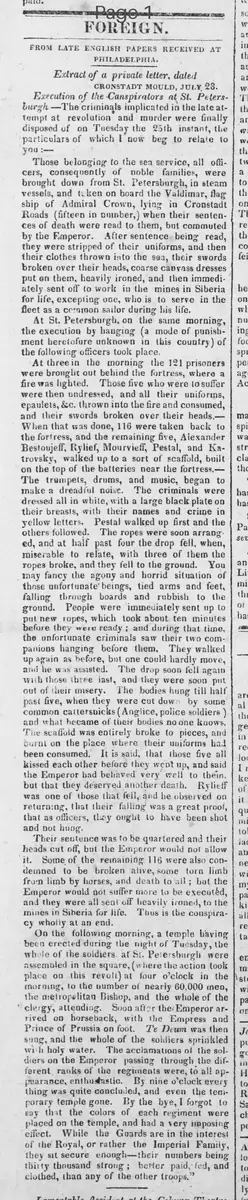
FROM LATE ENGLISH PAPERS RECEIVED AT PHILADELPHIA.
Extract of a private letter, dated CRONSTADT MOULD, JULY 28.
Execution of the Conspirators at St. Petersburgh.—The criminals implicated in the late attempt at revolution and murder were finally disposed of on Tuesday the 25th instant, the particulars of which I now beg to relate to you:——
Those belonging to the sea service, all officers, consequently of noble families, were brought down from St. Petersburgh, in steam vessels, and taken on board the Valdimar, flag ship of Admiral Crown, lying in Cronstadt Roads (fifteen in number,) when their sentences of death were read to them, but commuted by the Emperor. After sentence being read, they were stripped of their uniforms, and then their clothes thrown into the sea, their swords broken over their heads, coarse canvas dresses put on them, heavily ironed, and then immediately sent off to work in the mines in Siberia for life, excepting one, who is to serve in the fleet as a common sailor during his life.
At St. Petersburgh, on the same morning, the execution by hanging (a mode of punishment heretofore unknown in this country) of the following officers took place
At three in the morning the 121 prisoners were brought out behind the fortress, where a fire was lighted. Those five who were to suffer were then undressed, and all their uniforms, epaulets, &c. thrown into the fire and consumed, and their swords broken over their heads.—
When that was done, 116 were taken back to the fortress, and the remaining five, Alexander Bestoujeff, Rylief, Mourvieff, Pestal, and Katrovsky, walked up to a sort of scaffold, built on the top of the batteries near the fortress.—
The trumpets, drums, and music, began to make a dreadful noise. The criminals were dressed all in white, with a large black plate on their breasts, with their names and crime in yellow letters. Pestal walked up first and the others followed. The ropes were soon arranged, and at half past four the drop fell, when, miserable to relate, with three of them the ropes broke, and they fell to the ground. You may fancy the agony and horrid situation of those unfortunate beings, tied arms and feet, falling through boards and rubbish to the ground. People were immediately sent up to put new ropes, which took about ten minutes before they were ready; and during that time, the unfortunate criminals saw their two companions hanging before them. They walked up again as before, but one could hardly move, and he was assisted. The drop soon fell again with those three last, and they were soon put out of their misery. The bodies hung till half past five, when they were cut down by some common cattersnicks (Anglice, police soldiers) and what became of their bodies no one knows.
The scaffold was entirely broke to pieces, and burnt on the place where their uniforms had been consumed. It is said, that those five all kissed each other before they went up, and said the Emperor had behaved very well to them, but that they deserved another death. Rylieff was one of those that fell, and he observed on returning, that their falling was a great proof, that as officers, they ought to have been shot and not hung.
Their sentence was to be quartered and their heads cut off, but the Emperor would not allow it. Some of the remaining 116 were also condemned to be broken alive, some torn limb from limb by horses, and death to all; but the Emperor would not suffer more to be executed, and they were all sent off heavily ironed, to the mines in Siberia for life. Thus is the conspiracy wholly at an end.
On the following morning, a temple having been erected during the night of Tuesday, the whole of the soldiers at St. Petersburgh were assembled in the square, (where the action took place on this revolt) at four o'clock in the morning, to the number of nearly 60,000 men, the metropolitan Bishop, and the whole of the clergy, attending. Soon after the Emperor arrived on horseback, with the Empress and Prince of Prussia on foot. Te Deum was then sung, and the whole of the soldiers sprinkled with holy water. The acclamations of the soldiers on the Emperor passing through the different ranks of the regiments were, to all appearance, enthusiastic. By nine o'clock every thing was quite concluded, and even the temporary temple gone. By the bye, I forgot to say that the colors of each regiment were placed on the temple, and had a very imposing effect. While the Guards are in the interest of the Royal, or rather the Imperial Family, they sit secure enough—their numbers being thirty thousand strong; better paid, fed, and clothed, than any of the other troops.
What sub-type of article is it?
What keywords are associated?
What entities or persons were involved?
Where did it happen?
Foreign News Details
Primary Location
St. Petersburgh
Event Date
Tuesday The 25th Instant
Key Persons
Outcome
five officers hanged: alexander bestoujeff, rylief, mourvieff, pestal, and katrovsky; fifteen naval officers and 116 others sentenced to life in siberian mines; one to serve as common sailor; conspiracy ended.
Event Details
Conspirators in revolutionary attempt executed or punished: naval officers commuted from death to Siberian mines aboard Valdimar in Cronstadt Roads; at St. Petersburgh, five officers hanged after botched initial drop due to broken ropes; uniforms burned, swords broken; remaining prisoners to Siberia; followed by Te Deum ceremony with 60,000 troops, Emperor, Empress, Prince of Prussia, and clergy.