Thank you for visiting SNEWPapers!
Sign up free
The Virginia Gazette
Richmond, Williamsburg, Richmond County, Virginia
What is this article about?
A 1768 letter from Maryland defends Lord B— against rape accusations by Miss W—, portraying the encounter as consensual and the prosecution as a mercenary plot by her impoverished family and lover. Details a habeas corpus hearing where she initially confirmed consent but later recanted after private consultation.
Merged-components note: Direct text continuation across columns on page 1.
Clipping
OCR Quality
Full Text
MARYLAND, April 2, 1768.
Messrs. BRADFORD'S,
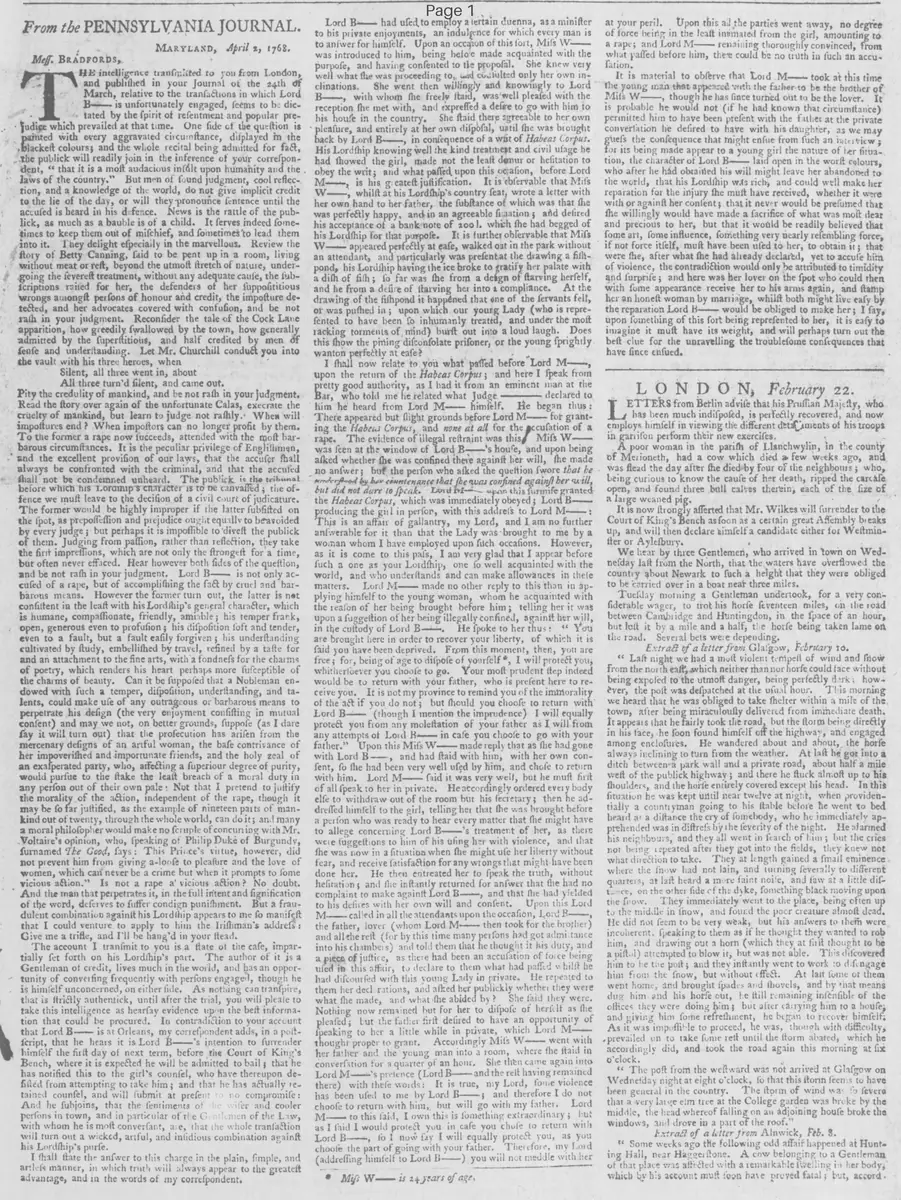
The intelligence transmitted to you from London, and published in your Journal of the 24th of March, relative to the transactions in which Lord B— is unfortunately engaged, seems to be dictated by the spirit of resentment and popular prejudice which prevailed at that time. One side of the question is painted with every aggravated circumstance, displayed in the blackest colours; and the whole recital being admitted for fact, the public will readily join in the inference of your correspondent, "that it is a most audacious insult upon humanity and the laws of the country." But men of sound judgment, cool reflection, and a knowledge of the world, do not give implicit credit to the lie of the day, nor will they pronounce sentence until the accused is heard in his defence. News is the rattle of the public, as much as a bauble is of a child. It serves indeed sometimes to keep them out of mischief, and sometimes to lead them into it. They delight especially in the marvellous. Review the story of Betty Canning, said to be pent up in a room, living without meat or rest, beyond the utmost stretch of nature, undergoing the severest treatment, without any adequate cause, the subscriptions raised for her, the defenders of her upposititious wrongs amongst persons of honour and credit, the imposture detected, and her advocates covered with confusion, and be not rash in your judgment. Reconsider the tale of the Cock Lane apparition, how greedily swallowed by the town, how generally admitted by the superstitious, and half credited by men of sense and understanding. Let Mr. Churchill conduct you into the vault with his three heroes, when
Silent, all three went in, about
All three turn'd silent, and came out.
Pity the credulity of mankind, and be not rash in your judgment. Read the story over again of the unfortunate Calas, execrate the cruelty of mankind, but learn to judge not rashly. When will impostures end? When impostors can no longer profit by them. To the former a rape now succeeds, attended with the most barbarous circumstances. It is the peculiar privilege of Englishmen, and the excellent provision of our laws, that the accuser shall always be confronted with the criminal, and that the accused shall not be condemned unheard. The public is the tribunal before which his Lordship's character is to be canvassed; the offence we must leave to the decision of a civil court of judicature. The former would be highly improper if the latter subsisted on the spot, as prepossession and prejudice ought equally to be avoided by every judge; but perhaps it is impossible to 'divest the public of them. Judging from passion, rather than reflection, they take the first impressions, which are not only the strongest for a time, but often never effaced. Hear however both sides of the question, and be not rash in your judgment. Lord B— is not only accused of a rape, but of accomplishing the fact by cruel and barbarous means. However the former turn out, the latter is not consistent in the least with his Lordship's general character, which is humane, compassionate, friendly, amiable; his temper frank, open, generous even to profusion; his disposition soft and tender, even to a fault, but a fault easily forgiven; his understanding cultivated by study, embellished by travel, refined by a taste for and an attachment to the fine arts, with a fondness for the charms of poetry, which renders his heart perhaps more susceptible of the charms of beauty. Can it be supposed that a Nobleman endowed with such a temper, disposition, understanding, and talents, could make use of any outrageous or barbarous means to perpetrate his design (the very enjoyment consisting in mutual consent) and may we not, on better grounds, suppose (as I dare say it will turn out) that the prosecution has arisen from the mercenary designs of an artful woman, the base contrivance of her impoverished and importunate friends, and the holy zeal of an exasperated party, who, affecting a superior degree of purity, would pursue to the stake the least breach of a moral duty in any person out of their own pale: Not that I pretend to justify the morality of the action, independent of the rape, though it may be so far justified, as the example of nineteen pairs of mankind out of twenty, through the whole world, can do it; and many a moral philosopher would make no scruple of concurring with Mr. Voltaire's opinion, who, speaking of Philip Duke of Burgundy, surnamed The Good, says: This Prince's virtue, however, did not prevent him from giving a loose to pleasure and the love of women, which can never be a crime but when it prompts to some vicious action. Is not a rape a vicious action? No doubt. And the man that perpetrates it, in the full intent and signification of the word, deserves to suffer condign punishment. But a fraudulent combination against his Lordship appears to me so manifest that I could venture to apply to him the Irishman's address:
Give me a trifle, and I'll be hang'd in your stead.
The account I transmit to you is a state of the case, impartially set forth on his Lordship's part. The author of it is a Gentleman of credit, lives much in the world, and has an opportunity of conversing frequently with persons engaged, though he himself is unconcerned, on either side. As nothing can transpire, that is strictly authentick, until after the trial, you will please to take this intelligence as hearsay evidence upon the best information that could be procured. "In contradiction to your account that Lord B— is at Orleans, my correspondent adds, in a postscript, that he hears it is Lord B—'s intention to surrender himself the first day of next term, before the Court of King's Bench, where it is expected he will be admitted to bail; that he has notified this to the girl's counsel, who have thereupon desisted from attempting to take him; and that he has actually retained counsel, and will submit at present to no compromise: And he subjoins, that the sentiments of the wiser and cooler persons in town, and in particular of the Gentlemen of the Law, with whom he is most conversant, are, that the whole transaction will turn out a wicked, artful, and insidious combination against his Lordship's purse."
I shall state the answer to this charge in the plain, simple, and artless manner, in which truth will always appear to the greatest advantage, and in the words of my correspondent.
Lord B— had used to employ a certain duenna, as a minister to his private enjoyments, an indulgence for which every man is to answer for himself. Upon an occasion of this sort, Miss W— was introduced to him, being before made acquainted with the purpose, and having consented to the proposal. She knew very well what she was proceeding to, was consulted only her own inclinations. She went then willingly and knowingly to Lord B—, with whom she freely stayed, was well pleased with the reception she met with, and expressed a desire to go with him to his house in the country. She stayed there agreeable to her own pleasure, and entirely at her own disposal, until she was brought back by Lord B—, in consequence of a writ of Habeas Corpus. His Lordship knowing well the kind treatment and civil usage he had showed the girl, made not the least demur or hesitation to obey the writ; and what passed upon this occasion, before Lord M—, is his greatest justification. It is observable that Miss W—, whilst at his Lordship's country seat, wrote a letter with her own hand to her father, the substance of which was that she was perfectly happy, and in an agreeable situation; and desired his acceptance of a bank note of 200 l. which she had begged of his Lordship for that purpose. It is further observable that Miss W— appeared perfectly at ease, walked out in the park without an attendant, and particularly was present at the drawing a fish-pond, his Lordship having the ice broke to gratify her palate with a dish of fish; so far was she from a design of starving herself, and he from a desire of starving her into a compliance. At the drawing of the fishpond it happened that one of the servants fell, or was pushed in; upon which our young Lady (who is represented to have been so inhumanly treated, and under the most racking torments of mind) burst out into a loud laugh. Does this show the pining disconsolate prisoner, or the young sprightly wanton perfectly at ease?
I shall now relate to you what passed before Lord M— upon the return of the Habeas Corpus; and here I speak from pretty good authority, as I had it from an eminent man at the Bar, who told me he related what Judge declared to him he heard from Lord M— himself. He began thus:
There appeared but slight grounds before Lord M— for granting the Habeas Corpus, and none at all for the accusation of a rape. The evidence of illegal restraint was this: Miss W— was seen at the window of Lord B—'s house, and upon being asked whether she was confined there against her will, she made no answer; but the person who asked the question swore that he understood by her countenance that she was confined against her will, but did not dare to speak. Lord M— upon this surmise granted the Habeas Corpus, which was immediately obeyed; Lord B— producing the girl in person, with this address to Lord M—:
This is an affair of gallantry, my Lord, and I am no further answerable for it than that the Lady was brought to me by a woman whom I have employed upon such occasions. However, as it is come to this pass, I am very glad that I appear before such a one as your Lordship, one so well acquainted with the world, and who understands and can make allowances in these matters.
Lord M— made no other reply to this than applying himself to the young woman, whom he acquainted with the reason of her being brought before him; telling her it was upon a suggestion of her being illegally confined, against her will, in the custody of Lord B—. He spoke to her thus: You are brought here in order to recover your liberty, of which it is said you have been deprived. From this moment, then, you are free; for, being of age to dispose of yourself, I will protect you, whithersoever you choose to go. Your most prudent step indeed would be to return with your father, who is present here to receive you. It is not my province to remind you of the immorality of the act if you do not; but should you choose to return with Lord B— (though I mention the imprudence) I will equally protect you from any molestation of your father as I will from any attempts of Lord B— in case you choose to go with your father. Upon this Miss W— made reply that as she had gone with Lord B—, and had stayed with him, with her own consent, so she had been very well used by him, and chose to return with him. Lord M— said it was very well, but he must first of all speak to her in private. He accordingly ordered every body else to withdraw out of the room but his secretary; then he addressed himself to the girl, telling her that she was brought before a person who was ready to hear every matter that she might have to allege concerning Lord B—'s treatment of her, as there were suggestions to him of his using her with violence, and that she was now in a situation when she might use her liberty without fear, and receive satisfaction for any wrongs that might have been done her. He then entreated her to speak the truth, without hesitation; and she instantly returned for answer that she had no complaint to make against Lord B—, and that she had yielded to his desires with her own will and consent. Upon this Lord M— called in all the attendants upon the occasion, Lord B—, the father, lover (whom Lord M— then took for the brother) and all the rest (for by this time many persons had got admittance into his chambers) and told them that he thought it his duty, and a piece of justice, as there had been an accusation of force being used in this affair, to declare to them what had passed whilst he had discoursed with this young Lady in private. He repeated to them her declarations, and asked her publicly whether they were what she made, and what she abided by? She said they were. Nothing now remained but for her to dispose of herself as she pleased; but the father first desired to have an opportunity of speaking to her a little while in private, which Lord M— thought proper to grant. Accordingly Miss W— went with her father and the young man into a room, where she stayed in conversation for a quarter of an hour. She then came again into Lord M—'s presence (Lord B— and the rest having remained there) with these words: It is true, my Lord, some violence has been used to me by Lord B—; and therefore I do not choose to return with him, but will go with my father. Lord M— to this said, I own this is something extraordinary; but as I said I would protect you in case you choose to return with Lord B—, so I now say I will equally protect you, as you choose the part of going with your father. Therefore, my Lord (addressing himself to Lord B—) you will not meddle with her at your peril. Miss W— is 24 years of age, at your peril. Upon this all the parties went away, no degree of force being in the least insinuated from the girl, amounting to a rape; and Lord M— remaining thoroughly convinced, from what passed before him, there could be no truth in such an accusation.
It is material to observe that Lord M— took at this time the young man that appeared with the father to be the brother of Miss W—, though he has since turned out to be the lover. It is probable he would not (if he had known that circumstance) permitted him to have been present with the father at the private conversation he desired to have with his daughter, as we may guess the consequence that might ensue from such an interview; for its being made appear to a young girl the nature of her situation, the character of Lord B— laid open in the worst colours, who after he had obtained his will might leave her abandoned to the world, that his Lordship was rich, and could well make her reparation for the injury she must have received, whether it were with or against her consent; that it never would be presumed that she willingly would have made a sacrifice of what was most dear and precious to her, but that it would be readily believed that some art, some influence, something very nearly resembling force, if not force itself, must have been used to her, to obtain it; that were she, after what she had already declared, yet to accuse him of violence, the contradiction would only be attributed to timidity and surprise; and here was her lover on the spot who could then with some appearance receive her to his arms again, and stamp her an honest woman by marriage, whilst both might live easy by the reparation Lord B— would be obliged to make her; I say, upon something of this sort being represented to her, it is easy to imagine it must have its weight, and will perhaps turn out the best clue for the unravelling the troublesome consequences that have since ensued.
What sub-type of article is it?
What themes does it cover?
What keywords are associated?
What entities or persons were involved?
Where did it happen?
Story Details
Key Persons
Location
London
Event Date
1768
Story Details
Lord B— is accused of raping Miss W— with barbarous means, but the defense claims it was consensual; she was introduced via a duenna, stayed willingly at his country house, wrote a happy letter to her father with a gift, and initially affirmed consent in a habeas corpus hearing before Lord M—, but recanted after private talk with father and lover, suggesting a plot for money and marriage.