Thank you for visiting SNEWPapers!
Sign up free
The Enquirer
Richmond, Henrico County, Virginia
What is this article about?
Correspondence between Secretary of War John Armstrong and Major General James Wilkinson in October 1813 at Sackett's Harbor, debating military strategy for attacking Kingston before Montreal during the War of 1812, including reasons for and against, and updates on forces and plans.
Merged-components note: Relabeled from 'foreign_news' to 'domestic_news' as the content details official U.S. military correspondence and operations during the war; merged small table components which represent dated sections of the letters within the overall correspondence.
Clipping
OCR Quality
Full Text
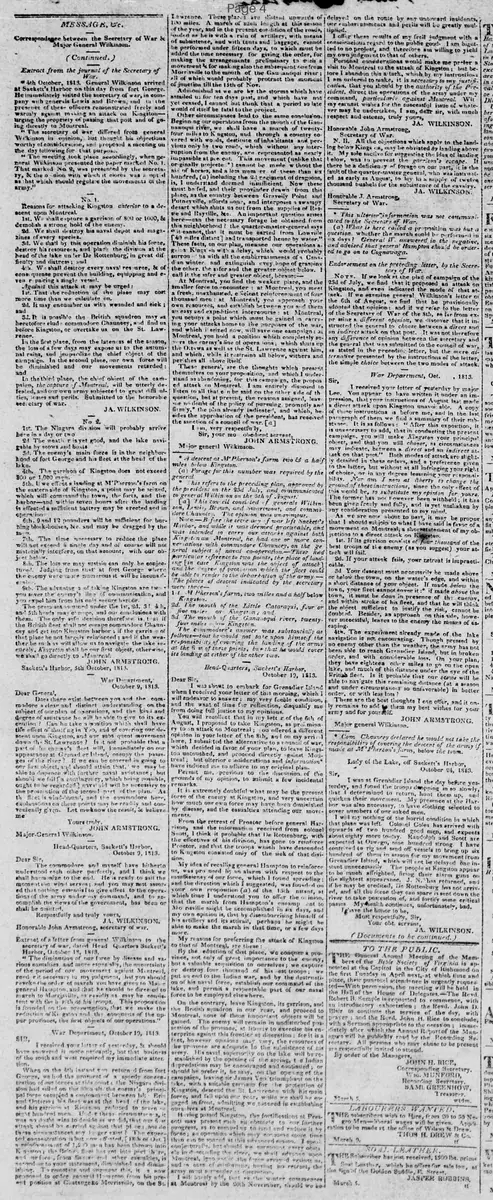
(Continued.)
Extract from the journal of the Secretary of War.
4th October, 1813. General Wilkinson arrived at Sackett's Harbor on this day from Fort George. He immediately visited the secretary of war, in company with generals Lewis and Brown, and in the presence of these officers remonstrated freely and warmly against rushing an attack on Kingston—urging the propriety of pressing that post and of going directly to Montreal.
The secretary of war differed from general Wilkinson in opinion, but thought his objections worthy of consideration, and proposed a meeting on the day following for that purpose.
The meeting took place accordingly, when general Wilkinson presented the paper marked No. 1. That marked No. 2, was presented by the secretary, & the opinion with which it closes was adopted as that which should regulate the movements of the army.
No. 1.
Reasons for attacking Kingston previous to a descent upon Montreal.
1st. We shall capture a garrison of 800 or 1000, & demolish a strong hold of the enemy.
2d. We shall destroy his naval depot and magazines of every species.
3d. We shall by this operation diminish his force, destroy his resources, and place the division at the head of the lake under DeRottenburg; in great difficulty and distress; and
4th. We shall destroy every naval resource, & of consequence prevent the building, equipping and even repairing a single vessel.
Against this attack it may be urged:
1st. That the reduction of the place may consume more time than we calculate on.
2d. It may encumber us with wounded and sick; and
3d. It is possible the British squadron may as heretofore elude commodore Chauncey, and find us before Kingston, or overtake us on the St. Lawrence.
In the first place, from the lateness of the season the loss of a few days may expose us to the autumnal rains, and jeopardize the chief object of the campaign. In the second place, our own force will be diminished and our movements retarded; and
In the third place, the chief object of the campaign, the capture of Montreal, will be utterly defeated, and our own army subjected to great difficulties, losses and perils. Submitted to the honorable secretary of war.
JA. WILKINSON.
No. 2.
1st. The Niagara division will probably arrive here in a day or two
2d. The weather is yet good, and the lake navigable by sloops and boats
3d. The enemy's main force is in the neighborhood of Fort George and his fleet at the head of the lake.
4th. The garrison of Kingston does not exceed 800 or 1000 men.
5th. If we effect a landing at M'Pherson's farm on the eastern side of Kingston, a point may be seized which will command the town, the forts, and the harbor—and within seven hours after the landing is effected a sufficient battery may be erected and in operation—
6th. 9 and 12 pounders will be sufficient for bursting block-houses, &c. and may be dragged by the men.
7th. The time necessary to reduce the place will not exceed a single day and of course will not materially interfere, on that account, with our object below.
8th. The loss we may sustain can only be conjectured. Judging from that at Fort George where the enemy were more numerous it will be inconsiderable.
9th. The advantages of taking Kingston are that you sever the enemy's lines of communication, and you expel him from his only secure harbor.
The premises argued under the 1st. 2d. 3d. 4th. and 5th heads may be granted, and our conclusions with them. The only safe decision therefore is, that if the British fleet shall not escape commodore Chauncey and get into Kingston harbor; if the garrison of that place be not largely reinforced: and if the weather be such as will allow us to navigate the lake securely. Kingston shall be our first object, otherwise, we shall go directly to Montreal.
JOHN ARMSTRONG.
Sackett's Harbor, 5th October, 1813.
War Department,
October 9, 1813.
Dear General
Does there exist between you and the commodore a clear and distinct understanding on the subject of our plan of operations, and the kind and degree of assistance he will be able to give to its execution? Can he take a position which shall have the effect of shutting in Yeo, and of covering our descent upon Kingston, and our subsequent movement down the St. Lawrence? Is it not probable that a part of the enemy's fleet will, immediately on our appearance at Grenadier Island, occupy the passes of that river? If we can be covered in going to our first object, and should attain that, we may be able to dispense with farther naval assistance; but should we fail (a contingency, which being possible, ought to be regarded) naval aid will be necessary to the prosecution of the second part of the plan. As the fleet is wind-bound, and the commodore here, explanations on these points may be readily and conveniently given. Let me know the result, & believe
Yours truly,
JOHN ARMSTRONG.
Major-General Wilkinson.
Head-Quarters, Sackett's Harbor,
October 9, 1813.
Dear Sir,
The commodore and myself have hitherto understood each other perfectly, and I think we shall harmonize to the end. He is ready to sail the moment the wind serves; and you may rest assured that nothing essential to give effect to the operations of the army under my command, and to accomplish the views of the government, has been or shall be omitted.
Respectfully and truly yours,
JA. WILKINSON.
Honorable John Armstrong, secretary of war.
Extract of a letter from general Wilkinson to the secretary of war, dated Head Quarters Sackett's Harbor, October 18, 1813.
The diminution of our force by disease and various casualties, and more especially, the uncertainty of the period of our movement against Montreal, render it necessary in my judgment, that you should revoke the order of march you have given to Major general Hampton, and that he should be directed to march to Morrisville, as rapidly as may be consistent with the health of his troops. This proposition is founded on the presumption, that we make the reduction of Kingston and the conquest of the upper provinces, the first objects of our operations.
War Department, October 19, 1813.
Sir,
I received your letter of yesterday, & should have answered it more promptly, but that business of the south and west required my immediate attention.
When on the 4th instant you returned from Fort George, we had the prospect of a speedy concentration of our forces at this point; the Niagara division had sailed on the 30th ult. the enemy's principal force occupied a cantonment between Lake Erie and Ontario: his fleet was at the head of the lake, and his garrison at Kingston reduced to seven or eight hundred men. Under these circumstances, it was no doubt wise to decide as we did, that our first attack should be carried against that place: but do those circumstances any longer exist? The expected concentration is but now effected, [15th of Oct.] a reinforcement of 1500 men has been thrown into Kingston: the British fleet has got into port there, and our force, from sickness and other casualties, is according to your statement, diminished and diminishing. To reinstate and augment this, it was now proposed to order general Hampton from his present position at Chateaugay to Morrisville, on the St.
| Dear Sir, | October 13, 1813. |
| Sir, | October 24, 1913. |
What sub-type of article is it?
What keywords are associated?
What entities or persons were involved?
Where did it happen?
Domestic News Details
Primary Location
Sackett's Harbor
Event Date
October 1813
Key Persons
Outcome
strategic decision to attack kingston first if british fleet does not escape commodore chauncey, garrison not reinforced, and weather allows; otherwise proceed directly to montreal. forces diminished by disease and casualties; proposal to redirect hampton to morrisville.
Event Details
Extract from Secretary of War's journal on October 4, 1813, detailing Wilkinson's arrival and remonstrance against attacking Kingston, followed by meeting on October 5 with presented papers No. 1 (Wilkinson's reasons for attacking Kingston) and No. 2 (Armstrong's counterarguments and conditional plan). Letters exchanged on October 9 confirming coordination with Commodore; October 18 Wilkinson suggests revoking Hampton's march order; October 19 Armstrong responds assessing changed circumstances including reinforcements to Kingston.