Thank you for visiting SNEWPapers!
Sign up free
Daily Kennebec Journal
Augusta, Kennebec County, Maine
What is this article about?
A Constantinople correspondent describes the decaying Turkish cemeteries near the city, featuring chaotic gravestones in kite shapes adorned with fezzes or peaks, colorful but fading decorations, and overall neglect with broken walls and dried water holes.
Clipping
OCR Quality
Full Text
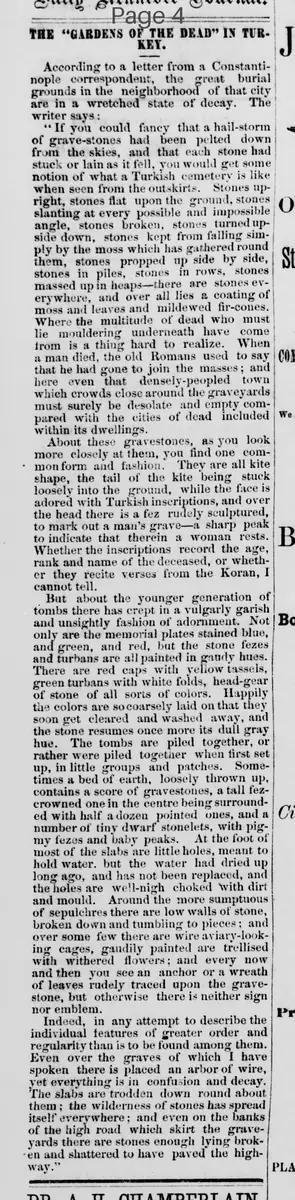
THE "GARDENS OF THE DEAD" IN TURKEY.
According to a letter from a Constantinople correspondent, the great burial grounds in the neighborhood of that city are in a wretched state of decay. The writer says:
"If you could fancy that a hail-storm of grave-stones had been pelted down from the skies, and that each stone had stuck or lain as it fell, you would get some notion of what a Turkish cemetery is like when seen from the outskirts. Stones upright, stones flat upon the ground, stones slanting at every possible and impossible angle, stones broken, stones turned upside down, stones kept from falling simply by the moss which has gathered round them, stones propped up side by side, stones in piles, stones in rows, stones massed up in heaps--there are stones everywhere, and over all lies a coating of moss and leaves and mildewed fir-cones.
Where the multitude of dead who must lie mouldering underneath have come from is a thing hard to realize. When a man died, the old Romans used to say that he had gone to join the masses; and here even that densely-peopled town which crowds close around the graveyards must surely be desolate and empty compared with the cities of dead included within its dwellings.
About these gravestones, as you look more closely at them, you find one common form and fashion. They are all kite shape, the tail of the kite being stuck loosely into the ground, while the face is adorned with Turkish inscriptions, and over the head there is a fez rudely sculptured, to mark out a man's grave--a sharp peak to indicate that therein a woman rests.
Whether the inscriptions record the age, rank and name of the deceased, or whether they recite verses from the Koran, I cannot tell.
But about the younger generation of tombs there has crept in a vulgarly garish and unsightly fashion of adornment. Not only are the memorial plates stained blue and green and red, but the stone fezes and turbans are all painted in gaudy hues. There are red caps with yellow tassels, green turbans with white folds, head-gear of stone of all sorts of colors. Happily the colors are so coarsely laid on that they soon get cleared and washed away, and the stone resumes once more its dull gray hue.
The tombs are piled together, or rather were piled together when first set up, in little groups and patches. Sometimes a bed of earth, loosely thrown up, contains a score of gravestones, a tall fez-crowned one in the centre being surrounded with half a dozen pointed ones, and a number of tiny dwarf stonelets, with pigmy fezes and baby peaks.
At the foot of most of the slabs are little holes, meant to hold water, but the water had dried up long ago, and has not been replaced, and the holes are well-nigh choked with dirt and mould.
Around the more sumptuous of sepulchres there are low walls of stone, broken down and tumbling to pieces; and over some few there are wire aviary-looking cages, gaudily painted or trellised with withered flowers; and every now and then you see an anchor or a wreath of leaves rudely traced upon the gravestone, but otherwise there is neither sign nor emblem.
Indeed, in any attempt to describe the individual features of greater order and regularity than is to be found among them. Even over the graves of which I have spoken there is placed an arbor of wire, yet everything is in confusion and decay.
The slabs are trodden down round about them: the wilderness of stones has spread itself everywhere: and even on the banks of the high road which skirt the graveyards there are stones enough lying broken and shattered to have paved the high way."
What sub-type of article is it?
What keywords are associated?
Where did it happen?
Foreign News Details
Primary Location
Constantinople
Event Details
The great burial grounds near Constantinople are in wretched decay, resembling a hail-storm of gravestones at various angles, covered in moss and leaves. Stones are kite-shaped with Turkish inscriptions, fezzes for men and peaks for women. Younger tombs have garish painted decorations that fade. Tombs are grouped with central tall stones surrounded by smaller ones; water holes are dry and choked. Sumptuous sepulchres have broken walls and wire arbors; the area is confused and trodden down.