Thank you for visiting SNEWPapers!
Sign up free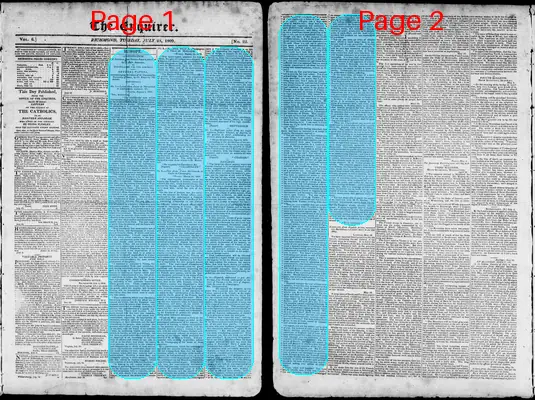
The Enquirer
Richmond, Henrico County, Virginia
What is this article about?
Diplomatic correspondence between French and Austrian officials from August 1808 to April 1809, detailing escalating tensions, mutual assurances of peace, military preparations, and culminating in Austria's declaration of war against France.
Merged-components note: Sequential components form a single continued article on European diplomatic correspondence and the Austria-France war, spanning pages 1-2.
Clippings
1 of 2
OCR Quality
Full Text
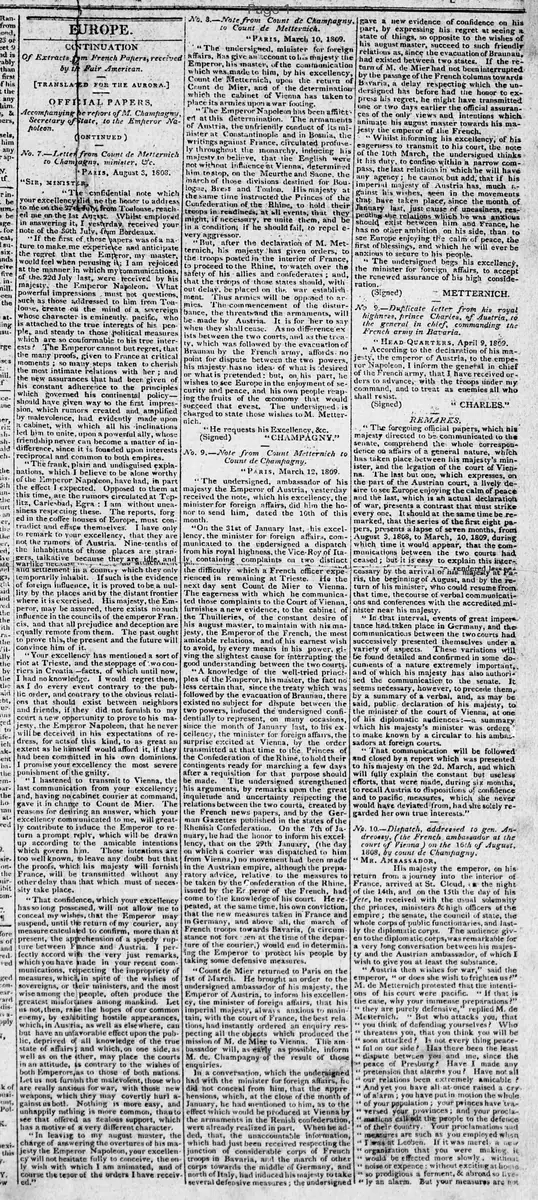
CONTINUATION
Of Extracts from French Papers, received
by the Fair American.
[TRANSLATED FOR THE AURORA.]
OFFICIAL PAPERS,
Accompanying the report of M. Champagny,
Secretary of State, to the Emperor Na-
poleon.
(CONTINUED)
No. 7.--Letter from Count de Metternich
to Champagny, minister, &c.
PARIS, August 3, 1808.
"SIR, MINISTER,
"The confidential note which
your excellency did me the honor to address
to me on the 26th July from Toulouse, reach-
ed me on the 1st August. Whilst employed
in answering it, I yesterday received your
note of the 20th July, from Bordeaux.
If the first of those papers was of a na-
ture to make me experience and anticipate
the regret that the Emperor, my master,
would feel when perusing it; I am rejoiced
at the manner in which my communications
of the 22d July last, were received by his
majesty, the Emperor Napoleon. What
powerful impressions, must not questions,
such as those addressed to him from Tou-
louse, create on the mind of a sovereign
whose character is eminently pacific, who
is attached to the true interests of his peo-
ple, and steady to those political measures
which are so conformable to his true inter-
ests? The Emperor cannot but regret, that
the many proofs, given to France at critical
moments; so many steps taken to cherish
the most intimate relations with her; and
the new assurances that had been given of
his constant adherence to the principles
which governed his continental policy--
should have given way to the first impres-
sion, which rumors created and amplified
by malevolence, had evidently made upon
a cabinet, with which all his inclinations
led him to unite, upon a powerful ally, whose
friendship never can become a matter of in-
difference, since it is founded upon interests
reciprocal and common to both empires.
"The frank, plain and undisguised expla-
nations, which I believe to be alone worthy
of the Emperor Napoleon, have had, in part
the effect I expected. Opposed to them at
this time, are the rumors circulated at Top-
litz, Carlsbad, Egra: I am without unea-
siness respecting these. The reports, forg-
ed in the coffee houses of Europe, must con-
tradict and efface themselves. I have only
to remark to your excellency, that they are
not the rumors of Austria. Nine-tenths of
the inhabitants of those places are stran-
and settieient in a country which they only
temporarily inhabit. If such is the evidence
of foreign influence, it is proved to be a nul-
lity by the places and by the distant frontier
where it is exercised. His majesty, the Em-
peror, may be assured, there exists no such
influence in the councils of the emperor Fran-
cis, and that all prejudice and deception are
equally remote from them. The past ought
to prove this, the present and the future will
convince him of it.
"Your excellency has mentioned a sort of
riot at Trieste, and the stoppage of two cou-
riers in Croatia--facts, of which until now,
I had no knowledge. I would regret them,
as I do every event contrary to the pub-
lic order, and contrary to the obvious relati-
ons that should exist between neighbors
and friends, if they did not furnish to my
court a new opportunity to prove to his ma-
jesty, the Emperor Napoleon, that he never
will be deceived in his expectations of re-
dress, for acts of this kind, to as great an
extent as he himself would afford it, if they
had been committed in his own dominions.
I promise your excellency the most severe
punishment of the guilty.
"I hastened to transmit to Vienna, the
last communication from your excellency;
and, having no cabinet courier at command,
gave it in charge to Count de Mier. The
reasons for desiring an answer, which your
excellency communicated to me, will great-
ly contribute to induce the Emperor to re-
turn a prompt reply, which will be drawn
up according to the amicable intentions
which govern him. Those intentions are
too well known, to leave any doubt but that
the proofs, which his majesty will furnish
France, will be transmitted without any
other delay than that which must of neces-
sity take place.
"That confidence, which your excellency
has so long possessed, will not allow me to
conceal my wishes, that the Emperor may
suspend, until the return of my courier, any
measure calculated to confirm, more than at
present, the apprehension of a speedy rup-
ture between France and Austria. I per-
fectly accord with the very just remarks,
which you have made in your recent com.
munications, respecting the impropriety of
measures, which, in spite of the wishes of
sovereigns, or their ministers, and the most
wise among the people, often produce the
greatest misfortunes among mankind. Let
us not, then, raise the hopes of our common
enemy, by exhibiting hostile appearances,
which, in Austria, as well as elsewhere, can
but have an unfavorable effect upon the pub-
lic, deprived of all knowledge of the true
state of affairs; and which, on one side, as
well as on the other, may place the courts
in an attitude, as contrary to the wishes of
both Emperors as to those of both nations.
Let us not furnish the malevolent, those who
are really anxious for war, with those new
weapons, which they may covertly hurl a-
gainst us both. Nothing is more easy, and
unhappily nothing is more common, than to
see that offered as zealous support, which
has a motive of a very different character.
"In leaving to my august master, the
charge of answering the overtures of his ma-
jesty the Emperor Napoleon, your excellen-
cy will not hesitate fully to conceive, the on-
ly wish with which I am animated, and of
course the tenor of the orders I have receiv-
ed."
No. 8. Note from Count de Champagny
Count de Metternich.
"PARIS, March 10, 1809.
"The undersigned, minister for foreign
affairs, has given an account to his majesty the
Emperor, his master, of the communication
which was made to him, by his excellency,
Count de Metternich, upon the return of
Count de Mier, and of the determination
which the cabinet of Vienna has taken to
place its armies upon a war footing.
"The Emperor Napoleon has been afflicted
at this determination. The armaments
of Austria, the unfriendly conduct of its mi-
nister at Constantinople and in Bosnia, the
writings against France, circulated profuse-
ly throughout the monarchy, inducing his
majesty to believe, that the English were
not without influence at Vienna, determined
him to stop, on the Meurthe and Saone, the
march of those divisions destined for Bou-
logne, Brest and Toulon. His majesty at
the same time instructed the Princes of the
Confederation of the Rhine, to hold their
troops in readiness, at all events, that they
might, if necessary, re-unite them, and be
in a condition, if he should fail, to repel e-
very aggressor.
"But, after the declaration of M. Met-
ternich, his majesty has given orders to
the troops posted in the interior of France,
to proceed to the Rhine, to watch over the
safety of his allies and confederates; and,
that the troops of those states should, with-
out delay, be placed on the war establish-
ment. Thus armies will be opposed to ar-
mies. The commencement of the distur-
bance, the threats and the armaments, will
be made by Austria. It is for her to say
when they shall cease. As no difference ex-
ists between the two courts, and as the trea-
ty, which was followed by the evacuation of
Braunau by the French army, affords no
point for dispute between the two powers,
his majesty has no idea of what is desired
or what is pretended: but, on his part, he
wishes to see Europe in the enjoyment of se-
curity and peace, and his own people reap-
ing the fruits of the economy that would
succeed that event. The undersigned is
charged to state those wishes to M. Metter-
nich.
"He requests his Excellency, &c.
(Signed)
"CHAMPAGNY."
No. 9.--Note from Count Metternich to
Count de Champagny:
"PARIS, March 12, 1809.
"The undersigned, ambassador of his
majesty the Emperor of Austria, yesterday
received the note, which his excellency, the
minister for foreign affairs, did him the ho-
nor to send him, dated the 10th of this
month.
"On the 31st of January last, his excel-
lency, the minister for foreign affairs, com-
municated to the undersigned a dispatch
from his royal highness, the Vice-Roy of Ita-
ly, containing complaints on two distinct
points: the one relative to the treatment of
French subjects at Trieste, and the difficul-
ty which a French officer expe-
rienced in remaining at Trieste. He the
next day sent Count de Mier to Vienna.
The eagerness with which he communica-
ted those complaints to the Court of Vienna,
furnishes a new evidence, to the cabinet of
the Thuilleries, of the constant desire of
his august master, to maintain with his ma-
jesty, the Emperor of the French, the most
amicable relations, and of his earnest wish
to avoid, by every means in his power, gi-
ving the slightest cause for interrupting the
good understanding between the two courts.
"A knowledge of the well-tried princi-
ples of the Emperor, his master, the fact no
less certain that, since the treaty which was
followed by the evacuation of Braunau, there
existed no subject for dispute between the
two powers, induced the undersigned confi-
dentially to represent, on many occasions,
since the month of January last, to his ex.
cellency, the minister for foreign affairs, the
surprise excited at Vienna, by the order
transmitted at that time to the Princes of
the Confederation of the Rhine, to hold their
contingents ready for marching a few days
after a requisition for that purpose should
be made. The undersigned strengthened
his arguments, by remarks upon the great
inquietude and uncertainty respecting the
relations between the two courts, created by
the French newspapers, and by the Ger-
man Gazettes published in the states of the
Rhenish Confederation. On the 7th of Ja-
uary, he had the honor to inform his excel-
lency, that on the 29th January, (the day
on which a courier was dispatched to him
from Vienna,) no movement had been made
in the Austrian empire, although the prepa-
ratory advice, relative to the measures to
be taken by the Confederation of the Rhine,
issued by the Emperor of the French, had
come to the knowledge of his court. He re-
peated, at the same time, his own conviction,
that the new measures taken in France and
in Germany, and above all, the march of
French troops towards Bavaria, (a circum-
stance not foreseen at the time of the depar-
ture of the courier,) would end in determin-
ing the Emperor to protect his people by
taking some defensive measures.
"Count de Mier returned to Paris on the
1st of March. He brought an order to the
undersigned ambassador of his majesty, the
Emperor of Austria, to inform his excellen-
cy, the minister of foreign affairs, that his
imperial majesty, always anxious to main-
tain, with the court of France, the best rela-
tions, had instantly ordered an enquiry res-
pecting all the objects which produced the
mission of M. de Mier to Vienna. The am-
bassador will, as early as possible, inform
M. de Champagny of the result of those
enquiries.
In a conversation, which the undersigned
had with the minister for foreign affairs, he
did not conceal from him, that the appre-
hensions, which, at the close of the month of
January, he had mentioned to him, as to the
effect which would be produced at Vienna by
the armaments in the Rhenish confederation,
were already realized in part. When he ad-
ded, that, the unaccountable information,
which had just been received respecting the
junction of considerable corps of French
troops in Bavaria, and the march of other
corps towards the middle of Germany, and
north of Italy, had induced his majesty to take
several defensive measures; the undersigned
gave a new evidence of confidence on his
part, by expressing his regret at seeing a
state of things, so opposite to the wishes of
his august master, succeed to such friendly
relations as, since the evacuation of Braunau,
had existed between two states. If the re-
turn of M. de Mier had not been interrupted
by the passage of the French columns towards
Bavaria, a delay respecting which the un-
derigned has before had the honor to ex-
press his regret, he might have transmitted
one or two days earlier the official assuran-
ces of the only views and intentions which
animate his august master towards his ma-
jesty the emperor of the French.
"Whilst informing his excellency, of his
eagerness to transmit to his court, the note
of the 10th March, the undersigned thinks
it his duty, to confine within a narrow com-
pass, the last relations in which he will have
any agency; he cannot but add, that if his
imperial majesty of Austria has, much a-
gainst his wishes, seen in the movements
that have taken place, since the month of
January last, just cause of uneasiness, res-
pecting the relations which he was anxious
should exist between him and France, he
has no other ambition on his side, than to
see Europe enjoying the calm of peace, the
first of blessings, and which he will ever be
anxious to secure to his people.
"The undersigned begs his excellency,
the minister for foreign affairs, to accept
the renewed assurance of his high conside-
ration.
(Signed)
METTERNICH.
No. 9. Duplicate letter from his royal
highness, prince Charles, of Austria, to
the general in chief, commanding the
French army in Bavaria.
"Head-Quarters, April 9, 1809.
"According to the declaration of his ma-
jesty, the emperor of Austria, to the empe-
ror Napoleon, I inform the general in chief
of the French army, that I have received or-
ders to advance, with the troops under my
command, and to treat as enemies all who
shall resist.
(Signed)
CHARLES."
REMARKS.
"The foregoing official papers, which his
majesty directed to be communicated to the
senate, comprehend the whole correspon-
dence on affairs of a general nature, which
has taken place between his majesty's min-
ister, and the legation of the court of Vi-
enna. The last but one, which expresses, on
the part of the Austrian court, a lively de-
sire to see Europe enjoying the calm of peace
and the last, which is an actual declaration
of war, presents a contrast that must strike
every one. It should at the same time be re-
marked, that the series of the first eight pa-
pers, presents a lapse of seven months, from
August 3, 1808, to March, 10, 1809, during
which time it would appear, that the com-
munications between the two courts had
ceased; but it is easy to explain this inter-
val by the arrival of his majesty at Pa-
ris, the beginning of August, and by the re-
turn of his minister, who could resume from
that time, the course of verbal communicati-
ons and conferences with the accredited mi-
nister near his majesty.
"In that interval, events of great impor-
tance had taken place in Germany, and the
communications between the two courts had
successively presented themselves under a
variety of aspects. These variations will
be found detailed and confirmed in some do-
cuments of a nature extremely important
and of which his majesty has also authori-
zed the communication to the senate. It
seems necessary, however, to precede them,
by a summary of a verbal, and, as may be
said, public, declaration of his majesty, to
the minister of the court of Vienna, at one
of his diplomatic audiences:--a summary
which his majesty's minister was ordered
to make known by a circular to his ambassa-
dors at foreign courts.
"That communication will be followed
and closed by a report which was presented
to his majesty on the 2d March, and which
will fully explain the constant but useless
efforts, that were made, during six months,
to recall Austria to dispositions of confidence
and to pacific measures, which she never
would have deviated from, had she solely re-
garded her own true interests."
No. 10.--Dispatch, addressed to gen. An-
dreossy, (the French ambassador at the
court of Vienna) on the 16th of August,
1808, by count de Champagny.
"MR. AMBASSADOR,
His majesty the emperor, on his
return from a journey into the interior of
France, arrived at St. Cloud, the night
of the 14th, and on the 15th the day of his
fete, he received with the usual solemnity
the princes, ministers & high officers of the
empire; the senate, the council of state, the
whole corps of public functionaries, and last-
ly the diplomatic corps. The audience giv-
en to the diplomatic corps, was remarkable for
a very long conversation between his majes-
ty and the Austrian ambassador, of which I
wish to give you at least the substance.
"Austria then wishes for war," said the
emperor, "or does she wish to frighten us?"
M. de Metternich protested that the intenti-
ons of his court were pacific. "If that is
the case, why your immense preparations?"
"They are purely defensive," replied M. de
Metternich. "But who attacks you, that
"you think of defending yourselves? Who
"threatens you, that you think you will be
"soon attacked? Is not every thing peace-
"ful on our side? Has there been the least
"dispute between you and me, since the
"peace of Presburg? Have I made any
"pretension that alarms you? Have not all
"our relations been extremely amicable?
"And yet you have all at once raised a cry
"of alarm; you have put in motion the whole
"of your population; your princes have tra-
"versed your provinces; and your procla-
"mations call out the people to the defence
"of their country. Your proclamations and
"measures are such as you employed when
"I was at Leoben. If it was merely a new
"organization that you were making, it
"would be effected more slowly, without
"noise or expense; without exciting at home
"so prodigious a ferment, & abroad so live-
"ly an alarm. But your measures are not
defensive; they are evidently hostile."
M. de Metternich replied, that the court of
Vienna had been alarmed by the movements
of the French troops in Germany, and by the
military preparations in the Rhenish confede-
ration. "But these movements," said the
emperor, "have no other object than to fa-
cilitate the passage of my troops to Spain,
and to enable me to chastise the insolence
of the English, who have just destroyed my
fleet at Lisbon."
"The ambassador then endeavored to jus-
tify the conduct of his court, by alleging
that the emperor of Austria was obliged to
place himself in a state of defence, in order
to protect his states against the enterprises
of the French. The emperor replied, with
some warmth, that he had no intention to
attack Austria; that he desired only peace
and tranquillity; that he was the ally of the
emperor of Austria, and that he would al-
ways be ready to prove his friendship to
him. He added, that if Austria persisted in
her warlike preparations, he would be com-
pelled to take measures to counteract them;
that he would assemble his troops on the
Rhine, and that he would call upon the con-
federates to arm. "But," said he, "I hope
that these explanations will suffice to dis-
sipate the mistrust of your court, and that
we shall continue to live in peace and good
intelligence."
M. de Metternich assured the emperor,
that his court had no hostile intentions; that
its only object was to place itself in a state
of defence, in case of any sudden attack; and
that it was ready to give every explanation
that could tend to remove the emperor's
suspicions. The emperor replied, that he
was satisfied with these assurances, and that
he hoped that the two courts would continue
to maintain the most friendly relations.
The conversation then turned upon the
affairs of Spain, and the emperor expressed
his astonishment at the conduct of the court
of Vienna, in recognizing the council of re-
gency at Seville. M. de Metternich replied,
that his court had been compelled to take
this step, in order to protect the interests of
its subjects in Spain; but that it had no in-
tention to interfere in the internal affairs of
that country. The emperor observed, that
this recognition was an act of hostility to-
wards France, and that it could only tend to
embarrass the negotiations which he was
carrying on with the Spanish insurgents.
The ambassador endeavored to justify the
conduct of his court, but the emperor cut
him short, by saying, that he would not suf-
fer any interference in the affairs of Spain;
that he would treat with the Spaniards as
he thought proper; and that he would pun-
ish all those who should dare to oppose his
will.
The conversation lasted more than an
hour, and was marked by great animation
on both sides. The emperor was evidently
much irritated against the court of Vienna,
and expressed himself with great freedom
and energy. M. de Metternich, on his part,
maintained the utmost calmness and modera-
tion, and endeavored, by the most respectful
and conciliatory language, to appease the
emperor's irritation. The result of the con-
versation was, that the emperor authorized
me to assure the court of Vienna, that he
had no intention to attack it; that his only
object was to chastise the English and the
Spanish insurgents; and that he was ready
to give every explanation that could tend to
remove the mistrust of the emperor of Aus-
tria. At the same time, he ordered me to
request the court of Vienna to suspend its
military preparations, and to give orders to
its ministers at foreign courts, to abstain
from all interference in the affairs of Spain.
I have the honor to be, &c.
CHAMPAGNY.
St. Cloud, August 16, 1808.
"Purely defensive: you have added to each
of your regiments a force of 1300 men;
your militia will give you a disposable
force of 400,000 men; those men will be
drafted into regiments and exercised, a
part of them is now clothed; your fortres-
ses are provisioned; and lastly, what is
to me a proof that you are preparing to be-
gin a war, you have purchased horses. al-
though you have at this moment 14,000
artillery horses; in the midst of peace. we
do not incur such enormous expenses.—
To men whom you call out to exercise,
you grant a pecuniary indemnification;
you have clothed a part, and you have
furnished them with arms; nothing of all
this could have been done but at very
great expense, and yet you all agree that
your finances are in a miserable condition;
your exchange, before so low, is now low-
er; and your commercial operations have
suffered—can it be supposed that you would
expose yourselves to all those inconveni-
ences and embarrassments, without an ob-
ject?
Do not say that you have been com-
pelled to provide for your safety. You must
acknowledge that all our relations have
been amicable; you know, that I ask no-
thing from you, that I make no claim to
any thing you have, and also that I regard
the preservation of your power in its ac-
tual condition as useful to the system of
Europe, and to the interest of France.—
I have encamped my troops, to keep them
in vigor and exercise; they cannot be en-
camped in France because it is too expen-
sive there, they are encamped in foreign
countries, where the expense is less. My
camps have been fixed in different direc-
tions; none of them threatened you. I
would not have encamped, had I any hos-
tile views towards you. In the excess of
my confidence and security, I dismantled
the fortresses of Silesia. Most certainly,
I would not have had camps, if I had any
idea that they could alarm you—a single
word from you would have dissuaded me
from forming them. I am ready to break
them up, if you think that is necessary to
your safety."
M. de Metternich having remarked, that
there had been no movements of troops in
Austria, the emperor replied:——
"You are mistaken: you have withdrawn
your troops from quarters, where they
were maintained at less expense; you have
concentrated them upon Cracovia; you
have placed yourselves in a condition to
menace Silesia at pleasure; your army
is united, and it has taken a military po-
sition. Yet what do you expect? Do you
think to frighten me? You will not be a-
ble to do it. Do you imagine circumstan-
ces are favorable for you? If you do, you
are deceived. My politics are open and
frank, because they are loyal, and because
I possess the love of my soldiers. I will
withdraw the 100,000 men from Germa-
ny, and send them into Spain, yet I will
be a match for you. Arm, and I will arm,
and if necessary raise 200,000 men more.
You have no continental power to assist
you: I would almost dare to tell you, in
the name of the emperor of Russia, that
he will require you to remain at peace.
He is already not well pleased at your re-
relations with the Servians; he has as much
reason to suppose himself menaced by your
preparations, as I have to suppose myself
threatened; and he suspects that you have
views upon Turkey. You may suppose
that I also have views on Turkey; I de-
clare that it is unfounded and that I want
nothing from Turkey, nothing from Aus-
tria; yet your emperor does not wish for
war—I believe him; I confide in the pro-
mise he gave me at our interview. He can
have no resentment against me. I was in
possession of his capital and of the greater
part of his provinces; nearly all was res-
tored to him—I kept Venice solely to pre-
vent any cause for discord, any pretext for
war. Do you think that a conqueror of the
French armies, and in possession of Paris,
would have acted with so much modera-
tion? No, your emperor does not desire
war; your ministry does not wish for it;
the most distinguished men of your monar-
chy do not desire it; and yet the move-
ments that you have made have been such,
that war will follow, in spite of you and me.
You have created a belief that I demanded
some of your provinces; and your people,
from a national and generous impulse, that
I am far from blaming, are indignant; their
indignation is carried to excess, and they
run to arms. You issued a proclamation
forbidding your people to talk of war, but
your proclamation was vague; it was con-
sidered as a measure of policy; and as
your measures were in opposition to your
proclamation, your measures have been re-
garded, & not your proclamation. Thence
the insult given to my consul at Trieste, by
your new militia; thence the assassination
of three of my couriers proceeding to Dal-
matia. Should there be any more such in-
sults, war will be inevitable; for we may be
killed, but will not be insulted with impu-
nity.
"England sustains the war without inter-
mission; it was thus they provoked the war
that followed the insult given to general
Bernadotte. Such intrigues will carry you
where you do not wish to go. The En-
glish and their partisans dictate all those
false measures, they already rejoice in the
expectation of seeing Europe again in
flames; they will gain fifty per cent. by
the impulse you are creating in Europe. it
is them that I accuse; it is owing to them
that a Frenchman cannot go to the waters
of Bohemia without being insulted. Why
do you suffer this? Have you any exam-
ples of it in France? Are not your consuls
and travellers hospitably received and res-
pected in France? The most trifling insult
given to one of them, would be instantly
and severely punished.
"I repeat, you are led astray, and in spite
of you, the ferment of your people impru-
dently excited, and the intrigues of the
partisans of England and of some mem-
bers of the equestrian order (who have car-
ried amongst you the bitterness of their
regrets) will drag you into a war. The em-
peror of Russia, perhaps, will oppose it,
and will declare to you in a firm manner,
that he does not approve of the war, and
that he will be against you. But if to his
intervention Europe will owe the continua-
tion of peace, you can expect no gratitude
from Europe or from me. I cannot regard
you as my friends, and shall consider myself
entirely at liberty to make such arrange-
ments as the state of Europe may require,
without asking your advice or concur-
rence.
"Then, what will happen? You have
levied 400,000 men, I will levy 200,000;
the confederation, which had discharged
its troops, will reorganize them and make
new levies; Germany, which is just be-
ginning to breathe, after so many ruinous
wars, will see all her wounds opened anew;
I will establish the fortresses of Silesia,
instead of evacuating that province and the
Prussian states, as I intended; Europe
will be aroused; armies will be in the pre-
sence of each other, and the most trivial
incident will produce the commencement
of hostilities.
"You say you have an army of 400,000
men, which is much larger than at any
former time of your monarchy. You wish
to double it; to follow your example, it
will be very soon necessary to arm even
the women. In such a state of things,
when every bow shall have been bent, war
will become necessary to produce the ca-
tastrophe. It is thus, that, in the physical
world, the state of agitation into which na-
ture is thrown at the approach of a hurri-
cane, makes it desirable that the storm
should increase, that the heavens and the
earth may the sooner exhibit a sweet se-
renity. Violent pain, but of short duration,
is preferable to tedious suffering.
"In the mean time, all hopes of a mari-
time peace vanish; the strong measures
taken to obtain it will have been useless.
The English smile with the thoughts of the
discord again excited on the continent, and
trust to it for the defence of their interests.
"See the evils you have produced, and I
believe without intending it. But, if your
dispositions are as pacific as you say they
are, prove them to be so; countermand the
measures which have excited so dangerous
a ferment; to this impulse involuntarily
given, it is necessary to oppose an im-
pulse of a contrary kind; and since, from
Petersburg to Naples, there is no doubt
that Austria prepares for war, since all
your merchants announce it as certain, it
is necessary that every voice should be able
to proclaim that your actions as well as
your words evince a disposition for peace.
On my side every security shall be given
that you can desire.
"Thus, sir, I have given you, as well as I
could trace it, a brief abstract of the remarks
which his majesty made to M. de Metter-
nich. The emperor shewed that he felt
a good deal of emotion, as was to have been
expected in treating on so momentous a sub-
ject. He had no more warmth, than that e-
motion naturally produced; he spoke of the
emperor of Austria and of his government, in
terms of regard and respect, and he said se-
veral things personally agreeable to M. de
Metternich. That ambassador, who has con-
stantly protested the pacific dispositions of his
court, has never found himself for one moment
in an embarrassing situation; and I have this
evening heard him felicitate himself at being
in a court, where such communications could
be thus directly made by the sovereign to a
foreign minister. M. de Tolstoi joins in the
opinion. The emperor appears even in the
eyes of those, who have the least observation
noble, frank, loyal, regardful of the conveni-
ence of those around him, observing a perfect
delicacy, eloquent as well as sensible, & pos-
sessed of that sensibility, which the great in-
terests of humanity excite; he judges it e-
qually necessary, to be prepared for war as
well as for peace, and wishes for the latter
without fearing the former; and it is general-
ly thought, that to a language so frank and
noble, no answer can be made but an open
avowal of warlike intentions, or by facts as
well as words prove, that peace is really de-
sired.
"You can make this dispatch the subject
of an interview with M. de Stadion. The
Austrian Government cannot doubt the sin-
cerity of the emperor's pacific intentions.
But the Emperor wishes security during
peace. If peace is equally dear to Austria,
she will not hesitate to give the emperor a
full assurance of her wishes, and it is above
all by giving another direction to the public
opinion that she will confirm them—but that
direction can only be effected by a change of
measures."
(To be continued.)
What sub-type of article is it?
What keywords are associated?
What entities or persons were involved?
Where did it happen?
Foreign News Details
Primary Location
Austria
Event Date
August 1808 To April 1809
Key Persons
Outcome
escalating military preparations by both sides; austria declares war on france in april 1809.
Event Details
Series of official letters and notes exchanged between French and Austrian diplomats addressing rumors, military movements, incidents at Trieste and Croatia, and mutual assurances of peace, but leading to increased armaments and eventual Austrian declaration of war.