Thank you for visiting SNEWPapers!
Sign up free
Fort Worth Gazette
Fort Worth, Tarrant County, Texas
What is this article about?
American journalist Kate Masterson interviews Capt.-Gen. Weyler in Havana on March 14, 1896. He denies U.S. reports of Spanish cruelties in the Cuban revolt, defends military restrictions, refuses battlefield access, and asserts innocents do not suffer. (214 chars)
Clipping
OCR Quality
Full Text
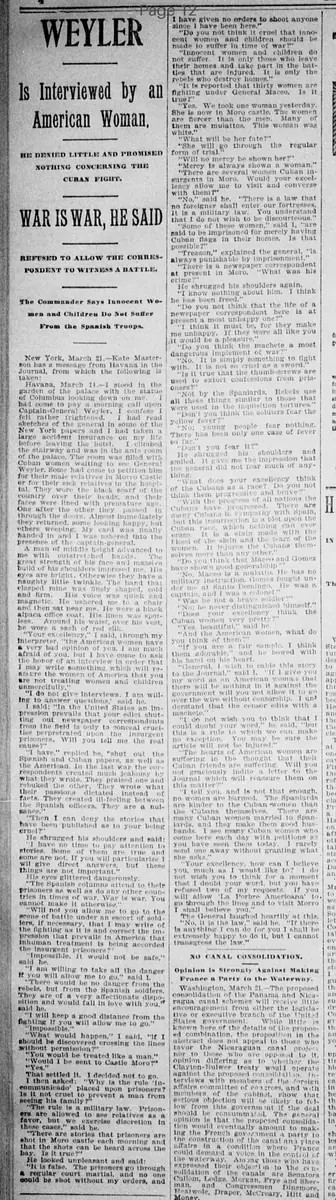
Is Interviewed by an
American Woman,
HE DENIED LITTLE AND PROMISED
NOTHING CONCERNING THE
CUBAN FIGHT,
WAR IS WAR, HE SAID
REFUSED TO ALLOW THE CORRES-
PONDENT TO WITNESS A BATTLE.
The Commander Says Innocent Wo-
men and Children Do Not Suffer
From the Spanish Troops.
New York, March 21.-Kate Master-
son has a message from Havana in the
Journal, from which the following is
taken:
Havana, March 14.-I stood in the
garden of the palace with the statue
of Columbus looking down on me. I
had come to pay a morning call upon
Captain-General Weyler. I confess I
felt rather frightened. I had read
sketches of the general in some of the
New York papers and I had taken a
large accident insurance on my life
before leaving the hotel. I climbed
the stairway and was in the ante room
of the palace. The room was filled with
Cuban women waiting to see General
Weyler. Some had come to petition him
for their male relatives in Morro Castle
or for their sick relatives in the hospi-
tal. They wore the black scarf of the
country over their heads, and their
faces were lined with premature age.
One after the other they passed in
through the door. Almost immediately
they returned, some looking happy, but
others weeping. My card was finally
handed in and I was ushered into the
presence of the captain-general.
A man of middle height advanced to
me with outstretched hands. The
great strength of his face and massive
build of his shoulders impressed me. His
eyes are bright. Otherwise they have a
naughty little twinkle. The hand that
clasped mine was finely shaped, cold
and firm. His voice was quick and
magnetic. He ushered me to a chair
and then sat near me. He wore a black
alpaca office coat. His linen was spot-
less. Around his waist, over his vest,
he wore a sash of red silk.
"Your excellency," I said, through my
interpreter, "the American women have
very bad opinion of you. I am much
afraid of you, but I have come to ask
the honor of an interview in order that
I may write something which will re-
assure the women of America that you
are not treating women and children
unmercifully."
"I do not give interviews. I am will-
ing to answer questions," said he.
I said: "In the United States an im-
pression prevails that your edict shut-
ting out newspaper correspondents
from the field is only to conceal cruel-
ties perpetrated upon the insurgent
prisoners. Will you tell me the real
cause?"
"I have," replied he, "shut out the
Spanish and Cuban papers, as well as
the American. In the last war the cor-
respondents created much jealousy by
what they wrote. They praised one and
rebuked the other. They wrote what
their passions dictated instead of
facts. They created ill-feeling between
the Spanish officers. They are a nui-
sance."
"Then I can deny the stories that
have been published as to your being
cruel?"
He shrugged his shoulders and said:
"I have no time to pay attention to
stories. Some of them are true and
some are not. If you will particularize I
will give direct answers, but these
things are not important."
His eyes glittered dangerously.
The Spanish columns attend to their
prisoners as well as do any other coun-
tries in times of war. War is war. You
cannot make it otherwise"
"Will not you allow me to go to the
scene of battle under an escort of sold-
iers, if necessary, that I may write of
the fighting as it is and correct the im-
pression that prevails in America that
inhuman treatment is being accorded
the insurgent prisoners?"
"Impossible. It would not be safe,"
said he.
"I am willing to take all the danger
if you will allow me to go," said I.
"There would be no danger from the
rebels, but from the Spanish soldiers.
They are of a very affectionate disposi-
tion and would fall in love with you,"
said he.
"I will keep a good distance from the
fighting if you will allow me to go."
"Impossible."
"What would happen," I said, "if I
should be discovered crossing the lines
without permission?"
"You would be treated like a man."
"Would I be sent to Castle Moro?"
"Yes."
That settled it. I decided not to go.
I then asked: "Why is the rule 'In-
communicado' placed upon prisoners?
Is it not cruel to prevent a man from
seeing his family?"
"The rule is a military law. Prison-
ers are allowed to see relatives as a
favor, but we exercise discretion in
these cases," said he.
There are stories that prisoners are
shot in Moro castle each morning and
that the shots can be heard across the
bay. Is it true?"
He looked unpleasant and said:
"It is false. The prisoners go through
regular court martial, and no one
could be shot without my orders, and
I have given no orders to shoot anyone
since I have been here."
"Do you not think it cruel that inno-
cent women and children should be
made to suffer in time of war?"
"Innocent women and children do
not suffer. It is only those who leave
their homes and take part in the bat-
tles that are injured. It is only the
rebels who destroy homes."
"It is reported that thirty women are
fighting under General Maceo. Is it
true?"
"Yes. We took one woman yesterday.
She is now in Moro castle. The women
are fiercer than the men. Many of
them are mulattos. This woman was
white."
"What will be her fate?"
She will go
through the regular
form of trial.
"Will no mercy be shown her?"
"Mercy is always shown a woman."
"There are several women Cuban in-
surgents in Moro. Would your excel-
lency allow me to visit and converse
with them?"
"No," said he, "there is a law that
no foreigner shall enter our fortresses.
It is a military law. You understand
that I do not wish to be discourteous."
"Some of these women," said I, "are
said to be imprisoned for merely having
Cuban flags in their homes. Is that
possible?"
"Treason," explained the general, "is
always punishable by imprisonment."
"There is a newspaper correspondent
at present in Moro,
"What was his
crime?"
He shrugged his shoulders again.
I know nothing about him. I think
he has been freed."
Do you not think that the life of a
newspaper correspondent here is at
present a most unhappy one?"
I think it must be, for they make
me unhappy. If they were all like you
it would be a pleasure."
"Do you think the machete a most
dangerous implement of war?"
"No. It is simply something to fight
with. It is not so cruel as a sword."
"Is it true that the thumb-screws are
used to extort confessions from pris-
oners?
all these things similar to those that
were used in the inquisition tortures."
"Not by the Spaniards. Rebels use
"Don't you think the soldiers fear the
yellow fever?
"No; young
people fear nothing.
There has been only one case of fever
so far."
Don't you fear it?"
He shrugged his shoulders and
smiled. It gave me the impression that
the general did not fear much of any-
thing.
"What does your excellency think
of the Cubans as a race? Do you not
think them progressive and brave"
"With the progress of all nations the
Cubans have progressed. There are
many Cubans in sympathy with Spain.
Cuban rice, which nothing can ever
but this insurrection is a blot upon the
race"
It is a stain made with the
blood of the slain and the tears of the
women. It injures the Cubans them-
selves more than any other."
"Do you think that Maceo and Gomez
have shown good generalship
"No. Maceo is a mulatto. He has no
militury instruction. Gomez fought un-
der me at Santo Domingo. He was a
captain, and I was a colonel."
"Was he not a brave soldier?"
No: he never distinguished himself."
"Does your excellency think the
Cuban women very pretty?
"Yes, beautiful," said he
"And the American women, what do
you think of them?"
"If you are a fair sample, I think
them adorable," and he bowed with
his hand on his heart.
"General, I wish to cable this story
to the Journal," said I. If I give you
my word as an American woman that
there will be nothing in it against the
government will you not allow it to go
over the wire without censorship. I un-
derstand that the censor edits with a
machete."
"I do not wish you to think that I
could doubt your word," he said, "but
this is a rule to which we can make
no exception. You may be sure the
article will not be injured."
"The hearts of American women are
suffering in the thought that their
Cuban friends are suffering. Will you
not graciously indite a letter to the
Journal which will reassure them on
this matter?"
"I tell you, and is not that enough,
no women are harmed. The Spaniards
are kinder to the Cuban women than
the Cubans themselves. There are
many Cuban women married to Span-
iards, and they make them good hus-
bands. I see many Cuban women who
come here each day with petitions as
you have seen them today. I rarely
send one away without granting what
she asks."
"Your excellency, how can I believe
you, much as I would like to? I do
not wish you to think for a moment
that I doubt your word, but you have
refused two of my requests." If you
will allow La Pobre Americanita to
go through the lines and to visit Morro
I shall believe you."
The general laughed heartily at this.
"No, it is the law," said he. "If there
is anything I can do for you I shall be
extremely happy to do it, but I cannot
transgress the law."
What sub-type of article is it?
What keywords are associated?
What entities or persons were involved?
Where did it happen?
Foreign News Details
Primary Location
Havana
Event Date
March 14
Key Persons
Outcome
weyler denies cruelties to innocent women and children, affirms prisoners receive regular trials, states mercy is shown to women, and reports no executions ordered since his arrival.
Event Details
American journalist Kate Masterson interviews Captain-General Weyler in the Havana palace. He defends Spanish policies in the Cuban insurgency, explains restrictions on correspondents to avoid jealousy and misinformation, refuses her requests to witness battles or visit female prisoners in Morro Castle citing military laws and safety, denies use of torture by Spaniards, asserts only rebels destroy homes, confirms women fighters among insurgents, and compliments American women.