Thank you for visiting SNEWPapers!
Sign up free
Alexandria Gazette
Alexandria, Alexandria County, District Of Columbia
What is this article about?
In the U.S. House of Representatives, Mr. Patton of Virginia defends his and others' dissent from a Speaker's ruling on procedure, decrying slanders in the official Globe newspaper as attacks on republican principles. Mr. Calhoun of Massachusetts and Mr. Wise of Virginia support calls for reprimanding the publisher to protect members' independence.
Clipping
OCR Quality
Full Text
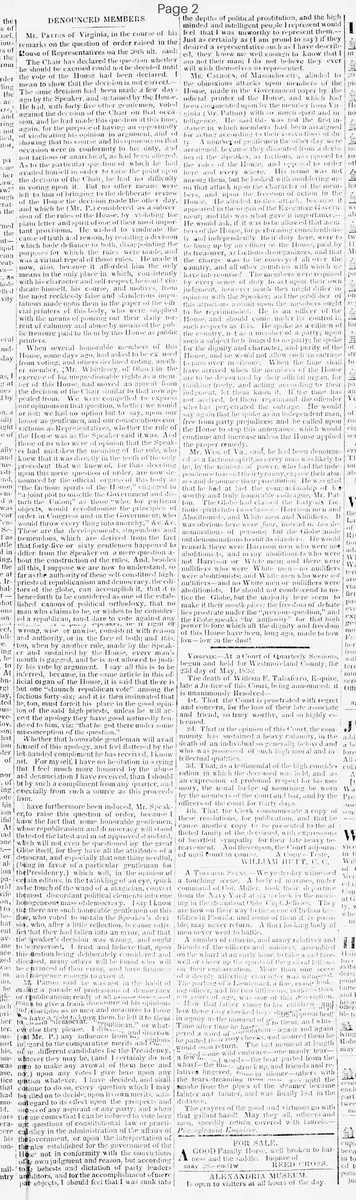
Mr. Patton of Virginia, in the course of his remarks on the question of order raised in the House of Representatives on the 30th ult. said:
The Chair has declared the question whether he should be excused could not be decided until the vote of the House had been declared. [I mean to show that the decision is not correct.- The same decision had been made a few days ago by the Speaker, and sustained by the House He had, with forty five other gentlemen, voted against the decision of the Chair on that occasion, and he had made this question at this time, again, for the purpose of having an opportunity of vindicating his opinion in argument, and of showing that his course and his opinions on that occasion were in conformity to his duty, and not factious or anarchical, as had been alleged.
As to the particular question of which he had availed himself in order to raise the point upon the decision of the Chair, he had no difficulty in voting upon it. But no other means were left to him of bringing to the deliberate review of the House the decision made the other day, and which he (Mr. P.) considered as a subversion of the rules of the House, by violating the plain letter and spirit of one of their most important provisions. He wished to vindicate the cause of truth and reason, by resisting a decision which bade defiance to both, disappointing the purposes for which the rules were made, and was a virtual repeal of those rules. He made it now, also, because it afforded him the only means in the only place in which, consistently with his character and self-respect, he could vindicate himself, his course, and motives, from the most recklessly false and slanderous imputations made upon them in the paper of the official printers of this body, who were supplied with the means of pouring out their daily torrent of calumny and abuse by means of the public treasure paid to them by this House as public printers.
When several honorable members of this House, some days ago, had asked to be excused from voting, and others declined voting, another member, (Mr. Whittlesey, of Ohio,) in the exercise of his unquestionable rights as a member of this House, had moved an appeal from the decision of the Chair similar to that now appealed from. We were compelled to express our opinions on that question, whether we would or not; we had no option but to say, upon our honor as gentlemen, and our conscientious convictions as Representatives, whether the rule of the House was as the Speaker said it was. And those of us who were of opinion that the Speaker had mistaken the meaning of the rule, who knew that it was directly in the teeth of the only precedent that we knew of, for thus deciding upon this mere question of order, are now denounced by the official organs of this body as "the factious spirits of the House," engaged in "a joint plot to unsettle the Government and disturb the Union;" as those "who, for partizan objects, would revolutionize the principles of order in Congress and in the Government; who would throw every thing into anarchy,"&c.&c.
These are the developments, stupendous and tremendous, which are derived from the fact that forty-five or sixty gentlemen happened to differ from the Speaker on a mere question about the construction of the rules. And, besides all this, I suppose we are now to understand, so far as the authority of these self-constituted high-priests of republicanism and democracy, the editors of the Globe, can accomplish it, that it is henceforth to be considered as one of the established canons of political orthodoxy, that no man who claims to be, or wishes to be considered a republican, must dare to vote against any decision of the Speaker, be it right or wrong, wise or unwise, consistent with reason and authority, or in the face of both; and this, too, when by another rule, made by the Speaker and sustained by the House, every man's mouth is gagged, and he is not allowed to justify his vote by argument. I say all this is to be inferred, because, in the same article in this official organ of the House, it is said that there is but one "staunch republican vote" among the factious forty-six; and it is then insinuated that he, too, must forfeit his place in the good opinion of the said high-priests, unless he will accept the apology they have good naturedly tendered to him, viz: "that he got there under some misconception of the question."
Whether that honorable gentleman will avail himself of this apology, and feel flattered by the left-handed compliment he has received, I know not. For myself, I have no hesitation in saying that I feel much more honored by the abuse and denunciation I have received, than I should be by such a compliment from any quarter, and especially from such a source as this proceeds from.
I have furthermore been induced, Mr. Speaker, to raise this question of order, because I know the fact that some honorable gentlemen, whose republicanism and democracy will stand the test of the latest and most approved standard, which will not even be questioned by the great Globe itself, for they have all the attributes of a democrat, and especially that one thing needful, (being in favor of a particular gentleman for the Presidency,) which will, in the opinion of certain editors, in the twinkling of an eye, quick as the touch of the wand of a magician, convert the most discordant political elements into one homogeneous mass of democracy. I say I know that there are such honorable gentlemen on this floor, who voted to sustain the Speaker's decision, who, after a little reflection, became satisfied that they had fallen into an error, and that the speaker's decision was wrong, and ought to be reversed, I trust and believe that, upon this question being deliberately considered and discussed, many others will be found who will be convinced of their error, and have firmness and independence enough to avow it.
Mr. Patton said he was not in the habit of making a parade of professions of democracy or republicanism: ready at all proper times and places to give a frank disclosure of his opinions and principles as to men and measures to those who have a right to know them, he left it to them to name him "democrat, republican or what- ever else they please" and disavow of different candidates for the Presidency, whatever they may be, (and I certainly do not mean to make any avowal of them here and now,) upon any votes I give here upon any question whatever. I have decided, and shall continue to do so, every question which I may be called on to decide, upon its own merits, without regard to its effect upon the prospects and success of any aspirant or any party; and when the time comes that I can be induced to vote here upon questions of constitutional law or practical policy in the administration of the affairs of the Government, or upon the interpretation of the rules established for the government of the House' not in conformity with the convictions of my own judgment and reason, but according to the behests and dictation of party leaders and editors, and for the accomplishment of mere partizan objects, I should feel that I was sunk into the depths of political prostitution, and the high minded and intelligent people I represent would feel that I was unworthy to represent them.- Just as certainly as (I am proud to say) if they desired a representative such as I have described, they know me well enough to know that I am not their man; I do not believe they ever will wish themselves so represented.
Mr. Calhoun, of Massachusetts, alluded to the obnoxious attacks upon members of the House, made in the Government paper by the official printer of the House, and which had been commented upon by the member from Virginia (Mr. Patton) with so much spirit and intelligence. He said this, was not the first instance in which members had been arraigned for acting according to their convictions of duty A number of gentlemen the other day were arraigned, because they dissented from a decision of the Speaker, as factious, opposed to the rules of the House, and opposed to order here and every where. His name was not among them, but he looked with shuddering upon that attack upon the character of the members, and upon the freedom of action in the House. He alluded to this attack, because it appeared in the organ of the Executive Government; and this was what gave it importance.- He would ask, if it was to be allowed that members of the House, for performing conscientiously and independently their duty here, were to be hung up by an officer of the House, paid by its treasurer, as factious disorganizers, and that the charge was to be conveyed all over the country, and all other countries with which we have intercourse? The members were required by every sense of duty to act upon their own judgment, however much they might differ in opinion with the Speaker; and the publisher of this atrocious assault upon the members ought to be reprimanded. He is an officer of the House, and should come under its control in such respects as this. He spoke as a citizen of the country, not as a member of a party; upon such a subject he belonged to no party; he spoke for the dignity and character, and purity of the House, and he would not allow such an outrage to pass over in silence. When the time shall have arrived when the members of the House are to be denounced by their official organ, for thinking freely, and acting according to their judgment, let them know it. If the time has not arrived, let them reprimand the offender who has perpetrated the outrage. He would say again that he spoke as an independent man, free from party prejudices; and he called upon the House to stop this annoyance, which would continue and increase unless the House applied the proper remedy.
Mr. Wise of Va. said, he had been denounced as a factious spirit, as every man was likely to be, by the minions of power, who had the independence to resist their tyranny, expose their abuses and denounce their prostitution. He was glad that he had at least the companionship of his worthy and truly honorable colleague, Mr. Patton. The Globe had classed the fifty-six factious spirits into two classes-Harrison men and Abolitionists, and White men and Nullifiers. It was obvious there were four, instead of two denominations of persons; but the Globe made out denominations to suit its slanders. He would remark there were Harrison men who were not abolitionists, and many abolitionists who were not Harrison or White men; and there were nullifiers who were White men-no nullifiers were abolitionists; and White men who were not nullifiers-and no White men or nullifiers were abolitionists. He should not condescend to notice the Globe, but the majority here seem to make it their mouth-piece: the freedom of debate lies prostrate under the "previous question," and the Globe speaks "by authority" for that high power before which all the dignity and freedom of this House have been, long ago, made to bow low-low in the dust!
What sub-type of article is it?
What themes does it cover?
What keywords are associated?
What entities or persons were involved?
Where did it happen?
Story Details
Key Persons
Location
House Of Representatives
Event Date
30th Ult.
Story Details
Mr. Patton defends dissenting votes against Speaker's procedural ruling, criticizes Globe's slanders labeling dissenters as factious; Calhoun calls for reprimand of publisher to protect independence; Wise denounces classifications and attacks on freedom of debate.