Thank you for visiting SNEWPapers!
Sign up free
Editorial
May 22, 1906
The White Pine News
East Ely, Treasure City, Taylor, Ely, White Pine County, Nevada
What is this article about?
Editorial supports President Roosevelt's push for heavier inheritance and income taxes, arguing they are fair, progressive, and reach untaxed personal property. Compares U.S. practices unfavorably to Europe and notes benefits over property taxes. Criticizes current U.S. tax system as outdated.
Clipping
OCR Quality
98%
Excellent
Full Text
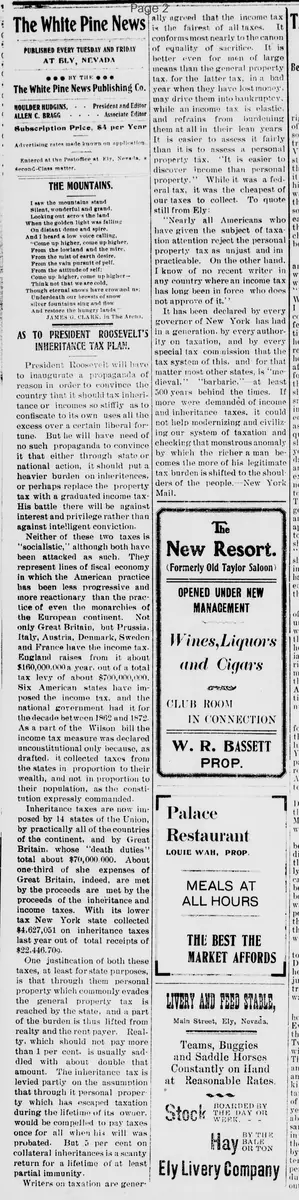
AS TO PRESIDENT ROOSEVELT'S
INHERITANCE TAX PLAN.
President Roosevelt will have
to inaugurate a propaganda of
reason in order to convince the
country that it should tax inheri-
tance or incomes so stiffly as to
confiscate to its own uses all the
excess over a certain liberal for-
tune. But he will have need of
no such propaganda to convince
it that either through state or
national action, it should put a
heavier burden on inheritances,
or perhaps replace the property
tax with a graduated income tax:
His battle there will be against
interest and privilege rather than
against intelligent conviction.
Neither of these two taxes is
"socialistic," although both have
been attacked as such. They
represent lines of fiscal economy
in which the American practice
has been less progressive and
more reactionary than the prac-
tice of even the monarchies of
the European continent. Not
only Great Britain, but Prussia,
Italy, Austria, Denmark, Sweden
and France have the income tax.
England raises from it about
$160,000,000 a year, out of a total
tax levy of about $700,000,000.
Six American states have im-
posed the income tax, and the
national government had it for
the decade between 1862 and 1872.
As a part of the Wilson bill the
income tax measure was declared
unconstitutional only because, as
drafted, it collected taxes from
the states in proportion to their
wealth, and not in proportion to
their population, as the consti-
tution expressly commanded.
Inheritance taxes are now im-
posed by 14 states of the Union,
by practically all of the countries
of the continent, and by Great
Britain, whose "death duties"
total about $70,000,000. About
one-third of the expenses of
Great Britain, indeed, are met
by the proceeds of the inheritance and
income taxes. With its lower
tax New York state collected
$4,627,051 on inheritance taxes
last year out of total receipts of
$22,446,709.
One justification of both these
taxes, at least for state purposes,
is that through them personal
property which commonly evades
the general property tax is
reached by the state, and a part
of the burden is thus lifted from
realty and the rent payer. Real-
ty, which should not pay more
than 1 per cent., is usually sad-
dled with about double that
amount. The inheritance tax is
levied partly on the assumption
that through it personal proper-
ty which has escaped taxation
during the lifetime of its owner
would be compelled to pay taxes
once for all when his will was
probated. But 5 per cent on
collateral inheritances is a scanty
return for a lifetime of at least
partial immunity.
Writers on taxation are gener-
ally agreed that the income tax
is the fairest of all taxes. It
conforms most nearly to the canon
of equality of sacrifice. It is
better even for men of large
means than the general property
tax, for the latter tax, in a bad
year when they have lost money,
may drive them into bankruptcy,
while an income tax is elastic,
and refrains from burdening
them at all in their lean years.
It is easier to assess it fairly
than it is to assess a personal
property tax. "It is easier to
discover income than personal
property." While it was a fed-
eral tax, it was the cheapest of
our taxes to collect. To quote
still from Ely:
"Nearly all Americans who
have given the subject of taxa-
tion attention reject the personal
property tax as unjust and im-
practicable. On the other hand,
I know of no recent writer in
any country where an income tax
has long been in force who does
not approve of it."
It has been declared by every
governor of New York in a generation, by every author-
ity on taxation, and by every
special tax commission that the
tax system of this, and for that
matter most other states, is "me-
dieval," "barbaric,"—at least
500 years behind the times. If
more were demanded of income
and inheritance taxes, it could
not help modernizing and civiliz-
ing our system of taxation and
checking that monstrous anomaly
by which the richer a man be-
comes the more of his legitimate
tax burden is shifted to the shoul-
ders of the people.—New York
Mail.
INHERITANCE TAX PLAN.
President Roosevelt will have
to inaugurate a propaganda of
reason in order to convince the
country that it should tax inheri-
tance or incomes so stiffly as to
confiscate to its own uses all the
excess over a certain liberal for-
tune. But he will have need of
no such propaganda to convince
it that either through state or
national action, it should put a
heavier burden on inheritances,
or perhaps replace the property
tax with a graduated income tax:
His battle there will be against
interest and privilege rather than
against intelligent conviction.
Neither of these two taxes is
"socialistic," although both have
been attacked as such. They
represent lines of fiscal economy
in which the American practice
has been less progressive and
more reactionary than the prac-
tice of even the monarchies of
the European continent. Not
only Great Britain, but Prussia,
Italy, Austria, Denmark, Sweden
and France have the income tax.
England raises from it about
$160,000,000 a year, out of a total
tax levy of about $700,000,000.
Six American states have im-
posed the income tax, and the
national government had it for
the decade between 1862 and 1872.
As a part of the Wilson bill the
income tax measure was declared
unconstitutional only because, as
drafted, it collected taxes from
the states in proportion to their
wealth, and not in proportion to
their population, as the consti-
tution expressly commanded.
Inheritance taxes are now im-
posed by 14 states of the Union,
by practically all of the countries
of the continent, and by Great
Britain, whose "death duties"
total about $70,000,000. About
one-third of the expenses of
Great Britain, indeed, are met
by the proceeds of the inheritance and
income taxes. With its lower
tax New York state collected
$4,627,051 on inheritance taxes
last year out of total receipts of
$22,446,709.
One justification of both these
taxes, at least for state purposes,
is that through them personal
property which commonly evades
the general property tax is
reached by the state, and a part
of the burden is thus lifted from
realty and the rent payer. Real-
ty, which should not pay more
than 1 per cent., is usually sad-
dled with about double that
amount. The inheritance tax is
levied partly on the assumption
that through it personal proper-
ty which has escaped taxation
during the lifetime of its owner
would be compelled to pay taxes
once for all when his will was
probated. But 5 per cent on
collateral inheritances is a scanty
return for a lifetime of at least
partial immunity.
Writers on taxation are gener-
ally agreed that the income tax
is the fairest of all taxes. It
conforms most nearly to the canon
of equality of sacrifice. It is
better even for men of large
means than the general property
tax, for the latter tax, in a bad
year when they have lost money,
may drive them into bankruptcy,
while an income tax is elastic,
and refrains from burdening
them at all in their lean years.
It is easier to assess it fairly
than it is to assess a personal
property tax. "It is easier to
discover income than personal
property." While it was a fed-
eral tax, it was the cheapest of
our taxes to collect. To quote
still from Ely:
"Nearly all Americans who
have given the subject of taxa-
tion attention reject the personal
property tax as unjust and im-
practicable. On the other hand,
I know of no recent writer in
any country where an income tax
has long been in force who does
not approve of it."
It has been declared by every
governor of New York in a generation, by every author-
ity on taxation, and by every
special tax commission that the
tax system of this, and for that
matter most other states, is "me-
dieval," "barbaric,"—at least
500 years behind the times. If
more were demanded of income
and inheritance taxes, it could
not help modernizing and civiliz-
ing our system of taxation and
checking that monstrous anomaly
by which the richer a man be-
comes the more of his legitimate
tax burden is shifted to the shoul-
ders of the people.—New York
Mail.
What sub-type of article is it?
Taxation
Economic Policy
What keywords are associated?
Inheritance Tax
Income Tax
Progressive Taxation
Roosevelt Plan
Tax Reform
Personal Property Tax
European Comparison
What entities or persons were involved?
President Roosevelt
Great Britain
New York State
Prussia
Italy
Austria
Denmark
Sweden
France
Editorial Details
Primary Topic
Support For Inheritance And Income Taxes
Stance / Tone
Supportive Of Progressive Taxation, Critical Of Current System
Key Figures
President Roosevelt
Great Britain
New York State
Prussia
Italy
Austria
Denmark
Sweden
France
Key Arguments
Heavier Inheritance And Income Taxes Are Needed To Reach Untaxed Personal Property.
These Taxes Are Not Socialistic And Are More Progressive Than U.S. Practices Compared To Europe.
Income Tax Is The Fairest, Conforming To Equality Of Sacrifice And Easier To Assess.
Current U.S. Tax System Is Medieval And Shifts Burden To The Poor As Wealth Increases.
Inheritance Taxes Help Lift Burden From Realty And Rent Payers.
European Countries Like Britain Raise Significant Revenue From These Taxes.