Thank you for visiting SNEWPapers!
Sign up free
The Weekly Kansas Chief
Troy, Doniphan County, Kansas
What is this article about?
An 1874 Washington article critiques Benjamin Ogle Tayloe's privately published book on past society scandals, questioning its partisan biases and revelations about figures like Commodore Decatur's wife and a suppressed story of Thomas Jefferson's alleged misconduct toward Judge Walker's wife, alongside political anecdotes involving Blair and Lincoln.
Clipping
OCR Quality
Full Text
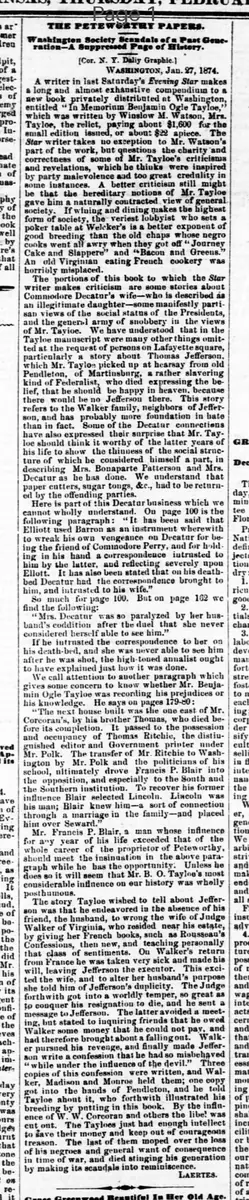
Washington Society Scandals of a Past Generation-A Suppressed Page of History.
[Cor. N. Y. Daily Graphic.]
Washington, Jan. 27, 1874.
A writer in last Saturday's Evening Star makes a long and almost exhaustive compendium to a new book privately distributed at Washington, entitled "In Memoriam Benjamin Ogle Tayloe," which was written by Winslow M. Watson, Mrs. Tayloe, the relict, paying about $1,600 for the small edition issued, or about $22 apiece. The Star writer takes no exception to Mr. Watson's part of the work, but questions the charity and correctness of some of Mr. Tayloe's criticisms and revelations, which he thinks were inspired by party malevolence and too great credulity in some instances. A better criticism still might be that the hereditary notions of Mr. Tayloe gave him a naturally contracted view of general society. If wining and dining makes the highest form of society, the veriest lobbyist who sets a poker table at Welcher's is a better exponent of good breeding than the old chaps whose negro cooks went all awry when they got off "Journey Cake and Slappers" and "Bacon and Greens."
An old Virginian eating French cookery was horribly misplaced.
The portions of this book to which the Star writer makes criticism are some stories about Commodore Decatur's wife-who is described as an illegitimate daughter-some manifestly partisan views of the social status of the Presidents, and the general army of snobbery in the views of Mr. Tayloe. We have understood that in the Tayloe manuscript were many other things omitted at the request of persons on Lafayette square, particularly a story about Thomas Jefferson, which Mr. Tayloe picked up at hearsay from old Pendleton, of Martinsburg, a rather slavering kind of Federalist, who died expressing the belief, that he should be happy in heaven, because there would be no Jefferson there. This story refers to the Walker family, neighbors of Jefferson, and has probably more foundation in hate than in fact. Some of the Decatur connections have also expressed their surprise that Mr. Tayloe should think it worthy of the latter years of his life to show the thinness of the social structure of which he considered himself a part, in describing Mrs. Bonaparte Patterson and Mrs. Decatur as he has done. We understand that paper cutters, sugar tongs, &c., had to be returned by the offending parties.
Here is part of this Decatur business which we cannot wholly understand. On page 100 is the following paragraph: "It has been said that Elliott used Barron as an instrument wherewith to wreak his own vengeance on Decatur for being the friend of Commodore Perry, and for holding in his hand a correspondence intrusted to him by the latter, and reflecting severely upon Elliott. It has also been stated that on his death-bed Decatur had the correspondence brought to him, and intrusted to his wife."
So much for page 100. But on page 162 we find the following:
"Mrs. Decatur was so paralyzed by her husband's condition after the duel that she never considered herself able to see him."
If he intrusted the correspondence to her on his death-bed, and she was never able to see him after he was shot, the high-toned annalist ought to have explained just how it was done.
We call attention to another paragraph which gives some concern to know whether Mr. Benjamin Ogle Tayloe was recording his prejudices or his knowledge. He says on pages 179-80:
"The next house built was the one east of Mr. Corcoran's, by his brother Thomas, who died before its completion. It passed to the possession and occupancy of Thomas Ritchie, the distinguished editor and Government printer under Mr. Polk. The transfer of Mr. Ritchie to Washington by Mr. Polk and the politicians of his school, ultimately drove Francis P. Blair into the opposition, and especially to the South and the Southern institution. To recover his former influence Blair selected Lincoln. Lincoln was his man; Blair knew him-a sort of connection through a marriage in the family-and placed him over Seward."
Mr. Francis P. Blair, a man whose influence for a year of his life exceeded that of the whole career of the proprietor of Peteworth, should meet the insinuation in the above paragraph while he has the opportunity: Unless he does so it will seem that Mr. B. O. Tayloe's most considerable influence on our history was wholly posthumous.
The story Tayloe wished to tell about Jefferson was that he endeavored in the absence of his friend, the husband, to wrong the wife of Judge Walker of Virginia, who resided near his estate, by giving her French books, such as Rousseau's Confessions, then new, and teaching personally that class of sentiments. On Walker's return from France he was taken very sick and made his will, leaving Jefferson the executor. This excited the wife, and to alter her husband's purpose she told him of Jefferson's duplicity. The Judge forthwith got into a worldly temper, so great as to conquer his resignation to die, and he sent a message to Jefferson. The latter avoided a meeting, but stated to inquiring friends that he owed Walker some money that he could not pay, and had therefore brought about a falling out. Walker pursued his revenge, and finally made Jefferson write a confession that he had so misbehaved "while under the influence of the devil." Three copies of this confession were written, and Walker, Madison and Monroe held them; one copy got into the hands of Pendleton, and he told Tayloe about it, who forthwith illustrated his breeding by putting in this book. By the influence of W. W. Corcoran and others the libel was cut out. The Tayloes just had enough intellect to save their money and keep out of cognizance treason. The last of them moped over the loss of his negroes and general want of consequence in time of war, and died stinging his generation by making its scandals into reminiscence.
LAERTES.
What sub-type of article is it?
What themes does it cover?
What keywords are associated?
What entities or persons were involved?
Where did it happen?
Story Details
Key Persons
Location
Washington
Event Date
Jan. 27, 1874
Story Details
Critique of Tayloe's book on Washington society scandals, highlighting biases in stories about Decatur's wife and a suppressed anecdote of Jefferson attempting to seduce Judge Walker's wife with French books, leading to a forced confession; also questions political claims about Blair and Lincoln.