Thank you for visiting SNEWPapers!
Sign up free
Editorial
May 16, 1835
New Hampshire Statesman And State Journal
Concord, Merrimack County, New Hampshire
What is this article about?
An editorial from the Cincinnati Whig analyzes the 1836 presidential election, estimating that a united opposition candidate could secure at least 130 electoral votes from states beyond reach of Van Buren or White, potentially winning key doubtful states like Pennsylvania and New York.
Clipping
OCR Quality
95%
Excellent
Full Text
PROSPECTS OF THE OPPOSITION.
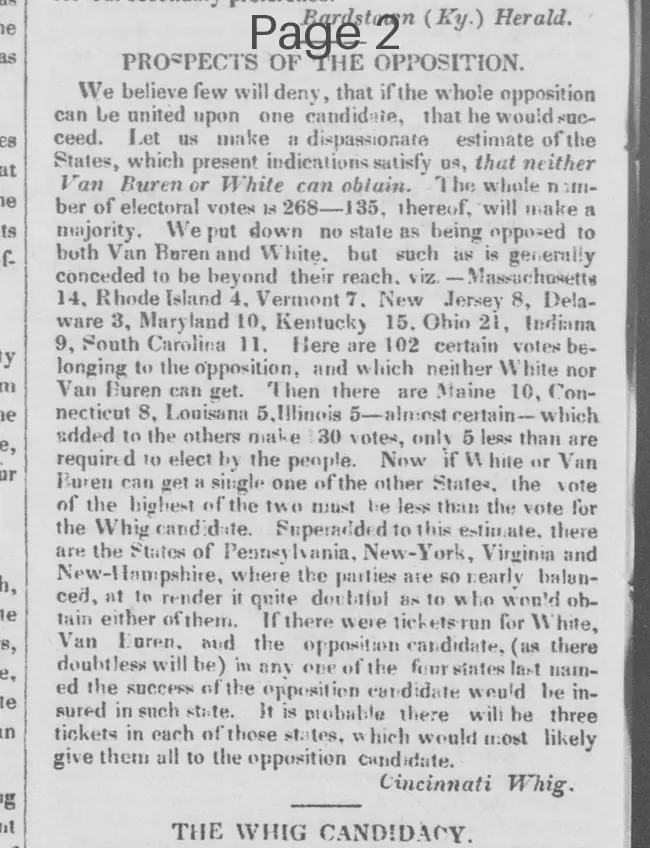
We believe few will deny, that if the whole opposition can be united upon one candidate, that he would succeed. Let us make a dispassionate estimate of the States, which present indications satisfy us, that neither Van Buren or White can obtain. The whole number of electoral votes is 288—144 thereof, will make a majority. We put down no state as being opposed to both Van Buren and White, but such as is generally conceded to be beyond their reach, viz.—Massachusetts 14, Rhode Island 4, Vermont 7, New Jersey 8, Delaware 3, Maryland 10, Kentucky 15, Ohio 21, Indiana 9, South Carolina 11. Here are 102 certain votes belonging to the opposition, and which neither White nor Van Buren can get. Then there are Maine 10, Connecticut 8, Louisiana 5, Illinois 5—almost certain—which added to the others make 130 votes, only 14 less than are required to elect by the people. Now if White or Van Buren can get a single one of the other States, the vote of the highest of the two must be less than the vote for the Whig candidate. Superadded to this estimate, there are the States of Pennsylvania, New-York, Virginia and New-Hampshire, where the parties are so nearly balanced, as to render it quite doubtful as to who would obtain either of them. If there were tickets run for White, Van Buren, and the opposition candidate, (as there doubtless will be) in any one of the four states last named the success of the opposition candidate would be insured in such state. It is probable there will be three tickets in each of those states, which would most likely give them all to the opposition candidate.
Cincinnati Whig.
We believe few will deny, that if the whole opposition can be united upon one candidate, that he would succeed. Let us make a dispassionate estimate of the States, which present indications satisfy us, that neither Van Buren or White can obtain. The whole number of electoral votes is 288—144 thereof, will make a majority. We put down no state as being opposed to both Van Buren and White, but such as is generally conceded to be beyond their reach, viz.—Massachusetts 14, Rhode Island 4, Vermont 7, New Jersey 8, Delaware 3, Maryland 10, Kentucky 15, Ohio 21, Indiana 9, South Carolina 11. Here are 102 certain votes belonging to the opposition, and which neither White nor Van Buren can get. Then there are Maine 10, Connecticut 8, Louisiana 5, Illinois 5—almost certain—which added to the others make 130 votes, only 14 less than are required to elect by the people. Now if White or Van Buren can get a single one of the other States, the vote of the highest of the two must be less than the vote for the Whig candidate. Superadded to this estimate, there are the States of Pennsylvania, New-York, Virginia and New-Hampshire, where the parties are so nearly balanced, as to render it quite doubtful as to who would obtain either of them. If there were tickets run for White, Van Buren, and the opposition candidate, (as there doubtless will be) in any one of the four states last named the success of the opposition candidate would be insured in such state. It is probable there will be three tickets in each of those states, which would most likely give them all to the opposition candidate.
Cincinnati Whig.
What sub-type of article is it?
Partisan Politics
What keywords are associated?
1836 Election
Electoral Votes
Opposition Candidate
Van Buren
White
Whig Prospects
State Analysis
What entities or persons were involved?
Van Buren
White
Whig Candidate
Massachusetts
Rhode Island
Vermont
New Jersey
Delaware
Maryland
Kentucky
Ohio
Indiana
South Carolina
Maine
Connecticut
Louisiana
Illinois
Pennsylvania
New York
Virginia
New Hampshire
Editorial Details
Primary Topic
Prospects For United Opposition In 1836 Presidential Election
Stance / Tone
Optimistic For Whig Opposition Success
Key Figures
Van Buren
White
Whig Candidate
Massachusetts
Rhode Island
Vermont
New Jersey
Delaware
Maryland
Kentucky
Ohio
Indiana
South Carolina
Maine
Connecticut
Louisiana
Illinois
Pennsylvania
New York
Virginia
New Hampshire
Key Arguments
United Opposition On One Candidate Would Succeed
States Beyond Van Buren And White's Reach Total 102 Electoral Votes
Additional Almost Certain States Add To 130 Votes, 14 Short Of Majority
Doubtful States Like Pennsylvania And New York Could Go To Opposition With Split Tickets
Three Way Race Likely Favors Opposition In Balanced States