Thank you for visiting SNEWPapers!

Sign up free
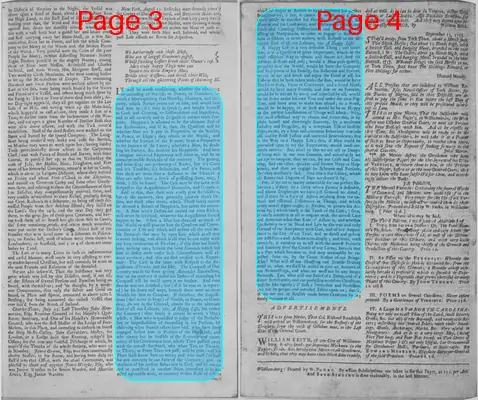
Page thumbnail for The Virginia Gazette
Editorial September 16, 1737

The Virginia Gazette

Richmond, Williamsburg, Richmond County, Virginia

What is this article about?

This editorial argues that pursuing wealth, power, and grandeur through dishonesty leads to unhappiness and moral compromise, while true happiness arises from honesty, sincerity, moderation, and adherence to moral and divine principles. It critiques insatiable desires, citing Alexander the Great, and urges ethical living for a peaceful life and divine favor.

Merged-components note: This is a continuation of the same opinion piece on wealth, happiness, and morality, split across pages.

Clippings
1 of 2

OCR Quality

95% Excellent

Full Text

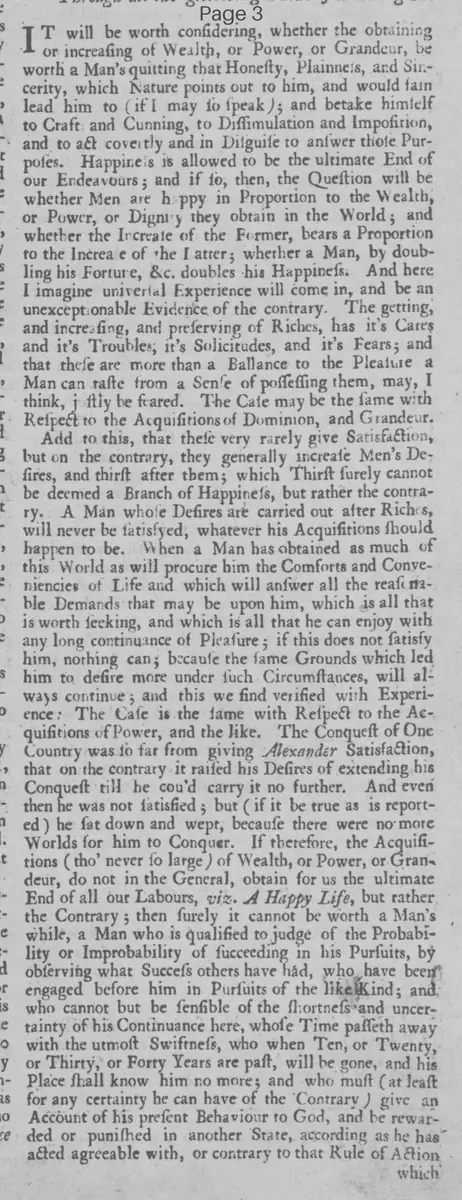
It will be worth considering, whether the obtaining or increasing of wealth, or power, or grandeur, be worth a man's quitting that honesty, plainness, and sincerity, which nature points out to him, and would fain lead him to (if I may so speak); and betake himself to craft and cunning, to dissimulation and imposition, and to act covertly and in disguise to answer those purposes. Happiness is allowed to be the ultimate end of our endeavours; and if so, then, the question will be whether men are happy in proportion to the wealth, or power, or dignity they obtain in the world; and whether the increase of the former, bears a proportion to the increase of the latter; whether a man, by doubling his fortune, &c. doubles his happiness. And here I imagine universal experience will come in, and be an unexceptionable evidence of the contrary. The getting, and increasing, and preserving of riches, has its cares and its troubles; its solicitudes, and its fears; and that these are more than a balance to the pleasure a man can taste from a sense of possessing them, may, I think, justly be inferred. The case may be the same with respect to the acquisitions of dominion, and grandeur. Add to this, that these very rarely give satisfaction, but on the contrary, they generally increase men's desires, and thirst after them; which thirst surely cannot be deemed a branch of happiness, but rather the contrary. A man whose desires are carried out after riches, will never be satisfied, whatever his acquisitions should happen to be. When a man has obtained as much of this world as will procure him the comforts and conveniences of life and which will answer all the reasonable demands that may be upon him, which is all that is worth seeking, and which is all that he can enjoy with any long continuance of pleasure; if this does not satisfy him, nothing can; because the same grounds which led him to desire more under such circumstances, will always continue; and this we find verified with experience. The case is the same with respect to the acquisitions of power, and the like. The conquest of one country was so far from giving Alexander satisfaction, that on the contrary it raised his desires of extending his conquest till he could carry it no further. And even then he was not satisfied; but (if it be true as is reported) he sat down and wept, because there were no more worlds for him to conquer. If therefore, the acquisitions (though never so large) of wealth, or power, or grandeur, do not in the general, obtain for us the ultimate end of all our labours, viz. a happy life, but rather the contrary; then surely it cannot be worth a man's while, a man who is qualified to judge of the probability or improbability of succeeding in his pursuits, by observing what success others have had, who have been engaged before him in pursuits of the like kind; and who cannot but be sensible of the shortness and uncertainty of his continuance here, whose time passeth away with the utmost swiftness, who when ten, or twenty, or thirty, or forty years are past, will be gone, and his place shall know him no more; and who must (at least for any certainty he can have of the contrary) give an account of his present behaviour to God, and be rewarded or punished in another state, according as he has acted agreeable with, or contrary to that rule of action which he ought in Reason to have governed his present Behaviour by; I say, it cannot be worth such a Creature's while to sacrifice his Honesty and Sincerity, his Honour and his Conscience, and substitute in their room Craft and Cunning, Dissimulation and Imposition, and acting in a Masquerade, in order to engage in such Pursuits as seldom or never answer, with Respect to the ultimate End of all our Labours, viz. A Happy Life.

A Happy Life is a very desirable Thing; and therefore, it is a Question of great Importance, which is the most effectual Way to obtain and secure it? And the Answer is short and easy; would a Man pass quietly, peaceably thro' the World, would he have the Company and Enjoyment of his Family, his Relations and Friends, would he eat and drink and enjoy the Good of all his Labour that he hath taken under the Sun, would he have Health of Body, Peace of Conscience, and a sound Mind, would he have many Friends, and few or no Enemies, would he be envied by none, and respected by all, would he sit down under his own Vine and under his own Fig-Tree, and have none to make him afraid; in a Word, would he be happy, or at least would he be as Happy as the present Constitution of Things will admit: Why, the most effectual way to obtain and secure this, is by plain honest and downright Sincerity, by a moderate Industry and Frugality, by a temperate Use of sensible Enjoyments, by a kind and courteous Behaviour towards all, and by strict Justice and universal Benevolence; this is the Way to a Happy Life: this, if Men could be prevailed upon to try the Experiment, would most certainly answer. But, alas! in this we are all in Danger of being wise in our own Conceits, and accordingly we are apt to imagine, that we can, by our Craft and Cunning, find out other, quicker and shorter Ways to Happiness; and then we engage in Schemes and Pursuits, tho' they constantly fail. And this is the fallacy, which all Ranks and Degrees of Men are deceiv'd by.

For, if we are in reality answerable for our present Behaviour; if there be a Deity whose Favour is desirable, and whose Displeasure we have just Ground to dread: and if there be a Rule of Action resulting from the natural and essential Differences in Things, and which every moral Agent ought, in Reason, to govern his Actions by, (which surely is the Truth of the Case;) then, it nearly concerns us all to enquire with the utmost Care and Attention what that Rule of Action is, and whether Conformity to it in Mind and Life be the true and only Ground of our Acceptance with God, and of our Acquittance in the Day of our Trial, and to direct and govern our Affections and Actions accordingly; and then, most certainly, it concerns us to act with the utmost Fairness and Sincerity thro' the Course of our Lives; because that is a Part which becomes us, and may reasonably be expected from us, by the Great Author of our Beings.

Alas! What will all our Shuffling and Double-Dealing avail us, when we shall be called to give an Account of our Stewardship, and when we must not be any longer Stewards. Yea, what will our Belief of a Deity, and of a future Retribution, and our professing ourselves Christians, and the like signify; if such a Persuation and Profession has not its proper and intended Effect upon us; that is, if we are not in Reality made better Creatures by it; surely nothing at all.

What sub-type of article is it?

Moral Or Religious

What keywords are associated?

Honesty Sincerity Happiness Wealth Power Morality Divine Accountability Frugality Benevolence

What entities or persons were involved?

Alexander God Deity

Editorial Details

Primary Topic

Pursuit Of Happiness Through Honesty And Sincerity Versus Worldly Ambitions

Stance / Tone

Advocacy For Moral Integrity And Divine Accountability

Key Figures

Alexander God Deity

Key Arguments

Wealth And Power Pursuits Bring More Cares Than Pleasures And Do Not Proportionately Increase Happiness. Insatiable Desires From Riches And Grandeur Prevent True Satisfaction. True Happiness Comes From Moderation, Honesty, Frugality, And Benevolence. Moral Actions Align With Divine Rule And Ensure Acceptance In Afterlife. Dishonesty And Cunning Lead To Ultimate Failure In Achieving A Happy Life. Belief In God And Christianity Must Effect Real Moral Improvement.

Are you sure?