Thank you for visiting SNEWPapers!
Sign up free
The Enquirer
Richmond, Henrico County, Virginia
What is this article about?
In a Senate speech, Mr. Brent explains his vote in favor of the United States Bank bill despite instructions from Virginia's legislature to oppose it on constitutional grounds. He argues that instructions cannot compel a senator to violate the Constitution, defends the bank's constitutionality as necessary for revenue collection, and outlines historical and practical justifications.
Merged-components note: Continuation of Mr. Brent's speech on the United States Bank, originally labeled as domestic_news on page 2.
Clippings
1 of 2
OCR Quality
Full Text
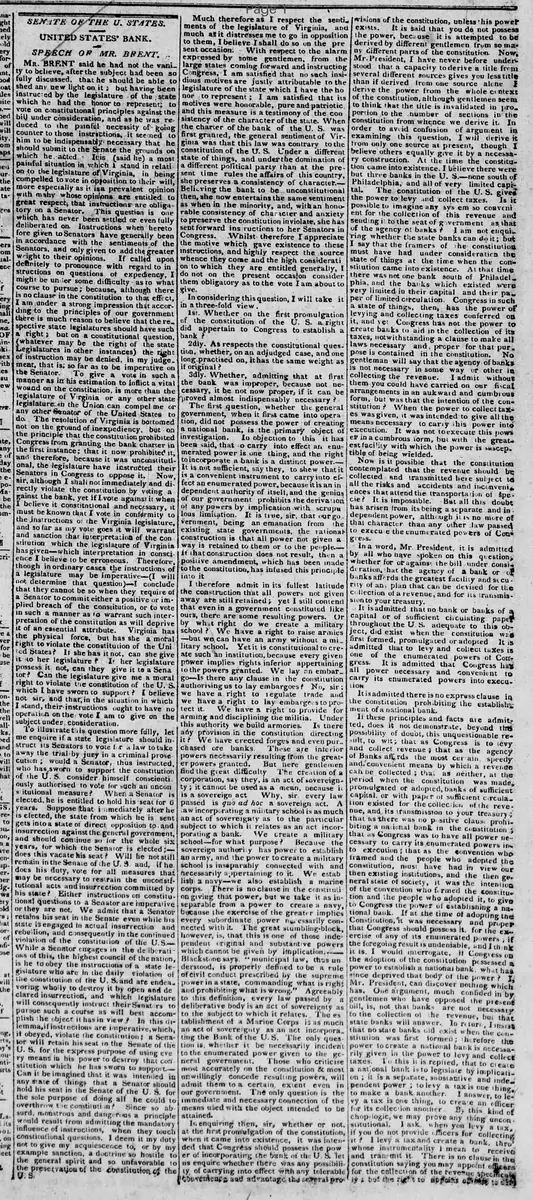
UNITED STATES' BANK.
SPEECH OF MR. BRENT.
MR. BRENT said he had not the vanity to believe, after the subject had been so fully discussed, that he should be able to shed any new light on it; but having been instructed by the legislature of the state which he had the honor to represent, to vote on constitutional principles against the bill under consideration, and as he was reduced to the painful necessity of going counter to those instructions, it seemed to him to be indispensably necessary that he should submit to the Senate the grounds on which he acted. It is (said he) a most painful situation in which I stand in relation to the legislature of Virginia, in being compelled to vote in opposition to their will, more especially as it is a prevalent opinion with many whose opinions are entitled to great respect, that instructions are obligatory on a Senator. This question is one which has never been settled or even fully deliberated on. Instructions when heretofore given to Senators have generally been in accordance with the sentiments of the Senators, and only given to add the greater weight to their opinions. If called upon definitely to pronounce with regard to instructions on questions of expediency, I might be under some difficulty -- as to what course to pursue; because, although there is no clause in the constitution to that effect, I am under a strong impression that according to the principles of our government there is much reason to believe that the respective state legislatures should have such a right; but on a constitutional question, (whatever may be the right of the state Legislatures in other instances) the right of instruction may be denied, in my judgment, that is, so far as to be imperative on the Senator. To give a vote in such a manner as in his estimation to inflict a vital wound on the constitution, is more than the legislature of Virginia or any other state legislature in the Union can compel me or any other Senator of the United States to do.
The resolution of Virginia is bottomed not on the ground of inexpediency, but on the principle that the constitution prohibited Congress from granting the bank charter in the first instance; that it now prohibits it, and therefore, because it was unconstitutional, the legislature have instructed their Senators in Congress to oppose it. Now, sir, although I shall not immediately and directly violate the constitution by voting against the bank, yet if I vote against it when I believe it constitutional and necessary, it must be known that I vote in conformity to the instructions of the Virginia legislature, and so far as my vote goes it will warrant and sanction that interpretation of the constitution which the legislature of Virginia has given--which interpretation in conscience I believe to be erroneous. Therefore, though in ordinary cases the instructions of a legislature may be imperative--(I will not determine that question)--I conclude that they cannot be so when they require of a Senator to commit either a positive or implied breach of the constitution, or to vote in such a manner as to warrant such interpretation of the constitution as will deprive it of an essential attribute. Virginia has the physical force, but has she a moral right to violate the constitution of the United States? If she has it not, can she give it to her legislature? If her legislature possess it not, can they give it to a Senator? Can the legislature give me a moral right to violate the constitution of the U. S. which I have sworn to support? I believe not sir, and that, in the situation in which I stand, their instructions ought to have no operation on the vote I am to give on the subject under consideration.
To illustrate this question more fully, let me enquire if a state legislature should instruct its Senators to vote for a law to take away the trial by jury in a criminal prosecution; would a Senator, thus instructed, who has sworn to support the constitution of the U. S. consider himself conscientiously authorised to vote for such an unconstitutional measure? When a Senator is elected, he is entitled to hold his seat for 6 years. Suppose that immediately after he is elected, the state from which he is sent gets into a state of direct opposition to and insurrection against the general government, and should continue so for the whole six years, for which the Senator is elected-- does this vacate his seat? Will he not still remain in the Senate of the U.S. and, if he does his duty, vote for all measures that may be necessary to restrain the unconstitutional acts and insurrection committed by his state? Either instructions on constitutional questions to a Senator are imperative or they are not. We admit that a Senator retains his seat in the Senate even while his state is engaged in actual insurrection and rebellion, and consequently in the continued violation of the constitution of the U.S.… While a Senator engages in the deliberations of this, the highest council of the nation, is he to obey the instructions of a state legislature who are in the daily violation of the constitution of the U. S. and are endeavoring wholly to destroy it by open and declared insurrection, and which legislature will consequently instruct their Senators to pursue such a course as will best accomplish the object it has in view? In this dilemma, if instructions are imperative, which, if obeyed, violate the constitution; a Senator will retain his seat in the Senate of the U. S. for the express purpose of using every means in his power to destroy that constitution which he has sworn to support.-- Can it be imagined that it was intended in any state of things that a Senator should hold his seat in the Senate of the U. S. for the sole purpose of doing all he could to overthrow the constitution? Since so absurd, monstrous and dangerous a principle would result from admitting the mandatory influence of instructions, when they touch constitutional questions, I deem it my duty not to give my acquiescence to, or by my example sanction, a doctrine so hostile to the general spirit and so unfavorable to the preservation of the constitution of the U.S.
Much therefore as I respect the sentiments of the legislature of Virginia, and much as it distresses me to go in opposition to them, I believe I shall do so on the present occasion! : With respect to the alarm expressed by some gentlemen, from the large states coming forward and instructing Congress, I am satisfied that no such insidious motives are justly attributable to the legislature of the state which I have the honor to represent; I am satisfied that its motives were honorable, pure and patriotic, and this measure is a testimony of the consistency of the character of the state. When the charter of the bank of the U. S. was first granted, the general sentiment of Virginia was that this law was contrary to the constitution of the U. S. Under a different state of things, and under the domination of a different political party than at the present time rules the affairs of this country, she preserves a consistency of character.-- Believing the bank to be unconstitutional then, she now entertains the same sentiment as when in the minority, and, with an honorable consistency of character and anxiety to preserve the constitution inviolate, she has sent forward instructions to her Senators in Congress. Whilst therefore I appreciate the motive which gave existence to these instructions, and highly respect the source whence they come and the high consideration to which they are entitled generally, I do not on the present occasion consider them obligatory as to the vote I am about to give.
In considering this question, I will take it in a three-fold view.
1st. Whether on the first promulgation of the Constitution of the U. S. a right did appertain to Congress to establish a bank?
2dly. As respects the constitutional question, whether, on an adjudged case, and one long practised on, it has the same weight as if original?
3dly. Whether, admitting that at first the bank was improper, because not necessary, it be not now proper, if it can be proved almost indispensably necessary?
The first question, whether the general government, when it first came into operation, did not possess the power of creating a national bank, is the primary object of investigation. In objection to this it has been said, that to carry into effect an enumerated power is one thing, and the right to incorporate a bank is a distinct power.-- It is not sufficient, say they, to shew that it is a convenient instrument to carry into effect an enumerated power, because it is an independent authority of itself, and the genius of our government prohibits the derivation of any powers by implication with scrupulous limitation. It is true, sir, that our government, being an emanation from the existing state governments, the rational construction is that all power not given away is retained to them or to the people.-- if that construction does not result, then a positive amendment, which has been made to the constitution, has infused this principle into it I therefore admit in its fullest latitude the construction that all powers not given away are still retained; yet I still contend that even in a government constituted like ours, there are some resulting powers. Or by what right do we create a military school? We have a right to raise armies --but we can have an army without a military school. Yet it is constitutional to create such an institution, because every given power implies rights inferior appertaining to the powers granted. We lay an embargo--Is there any clause in the constitution authorising us to lay embargoes? No, sir: we have a right to regulate trade and we have a right to lay embargoes to protect it. We have a right to provide for arming and disciplining the militia. Under this authority we build armories. Is there any provision in the constitution directing it? We have erected forges and even purchased ore banks. These are interior powers necessarily resulting from the greater powers granted. But here gentlemen find the great difficulty The creation of a corporation, say they, is an act of sovereignty; it cannot be used as a mean, because it is a sovereign act Why, sir, every law passed is qua ad hoc a sovereign act. A law incorporating a military school is as much an act of sovereignty as to the particular subject to which it relates as an act incorporating a bank. We create a military school--for what purpose? Because the sovereign authority has power to establish an army, and the power to create a military school is inseparably connected with and necessarily appertaining to it. We establish a navy--we also establish a marine corps. There is no clause in the constitution giving that power, but we take it as inseparable from a power to create a navy, because the exercise of the greater implies every subordinate power necessarily connected with it. The great stumbling-block, however, is, that this is one of those independent original and substantive powers which cannot be given by implication: e.g.-- Blackstone says, "municipal law, thus understood, is properly defined to be a rule of civil conduct prescribed by the supreme power in a state, commanding what is right and prohibiting what is wrong." Agreeably to this definition, every law passed by a deliberative body is an act of sovereignty as to the subject to which it relates. The establishment of a Marine Corps is as much an act of sovereignty as an act incorporating the Bank of the U.S. The only question is, whether it be necessarily incident to the enumerated power given to the general government. Those who criticise most accurately on the constitution & most unwillingly concede resulting powers, will admit them to a certain extent even in our government. The only question is the immediate and necessary connection of the means used with the object intended to be attained.
In enquiring then, sir, whether or not, at the first promulgation of the Constitution, when it came into existence, it was intended that Congress should possess the power of incorporating the bank of the U. S. let us enquire whether there was any possibility of carrying into effect with any tolerable convenience and advantage the several provisions of the constitution, unless this power exists.
It is said that you do not possess the power, because it is attempted to be derived by different gentlemen from so many different parts of the constitution. Now Mr. President, I have never before understood that a capacity to derive a title from several different sources gives you less title than if derived from one source alone I derive the power from the whole context of the constitution, although gentlemen seem to think that the title is invalidated in proportion to the number of sections in the constitution from whence we derive it. In order to avoid confusion of argument in examining this question, I will derive it from only one source at present, though I believe others equally give it by a necessary construction. At the time the constitution came into existence, I believe there were but three banks in the U. S. none south of Philadelphia, and all of very limited capital. The constitution of the U. S. gives the power to levy and collect taxes. Is it possible to imagine any system so convenient for the collection of this revenue and sending it to the seat of government, as that of the agency of banks? I am not enquiring whether the state banks can do it; but I say that the framers of the constitution must have had under consideration the state of things at the time when the constitution came into existence. At that time there was not one bank south of Philadelphia, and the banks which existed were very limited in their capital and their paper of limited circulation. Congress in such a state of things, then, has the power of levying and collecting taxes conferred on it, and yet Congress has not the power to create banks to aid in the collection of its taxes, notwithstanding a clause to make all laws necessary and proper for that purpose is contained in the constitution. No gentleman will say that the agency of banks is not necessary in some way or other in collecting the revenue. I admit without them you could have carried on our fiscal arrangements in an awkward and cumbrous form, but was that the intention of the constitution? When the power to collect taxes was given, it was intended to give all the means necessary to carry this power into execution. It was not to execute this power in a cumbrous form, but with the greatest facility with which the power is susceptible of being wielded.
Now is it possible that the constitution contemplated that the revenue should be collected and transmitted here subject to all the risks and accidents and inconveniences that attend the transportation of specie? It is impossible. --But all this doubt has arisen from its being a separate and independent power, although it is no more of that character than any other law passed to execute the enumerated powers of Congress.
In a word, Mr. President, it is admitted by all who have spoken on this question; whether for or against the bill under consideration, that the agency of a bank or of banks affords the greatest facility and security of any plan that can be devised for the collection of a revenue, and for its transmission to your treasury. It is admitted that no bank or banks of a capital or of sufficient circulating paper throughout the U.S. adequate to this object, did exist when the constitution was first formed, promulgated or adopted It is admitted that to levy and collect taxes is one of the enumerated powers of Congress. It is admitted that Congress has all power necessary and convenient to carry its enumerated powers into execution It is admitted there is no express clause in the constitution prohibiting the establishment of a national bank.
If these principles and facts are admitted, does it not demonstrate, beyond the possibility of doubt, this unquestionable result, to wit; that as Congress is to levy and collect revenues that as the agency of Banks affords the most certain, speedy and convenient means by which a revenue can be collected; that as neither, at the period when the constitution was made, promulgated or adopted, banks of sufficient capital, or with paper of sufficient circulation existed for the collection of the revenue, and its transmission to your treasury; that as there was no positive clause prohibiting a national bank in the Constitution; that as Congress was to have all power necessary to carry its enumerated powers into execution; that as the convention who framed and the people who adopted the constitution, must have had in view our then existing institutions, and the then general state of society, it was the intention of the convention who formed the constitution and the people who adopted it, to give to Congress the power of establishing a national bank. If at the time of adopting the Constitution, it was necessary and proper that Congress should possess it for the exercise of any of its enumerated powers; if the foregoing result is undeniable, and I think it is. I would interrogate, if Congress on the adoption of the constitution possessed a power to establish a national bank, what has since deprived that body of the power? I, Mr. President, can discover nothing which has. One argument, much confided in by gentlemen who have opposed the present bill, is, not that banks are not necessary to the collection of the revenue, but that state banks will answer. In return, I insist that no state banks did exist when the Constitution was first formed; therefore the power to create a national bank is necessarily given in the power to levy and collect taxes. To this it is replied, that to create a national bank is to legislate by implication; it is a separate, substantive and independent power; to levy a tax is one thing, to make a bank, another. I answer, to levy a tax is one thing, to create an officer for its collection another. By this kind of chop-logic, we may prove any thing unconstitutional. I ask, when you levy a tax, if you do not provide officers for collecting it? I levy a tax and create a bank, through whose instrumentality I mean to receive and transmit it. There is no clause in the constitution saying you may appoint officers for the collection of the revenue specifically by name the right to appoint officers is clearly implied in the right to levy taxes.
Direct revenue, is derived from the power of levying a tax, from which also may be derived the power of establishing a bank, if it be the best mode of collecting the revenue. It is said, you may collect this tax by means of the state banks. Very well, sir; I say you may collect the revenue by means of state officers; and upon the principle that you cannot establish a bank to collect the revenue, because the state banks can collect it, I say that the state officers can collect our taxes: and if your argument is just, you cannot appoint any other officers. The constitution authorises the President to appoint persons to fill all offices established by law, but says not a word about appointing officers to collect the tax you levy specifically. Upon the construction gentlemen contend for, they might say, because no power is expressly given to appoint officers of the customs, or for your taxes, and it is possible to collect the revenue by the agency of the state governments, and nothing should be done by the United States' authorities which can be done by the states, therefore these collectors of the customs or revenue should be such as are appointed by the states, for state purposes. This kind of reasoning, sir, cannot be admissible, and is in hostility with a most manifest principle of the constitution, as it is evidently a prominent feature of that instrument, that the general government should have within itself all those powers necessary and convenient for the execution of its enumerated trusts, entirely free and independent of the interference and agency of the states, their officers or ministers.
It has been triumphantly demanded, by some, whether we could create a trading company. I have not a doubt on the subject. If it can be demonstrated to me, that commerce would be benefited by the incorporation of a mercantile company, that it is indispensably necessary to do it to regulate trade to advantage; under such circumstances, I have no doubt we can create a company for the creation of a company is no more the exercise of a separate independent authority than any law which we make, when legislating under our enumerated powers. If it be enquired whether or no we could incorporate a company to cut canals through the streets, I answer, that there is in the constitution a clause authorising Congress to regulate trade between the states, and under this clause we could do it with the consent of the states. We could not do it without; and I derive this construction from the constitution itself. It is a fair mode of construction laid down by professional men, that where there is intricacy or difficulty in construction of any legal instrument, you must take the context together; one part of the instrument must be used to elucidate another; the different parts must be compared, and the true construction thereby obtained. In the 8th section of the first article, a power is given to Congress, 'to exercise exclusive legislation, &c. over all places purchased, by the consent of the legislature of the state in which the same shall be, for the erection of forts, magazines, arsenals, dock-yards and other needful buildings.' I discover here, that the constitution in order to preserve the sovereignty of the state governments, has been exceedingly vigilant in guarding their territorial rights. Therefore, where a power is given to the general government, interfering with the territorial rights of the states, there is a clause in the constitution saving territorial rights; and requiring the consent of the states to its exercise. If, therefore, government, in the exercise of its enumerated powers, is restrained from acting, where their acts affect state territory, unless with the consent of the states, I infer, that we have not a right to incorporate canal companies without the consent of the states through which the canal is to go. With this limitation I have little hesitation in saying, that we have a right to incorporate canal companies.
(Mr. Brent's Speech to be Continued.)
What sub-type of article is it?
What themes does it cover?
What keywords are associated?
What entities or persons were involved?
Where did it happen?
Story Details
Key Persons
Location
Senate Of The U. States
Story Details
Mr. Brent delivers a speech justifying his vote for the US Bank recharter despite Virginia's instructions to oppose it, arguing that constitutional questions override state instructions and defending the bank's necessity for revenue collection under implied powers.