Thank you for visiting SNEWPapers!
Sign up free
Carroll Free Press
Carrollton, Carroll County, Ohio
What is this article about?
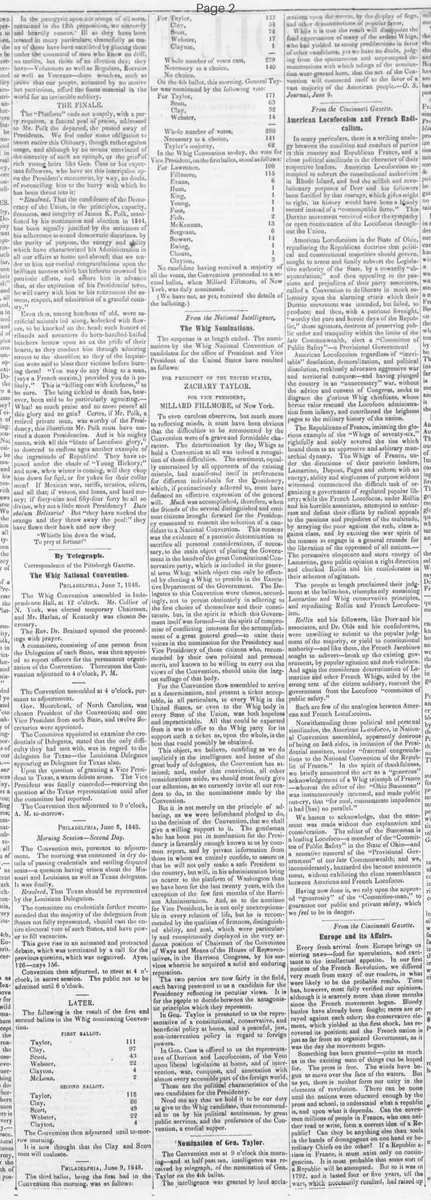
The Whig National Convention convened in Philadelphia from June 7-9, 1848, resolving delegate disputes and nominating Zachary Taylor for President on the fourth ballot and Millard Fillmore for Vice President. Reports detail proceedings, ballots, and supportive commentary from the National Intelligencer.
Merged-components note: Tables of Whig National Convention ballot results are integral to the telegraphic dispatch report on the convention proceedings.
Clipping
OCR Quality
Full Text
Correspondence of the Pittsburgh Gazette.
The Whig National Convention.
PHILADELPHIA, June 7, 1848.
The Whig Convention assembled in Independence Hall, at 12 o'clock. Mr. Collier of N. York, was elected temporary Chairman, and Mr. Harlan, of Kentucky was chosen Secretary.
The Rev. Dr. Brainard opened the proceedings with prayer.
A committee, consisting of one person from the Delegation of each State, was then appointed to report officers for the permanent organization of the Convention. Thereupon the Convention adjourned to 4 o'clock, P. M.
The Convention assembled at 4 o'clock, pursuant to adjournment.
Gov. Morehead, of North Carolina, was chosen President of the Convention; and one Vice President from each State, and twelve Secretaries were appointed.
The Committee appointed to examine the credentials of Delegates, stated that the only difficulty they had met with, was in regard to the delegates for Texas—the Louisiana Delegates appearing as Delegates for Texas also.
Upon the question of granting a Vice President to Texas, a warm debate arose. The Vice President was finally conceded—reserving the question of the Texas representation until after the committee had reported.
The Convention then adjourned to 9 o'clock, A. M. to-morrow.
PHILADELPHIA, June 8, 1848.
Morning Session—Second Day
The Convention met, pursuant to adjournment. The morning was consumed in dry details of passing credentials and settling disputed seats—a question having arisen about the Missouri and Louisiana as well as Texas delegates.
It was finally,
Resolved, That Texas should be represented by the Louisiana Delegation.
The committee on credentials further recommended that the majority of the delegation from States not fully represented, should cast the entire electoral vote of such States, and have power to fill vacancies.
This gave rise to an animated and protracted debate, which was terminated by a call for the previous question, which was negatived. Ayes, 126—nays 156.
Convention then adjourned, to meet at 4 o'clock, in secret session. The public not to be admitted until 6 o'clock.
LATER.
The following is the result of the first and second ballots in the Whig nominating Convention.
FIRST BALLOT.
Taylor, 111
Clay, 97
Scott, 43
Webster 22
Clayton, 4
McLean, 2
SECOND BALLOT.
The Convention then adjourned until to-morrow morning.
It is now thought that the Clay and Scott men will coalesce.
PHILADELPHIA, June 9, 1848.
The third ballot, being the first had in the Convention this morning, was as follows:
No candidate having received a majority of all the votes, the Convention proceeded to a second ballot, when Millard Fillmore, of New York, was duly nominated.
( We have not, as yet, received the details of the balloting.)
From the National Intelligencer,
The Whig Nominations.
The suspense is at length ended. The nominations by the Whig National Convention of candidates for the office of President and Vice President of the United States have resulted as follows:
FOR PRESIDENT OF THE UNITED STATES,
ZACHARY TAYLOR.
FOR VICE PRESIDENT,
MILLARD FILLMORE, of New York.
To even careless observers, but much more to reflecting minds, it must have been obvious that the difficulties to be surmounted by the Convention were of a grave and formidable character.
The determination by the Whigs to hold a Convention at all was indeed a recognition of those difficulties. The sentiment, equally entertained by all opponents of the existing misrule, had manifested itself in preferences for different individuals for the Presidency, which, if pertinaciously adhered to, must have defeated an effective expression of the general will. Much was accomplished, therefore, when the friends of the several distinguished and eminent citizens brought forward for the Presidency consented to commit the selection of a candidate to a National Convention.
This consent was the evidence of a patriotic determination to sacrifice all personal considerations, if necessary, to the main object of placing the Government in the hands of the great Constitutional Conservative party, which is included in the general term Whig; which object can only be effected by electing a Whig to preside in the Executive Department of the Government. The Delegates to this Convention were chosen, accordingly, not to persist obstinately in adhering to the first choice of themselves and their constituents, but, in the spirit in which this Government itself was formed—in the spirit of compromise of conflicting interests for the accomplishment of a great general good—to unite their voices in the nomination for the Presidency and Vice Presidency of those citizens who, recommended by their own political and personal merit, and known to be willing to carry out the views of the Convention, should unite the largest suffrage of that body.
For the Convention thus assembled to arrive at a determination, and present a ticket acceptable, in all particulars, to every Whig in the United States, or even to the Whig body in every State of the Union, was both hopeless and impracticable. All that could be expected from it was to offer to the Whig party for its support such a ticket as, upon the whole, is the best that could possibly be obtained.
This object, we believe, confiding as we do implicitly in the intelligence and honor of the great body of delegates, the Convention has attained; and, under that conviction, all other considerations aside, we should most freely give our adhesion, as we earnestly invite all our readers to do, to the nominations made by the Convention.
But it is not merely on the principle of adhering, as we were beforehand pledged to do, to the decision of the Convention, that we shall give a willing support to it. The gentleman who has been put in nomination for the Presidency is favorably enough known to us by common report, and by private information from those in whom we entirely confide, to assure us that he will not only make a safe President to the country, but will, in his administration bring us nearer to the platform of Washington than we have been for the last twenty years, with the exception of the few first months of the Harrison Administration. And, as to the nominee for Vice President, he is not only unexceptionable in every relation of life, but he is recommended by the qualities of firmness, distinguished ability, and zeal, which were particularly and conspicuously displayed in the very arduous position of Chairman of the Committee of Ways and Means of the House of Representatives, in the Harrison Congress, by his services wherein he acquired a solid and enduring reputation.
The two parties are now fairly in the field, each having presented to us a candidate for the Presidency reflecting its peculiar views. It is for the people to decide between the antagonistic principles which they represent.
In Gen. Taylor is presented to us the representative of a constitutional, conservative, and beneficial policy at home, and a peaceful, just, non-intervention policy in regard to foreign powers.
In Gen. Cass is offered to us the representative of Dorrism and Locofocoism, of the Veto upon liberal legislation at home, and of intervention, war, conquest, and annexation with almost every accessible part of the foreign world.
These are the political characteristics of the two candidates for the Presidency.
Need I say that we hold it to be our duty to give to the Whig candidate, thus recommended to us by his political sentiments, by great public services, and the preference of the Convention, a cordial support.
Nomination of Gen. Taylor.
The Convention met at 9 o'clock this morning—and at half past ten, intelligence was received by telegraph, of the nomination of Gen. Taylor on the 4th ballot.
The intelligence was greeted by loud acclamations upon the streets, by the display of flags, and other demonstrations of popular favor.
While it is true the result will disappoint the fond expectations of many of the ardent Whigs, who had yielded to strong predilections in favor of other candidates, yet we have no doubt, judging from the spontaneous and unprompted demonstrations with which tidings of the nomination were greeted here, that the act of the Convention will commend itself to the favor of a vast majority of the American people.—O. S. Journal, June 9.
| Taylor, | 118 |
| Clay, | 86 |
| Scott, | 49 |
| Webster, | 22 |
| Clayton, | 4 |
| For Taylor, | 133 |
| Clay, | 54 |
| Scott, | 74 |
| Webster, | 17 |
| Clayton, | 1 |
| Whole number of votes cast, | 279 |
| Necessary to a choice, | 140 |
| No choice. | |
| On the 4th ballot, this morning, General Taylor was nominated by the following vote: For Taylor, | 171 |
| Scott, | 63 |
| Clay, | 32 |
| Webster, | 14 |
| Whole number of votes, | 280 |
| Necessary to a choice, | 141 |
| Taylor's majority, | 62 |
| In the Whig Convention to-day, the vote for Vice President, on the first ballot, stood as follows For Lawrence, | 109 |
| Fillmore, | 115 |
| Evans, | 6 |
| Hunt, | 1 |
| King, | 1 |
| Young, | 1 |
| Foot, | 1 |
| Fish, | 2 |
| McKennan, | 13 |
| Sergeant, | 6 |
| Stewart, | 14 |
| Ewing, | 1 |
| Choate, | 1 |
| Clayton, | 3 |
What sub-type of article is it?
What keywords are associated?
What entities or persons were involved?
Where did it happen?
Domestic News Details
Primary Location
Philadelphia
Event Date
June 7 9, 1848
Key Persons
Outcome
zachary taylor nominated for president with 171 votes on the fourth ballot; millard fillmore nominated for vice president. convention resolved delegate disputes, including texas representation by louisiana delegation.
Event Details
The Whig National Convention assembled in Independence Hall, Philadelphia, electing officers, resolving credential disputes for Texas, Missouri, and Louisiana delegates, and conducting ballots. After multiple ballots, Zachary Taylor was nominated for President and Millard Fillmore for Vice President. Proceedings included debates, secret sessions, and prayers.