Thank you for visiting SNEWPapers!
Sign up free
Editorial
May 6, 1839
Lynchburg Virginian
Lynchburg, Virginia
What is this article about?
An editorial criticizes Gen. Gordon for denying his past Whig affiliation while seeking Whig support in the 1839 Amherst district congressional election, urging Whigs to back Maj. Garland instead due to Gordon's perceived duplicity.
Clipping
OCR Quality
97%
Excellent
Full Text
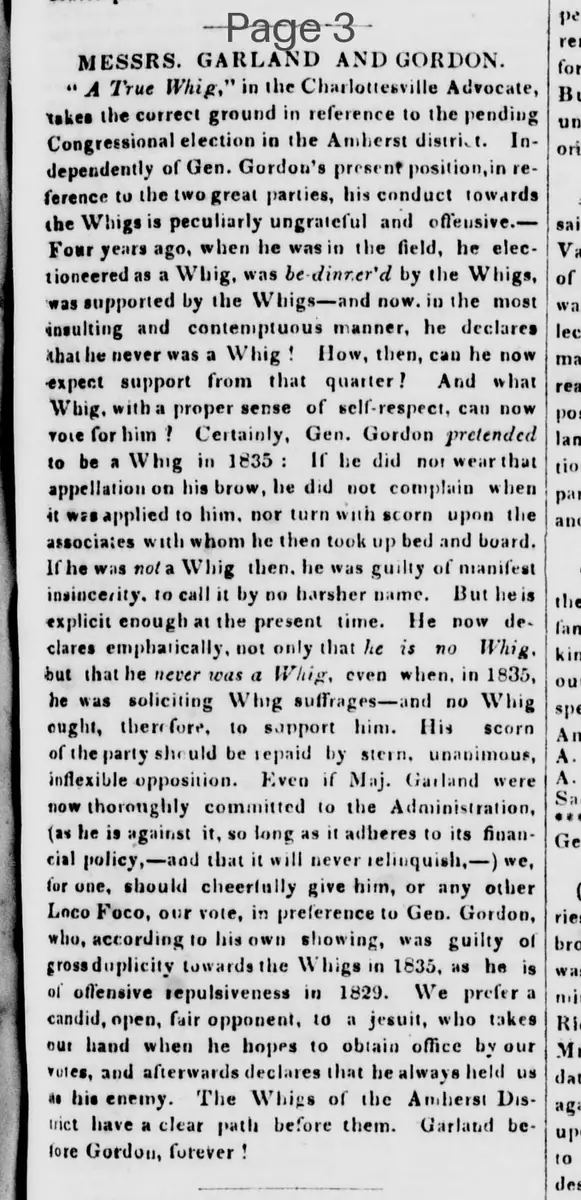
MESSRS. GARLAND AND GORDON.
"A True Whig," in the Charlottesville Advocate takes the correct ground in reference to the pending Congressional election in the Amherst district. Independently of Gen. Gordon's present position, in reference to the two great parties, his conduct towards the Whigs is peculiarly ungrateful and offensive. Four years ago, when he was in the field, he electioneered as a Whig, was be-dinner'd by the Whigs, was supported by the Whigs—and now, in the most insulting and contemptuous manner, he declares that he never was a Whig! How, then, can he now expect support from that quarter! And what Whig, with a proper sense of self-respect, can now vote for him? Certainly, Gen. Gordon pretended to be a Whig in 1835: If he did not wear that appellation on his brow, he did not complain when it was applied to him, nor turn with scorn upon the associates with whom he then took up bed and board. If he was not a Whig then, he was guilty of manifest insincerity, to call it by no harsher name. But he is explicit enough at the present time. He now declares emphatically, not only that he is no Whig, but that he never was a Whig, even when, in 1835, he was soliciting Whig suffrages—and no Whig ought, therefore, to support him. His scorn of the party should be repaid by stern, unanimous, inflexible opposition. Even if Maj. Garland were now thoroughly committed to the Administration, (as he is against it, so long as it adheres to its financial policy,—and that it will never relinquish,—) we, for one, should cheerfully give him, or any other Loco Foco, our vote, in preference to Gen. Gordon, who, according to his own showing, was guilty of gross duplicity towards the Whigs in 1835, as he is of offensive repulsiveness in 1839. We prefer a candid, open, fair opponent, to a Jesuit, who takes our hand when he hopes to obtain office by our votes, and afterwards declares that he always held us "in his enmity." The Whigs of the Amherst District have a clear path before them. Garland before Gordon, forever.
"A True Whig," in the Charlottesville Advocate takes the correct ground in reference to the pending Congressional election in the Amherst district. Independently of Gen. Gordon's present position, in reference to the two great parties, his conduct towards the Whigs is peculiarly ungrateful and offensive. Four years ago, when he was in the field, he electioneered as a Whig, was be-dinner'd by the Whigs, was supported by the Whigs—and now, in the most insulting and contemptuous manner, he declares that he never was a Whig! How, then, can he now expect support from that quarter! And what Whig, with a proper sense of self-respect, can now vote for him? Certainly, Gen. Gordon pretended to be a Whig in 1835: If he did not wear that appellation on his brow, he did not complain when it was applied to him, nor turn with scorn upon the associates with whom he then took up bed and board. If he was not a Whig then, he was guilty of manifest insincerity, to call it by no harsher name. But he is explicit enough at the present time. He now declares emphatically, not only that he is no Whig, but that he never was a Whig, even when, in 1835, he was soliciting Whig suffrages—and no Whig ought, therefore, to support him. His scorn of the party should be repaid by stern, unanimous, inflexible opposition. Even if Maj. Garland were now thoroughly committed to the Administration, (as he is against it, so long as it adheres to its financial policy,—and that it will never relinquish,—) we, for one, should cheerfully give him, or any other Loco Foco, our vote, in preference to Gen. Gordon, who, according to his own showing, was guilty of gross duplicity towards the Whigs in 1835, as he is of offensive repulsiveness in 1839. We prefer a candid, open, fair opponent, to a Jesuit, who takes our hand when he hopes to obtain office by our votes, and afterwards declares that he always held us "in his enmity." The Whigs of the Amherst District have a clear path before them. Garland before Gordon, forever.
What sub-type of article is it?
Partisan Politics
What keywords are associated?
Congressional Election
Amherst District
Whig Party
Gordon Duplicity
Party Loyalty
Loco Foco
Financial Policy
What entities or persons were involved?
Gen. Gordon
Maj. Garland
Whigs
Loco Foco
Administration
A True Whig
Charlottesville Advocate
Editorial Details
Primary Topic
Opposition To Gen. Gordon In Amherst District Election
Stance / Tone
Strongly Anti Gordon, Pro Garland, Emphasizing Whig Party Loyalty
Key Figures
Gen. Gordon
Maj. Garland
Whigs
Loco Foco
Administration
A True Whig
Charlottesville Advocate
Key Arguments
Gen. Gordon's Conduct Towards Whigs Is Ungrateful And Offensive
Gordon Electioneered As A Whig In 1835 But Now Denies Ever Being One
Gordon Guilty Of Insincerity Or Duplicity In 1835
Whigs Should Oppose Gordon Unanimously Due To His Scorn
Prefer Garland Or Any Loco Foco Over Gordon Despite Policy Differences
Gordon's Repulsiveness In 1839 Mirrors His Past Duplicity
Prefer Candid Opponent To Duplicitous Figure Like Gordon