Thank you for visiting SNEWPapers!
Sign up free
Story
May 31, 1915
The Daily Gate City
Keokuk, Lee County, Iowa
What is this article about?
Memorial Day 1915 service at First Baptist Church in Keokuk features Rev. F. B. McAllister's sermon tributing Civil War veterans, recounting the war's history from Fort Sumter to reconstruction, praising women's roles, and calling for ongoing patriotism, moral living, and fighting social ills. (248 characters)
Clipping
OCR Quality
98%
Excellent
Full Text
MONDAY, MAY 31, 1915
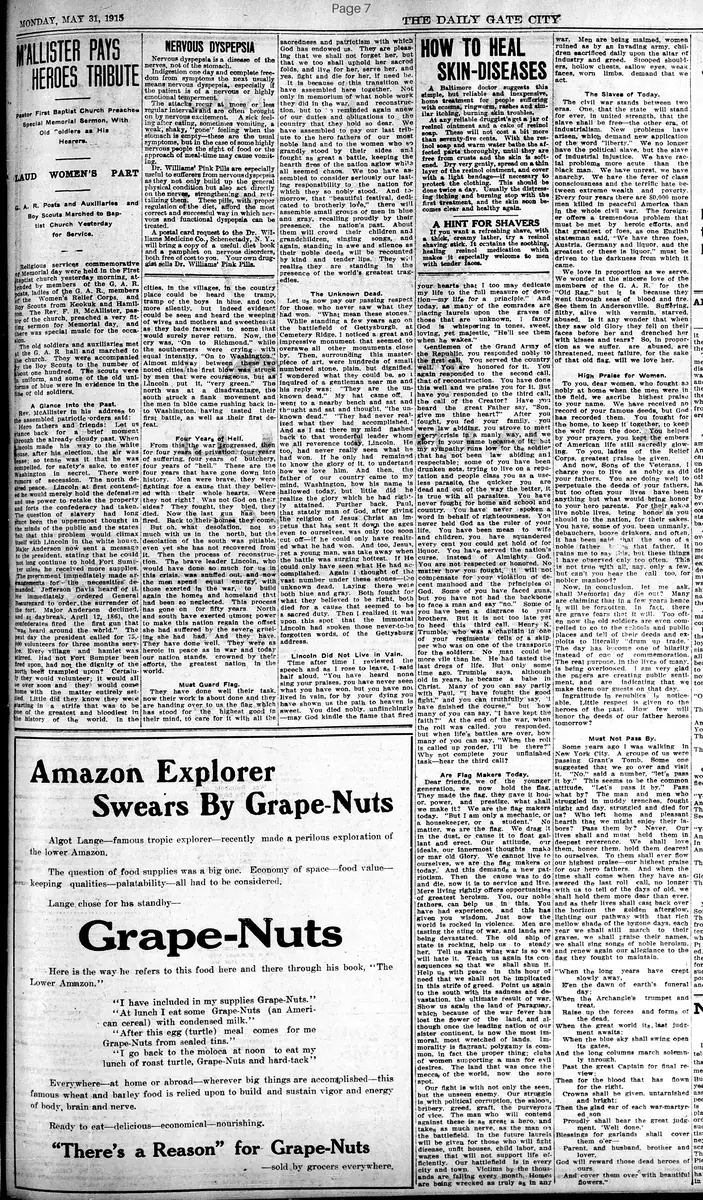
M'ALLISTER PAYS HEROES TRIBUTE
Pastor First Baptist Church Preaches Special Memorial Sermon, With Old Soldiers as His Hearers.
LAUD WOMEN'S PART A. R. Posts and Auxiliaries and Boy Scouts Marched to Baptist Church Yesterday for Service.
Religious services commemorative of Memorial day were held in the First Baptist church yesterday morning, attended by the Women's Relief Corps, and posts, ladies of the G. A. R., members attended by members of the G. A. R. Boy Scouts from Keokuk and Hamilton. The Rev. F. B. McAllister, pastor of the church, preached a very fitting sermon for Memorial day, and there was special music for the occasion.
The old soldiers and auxiliaries met at the G. A. R hall and marched to the church. They were accompanied by the Boy Scouts to the number of about one hundred. The scouts were in uniform, and some of the old uniforms of blue were in evidence in the line of old soldiers.
A Glance Into the Past.
Rev. McAllister in his address to the assembled patriotic orders said:
Hero fathers and friends: Let us glance back for a brief moment through the already cloudy past. When Lincoln made his way to the white house, after his election, the air was tense; so tense was it that he was compelled, for safety's sake, to enter Washington in secret. There were rumors of secession. The north desired peace. Lincoln at first contended he would merely hold the defensive and use power to retake the property and forts the confederacy had taken.
The question of slavery had long since been the uppermost thought in the minds of the public and the states felt that this problem would climax itself with Lincoln in the white house.
Major Anderson now sent a message to the president, stating that he could not long continue to hold Fort Sumter unless he received more supplies.
The government immediately made arrangements for the necessities demanded. Jefferson Davis heard of it. He immediately ordered General Beauregard to order the surrender of the fort. Major Anderson declined, and at daybreak, April 12, 1861, the confederates fired the first gun that was heard around the world. The next day the president called for 75,000 volunteers for three months service. Every village and hamlet was stirred. Had not Fort Sumter been fired upon, had not the dignity of the north been trampled upon? Certainly they would volunteer: it would all be over soon and they would come home with the matter entirely settled. Little did they know they were starting in a strife that was to be one of the greatest and bloodiest in the history of the world. In those
cities, in the villages, in the country place could be heard the tramp, tramp of the boys in blue, and too, more silently, but indeed evident could be seen and heard the weeping of wives and mothers and sweethearts as they bade farewell to some that would surely never return.
Now, the cry was, "On to Richmond," while the southerners were crying, with equal intensity, "On to Washington."
Almost midway between these two noted cities the first blow was struck by men that were courageous, but as Lincoln put it, very green.
The north was at a disadvantage, the south struck a flank movement and the men in blue came rushing back into Washington, having tasted their first battle, as well as their first defeat.
Four Years of Hell.
From this the war progressed, then for four years of privation, four years of suffering, four years of butchery, four years of "hell." These are the four years that have gone down into history. Men were brave, they were fighting for a cause that they believed with their whole hearts. Were they not right? Was not God on their sides? They fought, they bled, they died.
Now the last gun has been fired.
Back to their homes they come. But oh, what desolation. Not much with us in the north, but the desolation of the south was pitiable, even yet she has not recovered from it. Then the process of reconstruction. The brave leader Lincoln, who would have done so much for us in this crisis, was snuffed out, -and now the men spend equal energy, with those exerted in the war, to build again the homes and homeland that had been so neglected.
This process has gone on for fifty years. North and south have exerted utmost power to make this nation regain the offset she had suffered by the severe grueling she had had. And they have. They have done well. They were as heroic in peace as in war and today our nation stands, crowned by their efforts, the greatest nation in the world.
Must Guard Flag.
They have done well their task, now their work is about done and they are handing over to us the flag which has stood for the highest good in their mind, to care for it with all the sacredness and patriotism with which God has endowed us. They are pleading that we shall not forget her, but that we too shall uphold her sacred folds, and live for her, serve her, and yes, fight and die for her, if need be.
It is because of this transition we have assembled here together. Not only in memoriam of what noble work they did in the war and reconstruction, but to be reminded again anew of our duties and obligations to the country that they hold so dear. We have assembled to pay our last tribute to the hero fathers of our most noble land and to the women who so grandly stood by their sides and fought as great a battle, keeping the hearth fires of the nation aglow while all seemed chaos. We too have assembled to consider seriously our lasting responsibility to the nation for which they so nobly stood. - And tomorrow, that "beautiful festival, dedicated to brotherly love," there will assemble small groups of men in blue and gray, recalling proudly by their presence, the nation's past. About them will crowd their children and grandchildren, singing songs, and again, standing in awe and silence as their noble deeds will be recounted by kind and tender lips. They will realize they are standing in the presence of the world's greatest tragedies.
The Unknown Dead.
Let us now pay our passing respect for those who never saw what they had won. "What mean these stones." While standing a few years ago on the battlefield of Gettysburg, at Cemetery Ridge, I noticed a great and impressive monument that seemed to overawe all other monuments close by. Then, surrounding this masterpiece of art, were hundreds of small numbered stones, plain, but dignified. I wondered what they could be, so I inquired of a gentleman near me and his reply was: "They are the unknown dead."
My hat came off. I went to a nearby bench and sat and thought and sat and thought, "the unknown dead." "They had never realized what they had accomplished."
And as I sat there my mind flashed back to that wonderful leader whom we all reverence today, Lincoln. He too, had never really seen what he had won. If he only had remained to know the glory of it, to understand how we love him. And then, the father of our country came to my mind, Washington, how his name is hallowed today, but little did he realize the glory which he had rightly attained. Further back, Paul, that stately man of God, after giving the religion of Jesus Christ an impetus that has sent it down the ages even to ourselves, was only too soon cut off - if he could only have realized what he had won. And too, Jesus, yet a young man, was taken away when the battle was surging hottest. If He could only have seen what He had accomplished. Again I thought of the vast number under these stones - the unknown dead. Lying there were both blue and gray. Both fought for what they believed to be right, both died for a cause that seemed to be a sacred duty. Then I realized it was upon this spot that the immortal Lincoln had spoken those never-to-be-forgotten words, of the Gettysburg address.
Lincoln Did Not Live in Vain.
Time after time I reviewed the speech and as I rose to leave, I said half aloud, "You have heard none sing your praises, you have never seen what you have won, but you have not lived in vain, for by your dying you have shown us the path to heaven is sweet. You died nobly, unflinchingly --may God kindle the flame that fired your hearts that I too may dedicate my life to the full measure of devotion--my life for a principle." And today, as many of the comrades are placing laurels upon the graves of those that are unknown, I fancy God is whispering in tones, sweet, loving, yet majestic, "He'll see them when he wakes."
Gentlemen of the Grand Army of the Republic, you responded nobly to the first call. You served the country well. You are honored for it. You again responded to the second call, that of reconstruction. You have done this well and we praise you for it. But have you responded to the third call, the call of the Creator? Have you heard the great Father say, "Son, give me thine heart?"
After you fought, you fed your family, you were law abiding, you strove to meet every crisis in a manly way, and we glory in your name because of it; but my sympathy runs low for the soldier that has not been law abiding and respectable; some of you have been drunken sots, trying to live on a reputation and people class you as a useless parasite the quicker you are dead and out of the way the better. It is true with all parasites. You have never fought for home and school and country. You have never spoken a word in behalf of righteousness. You never held God as the ruler of your life. You have been mean to wife and children, you have squandered every cent you could get hold of for liquor. You have served the nation's curse, instead of Almighty God.
You are not respected or honored. No matter how you fought; it will not compensate for your violation of decent manhood and the principles of God. Some of you have faced guns, but you have not had the backbone to face a man and say "no." Some of you have been a disgrace to your brothers. But it is not too late yet to heed this third call. Henry K. Trumble, who was a chaplain in one of your regiments tells of a skipper who was on one of the transports for the soldiers. No man could be more vile than he. He had tasted the last dregs of life. But only some time ago, Trumble says, although old in years, he became a babe in Christ. Many of you can say partly with Paul, "I have fought the good fight," and you can truthfully say, "I have finished the course," but how many of you can say, "I have kept the faith?" At the end of the war, when the roll was called, you responded, but when life's battles are over, how many of you can say, "When the roll is called up yonder, I'll be there?"
Why not complete your unfinished task - hear the third call?
We Are Flag Makers Today.
Dear friends, we of the younger generation, we now hold the flag. They made the flag, they gave it honor, power, and prestige, what shall we make it? We are the flag makers today. "But I am only a mechanic, or a housekeeper, or a student." No matter, we are the flag. We drag it in the dust, or cause it to float gallant and erect. Our attitude, our ideals, our innermost thoughts make or mar old Glory. We cannot live to ourselves, we are the flag makers of today. And this demands a new patriotism. Then the cause was to do and die, now it is to service and live. Mere living rightly offers opportunities of greatest heroism. You, our noble fathers, can help us in this. You have had experience, and this has given you wisdom. Just now the world is rocked in violence. Men are tasting the sting of war, and lands are being devastated. The old ship of state is rocking, help us to steady her. Tell us again what war is so we will hate it. Teach us again its consequences so that we shall shun it. Help us with peace in this hour of need that we shall not be implicated in this strife of greed. Point us again to the south with its sadness and devastation, the ultimate result of war. Show us again the land of Paraguay, which because of the war fever has lost the flower of the land, and although once the leading nation of our sister continent, is now the most immoral, most wretched of lands. Immorality is flagrant, polygamy is common, in fact the proper thing: clubs of women supporting a man for evil desires. The land that was once the mecca of the world, now the sore spot.
Our fight is with not only the seen, but the unseen enemy. Our struggle is with political corruption, the saloon, bribery, greed, graft, the purveyors of vice. The man who will contend against these is as great a hero, and takes as much nerve, as the man of the battlefield. In the future laurels will be given for those who will fight disease, unfit houses, child labor, and wages that will not support life efficiently. Our battlefield is in every city and town. Victims by the thousands are falling every month. Homes are being wrecked as truly as in any war. Men are being maimed, women ruined as by an invading army, children sacrificed daily upon the altar of industry and greed. Stooped shoulders, hollow chests, sallow eyes, weak faces, worn limbs, demand that we act.
The Slaves of Today,
The civil war stands between two eras. One, that the state will stand for ever in united strength, that the slave shall be free - the other era, of industrialism. New problems have arisen, which demand new application of the word "liberty." We no longer have the political slave, but the slave of industrial injustice. We have racial problems more acute than the black man. We have unrest, we have anarchy. We have the fever of class consciousness and the terrible hate between extreme wealth and poverty. Every four years there are 50,000 more men killed in peaceful America than in the whole civil war. The foreigner offers a tremendous problem that must be met by heroic efforts, and that greatest of foes, as one English statesman said, "we have three foes, Austria, Germany and liquor, and the greatest of these is liquor," must be driven to the darkness from which it came.
We love in proportion as we serve. We wonder at the sincere love of the members of the G. A. R. for the "Old Flag," but it is because they went through seas of blood and fire. See them in Andersonville. Suffering, filthy, alive with vermin, starved, abused. Is it any wonder that when they saw old Glory they fell on their faces before her and drenched her with kisses and tears? So, in proportion as we suffer, are abused, are threatened, meet failure, for the sake of that old flag, will we love her.
High Praise for Women.
To you, dear women, who fought so nobly at home when the men were in the field, we ascribe highest praise to your name. We have received no record of your famous deeds, but God has recorded them. You fought for the home, to keep it together, to keep the wolf from the door. You helped by your prayers, you kept the embers of American life still sacredly glowing. To you, ladies of the Relief Corps, greatest praise be given.
And now, Sons of the Veterans, I charge you to live as nobly as did your fathers. You are doing well to perpetuate the deeds of your fathers, but too often your lives have been anything but what would bring honor to your hero parents. For their sake live noble lives, bring honor as you should to the nation, for their sakes. You have, some of you, been unmanly, debauchers, booze drinkers, and often, it has been said that the son of a noble father has that father. It pains me to say this, but these things I have observed only too often. This is not true with all, nay, only a few, but can't you hear the call too, for nobler manhood?
Now, in conclusion, let me ask, shall Memorial day die out? Many are claiming that in a few years hence it will be forgotten. In fact, there are grave fears that it will. Too often now the old soldiers are even compelled to go to the schools and public places and tell of their deeds and exploits to literally "drum up trade." The day has become one of hilarity instead of one of commemoration. The real purpose, in the lives of many, is being overlooked. I am very glad the papers are creating public sentiment, and are indicating that we make them our guests on that day. Ingratitude in republics is noticeable. Little respect is given to the heroes of the past. How few will honor the deeds of our father heroes tomorrow?
Must Not Pass By.
Some years ago I was walking in New York City. A group of us were passing Grant's Tomb. Some one suggested that we go over and visit it. "No," said a number, "let's pass it by." This seems to be the common attitude, "Let's pass it by." Pass what by? The man and men who struggled in muddy trenches, fought night and day, struggled and died for us? Who left home and pleasant hearth that we might enjoy their labors? Pass them by? Never. Our lives shall and must hold them in deepest reverence. We shall love them, honor them, hold them dearest to ourselves. To them shall ever flow our highest praise - our highest praise for our hero fathers. And when the time shall come when they have answered the last roll call, no longer with us to tell of the days of old, we shall hold them more dear than ever, and as their lives shall cast back over the horizon the golden afterglow, lighting our pathway with that rich mellow shade of the bygone days, each year we shall still march to their graves, we shall praise their names, we shall sing songs of noble heroism, and renew again our allegiance to the flag they fought to maintain.
"When the long years have crept slowly away,
Even the dawn of earth's funeral day;
When the Archangel's trumpet shall treat.
Raise up the forces and forms of the dead,
When the great world its last judgment awaits:
When the blue sky shall swing open its gates,
And the long columns march solemnly through,
Past the great Captain for final review:
Then for the blood that has flown for the right.
Crowns shall be given, untarnished and bright:
Then the glad ear of each war-martyred son
Proudly shall hear the great judgment, 'Well done.'
Blessings for garlands shall cover them o'er
Parent, and husband, brother and lover,
God will reward those dead heroes of ours.
And cover them over with beautiful flowers."
M'ALLISTER PAYS HEROES TRIBUTE
Pastor First Baptist Church Preaches Special Memorial Sermon, With Old Soldiers as His Hearers.
LAUD WOMEN'S PART A. R. Posts and Auxiliaries and Boy Scouts Marched to Baptist Church Yesterday for Service.
Religious services commemorative of Memorial day were held in the First Baptist church yesterday morning, attended by the Women's Relief Corps, and posts, ladies of the G. A. R., members attended by members of the G. A. R. Boy Scouts from Keokuk and Hamilton. The Rev. F. B. McAllister, pastor of the church, preached a very fitting sermon for Memorial day, and there was special music for the occasion.
The old soldiers and auxiliaries met at the G. A. R hall and marched to the church. They were accompanied by the Boy Scouts to the number of about one hundred. The scouts were in uniform, and some of the old uniforms of blue were in evidence in the line of old soldiers.
A Glance Into the Past.
Rev. McAllister in his address to the assembled patriotic orders said:
Hero fathers and friends: Let us glance back for a brief moment through the already cloudy past. When Lincoln made his way to the white house, after his election, the air was tense; so tense was it that he was compelled, for safety's sake, to enter Washington in secret. There were rumors of secession. The north desired peace. Lincoln at first contended he would merely hold the defensive and use power to retake the property and forts the confederacy had taken.
The question of slavery had long since been the uppermost thought in the minds of the public and the states felt that this problem would climax itself with Lincoln in the white house.
Major Anderson now sent a message to the president, stating that he could not long continue to hold Fort Sumter unless he received more supplies.
The government immediately made arrangements for the necessities demanded. Jefferson Davis heard of it. He immediately ordered General Beauregard to order the surrender of the fort. Major Anderson declined, and at daybreak, April 12, 1861, the confederates fired the first gun that was heard around the world. The next day the president called for 75,000 volunteers for three months service. Every village and hamlet was stirred. Had not Fort Sumter been fired upon, had not the dignity of the north been trampled upon? Certainly they would volunteer: it would all be over soon and they would come home with the matter entirely settled. Little did they know they were starting in a strife that was to be one of the greatest and bloodiest in the history of the world. In those
cities, in the villages, in the country place could be heard the tramp, tramp of the boys in blue, and too, more silently, but indeed evident could be seen and heard the weeping of wives and mothers and sweethearts as they bade farewell to some that would surely never return.
Now, the cry was, "On to Richmond," while the southerners were crying, with equal intensity, "On to Washington."
Almost midway between these two noted cities the first blow was struck by men that were courageous, but as Lincoln put it, very green.
The north was at a disadvantage, the south struck a flank movement and the men in blue came rushing back into Washington, having tasted their first battle, as well as their first defeat.
Four Years of Hell.
From this the war progressed, then for four years of privation, four years of suffering, four years of butchery, four years of "hell." These are the four years that have gone down into history. Men were brave, they were fighting for a cause that they believed with their whole hearts. Were they not right? Was not God on their sides? They fought, they bled, they died.
Now the last gun has been fired.
Back to their homes they come. But oh, what desolation. Not much with us in the north, but the desolation of the south was pitiable, even yet she has not recovered from it. Then the process of reconstruction. The brave leader Lincoln, who would have done so much for us in this crisis, was snuffed out, -and now the men spend equal energy, with those exerted in the war, to build again the homes and homeland that had been so neglected.
This process has gone on for fifty years. North and south have exerted utmost power to make this nation regain the offset she had suffered by the severe grueling she had had. And they have. They have done well. They were as heroic in peace as in war and today our nation stands, crowned by their efforts, the greatest nation in the world.
Must Guard Flag.
They have done well their task, now their work is about done and they are handing over to us the flag which has stood for the highest good in their mind, to care for it with all the sacredness and patriotism with which God has endowed us. They are pleading that we shall not forget her, but that we too shall uphold her sacred folds, and live for her, serve her, and yes, fight and die for her, if need be.
It is because of this transition we have assembled here together. Not only in memoriam of what noble work they did in the war and reconstruction, but to be reminded again anew of our duties and obligations to the country that they hold so dear. We have assembled to pay our last tribute to the hero fathers of our most noble land and to the women who so grandly stood by their sides and fought as great a battle, keeping the hearth fires of the nation aglow while all seemed chaos. We too have assembled to consider seriously our lasting responsibility to the nation for which they so nobly stood. - And tomorrow, that "beautiful festival, dedicated to brotherly love," there will assemble small groups of men in blue and gray, recalling proudly by their presence, the nation's past. About them will crowd their children and grandchildren, singing songs, and again, standing in awe and silence as their noble deeds will be recounted by kind and tender lips. They will realize they are standing in the presence of the world's greatest tragedies.
The Unknown Dead.
Let us now pay our passing respect for those who never saw what they had won. "What mean these stones." While standing a few years ago on the battlefield of Gettysburg, at Cemetery Ridge, I noticed a great and impressive monument that seemed to overawe all other monuments close by. Then, surrounding this masterpiece of art, were hundreds of small numbered stones, plain, but dignified. I wondered what they could be, so I inquired of a gentleman near me and his reply was: "They are the unknown dead."
My hat came off. I went to a nearby bench and sat and thought and sat and thought, "the unknown dead." "They had never realized what they had accomplished."
And as I sat there my mind flashed back to that wonderful leader whom we all reverence today, Lincoln. He too, had never really seen what he had won. If he only had remained to know the glory of it, to understand how we love him. And then, the father of our country came to my mind, Washington, how his name is hallowed today, but little did he realize the glory which he had rightly attained. Further back, Paul, that stately man of God, after giving the religion of Jesus Christ an impetus that has sent it down the ages even to ourselves, was only too soon cut off - if he could only have realized what he had won. And too, Jesus, yet a young man, was taken away when the battle was surging hottest. If He could only have seen what He had accomplished. Again I thought of the vast number under these stones - the unknown dead. Lying there were both blue and gray. Both fought for what they believed to be right, both died for a cause that seemed to be a sacred duty. Then I realized it was upon this spot that the immortal Lincoln had spoken those never-to-be-forgotten words, of the Gettysburg address.
Lincoln Did Not Live in Vain.
Time after time I reviewed the speech and as I rose to leave, I said half aloud, "You have heard none sing your praises, you have never seen what you have won, but you have not lived in vain, for by your dying you have shown us the path to heaven is sweet. You died nobly, unflinchingly --may God kindle the flame that fired your hearts that I too may dedicate my life to the full measure of devotion--my life for a principle." And today, as many of the comrades are placing laurels upon the graves of those that are unknown, I fancy God is whispering in tones, sweet, loving, yet majestic, "He'll see them when he wakes."
Gentlemen of the Grand Army of the Republic, you responded nobly to the first call. You served the country well. You are honored for it. You again responded to the second call, that of reconstruction. You have done this well and we praise you for it. But have you responded to the third call, the call of the Creator? Have you heard the great Father say, "Son, give me thine heart?"
After you fought, you fed your family, you were law abiding, you strove to meet every crisis in a manly way, and we glory in your name because of it; but my sympathy runs low for the soldier that has not been law abiding and respectable; some of you have been drunken sots, trying to live on a reputation and people class you as a useless parasite the quicker you are dead and out of the way the better. It is true with all parasites. You have never fought for home and school and country. You have never spoken a word in behalf of righteousness. You never held God as the ruler of your life. You have been mean to wife and children, you have squandered every cent you could get hold of for liquor. You have served the nation's curse, instead of Almighty God.
You are not respected or honored. No matter how you fought; it will not compensate for your violation of decent manhood and the principles of God. Some of you have faced guns, but you have not had the backbone to face a man and say "no." Some of you have been a disgrace to your brothers. But it is not too late yet to heed this third call. Henry K. Trumble, who was a chaplain in one of your regiments tells of a skipper who was on one of the transports for the soldiers. No man could be more vile than he. He had tasted the last dregs of life. But only some time ago, Trumble says, although old in years, he became a babe in Christ. Many of you can say partly with Paul, "I have fought the good fight," and you can truthfully say, "I have finished the course," but how many of you can say, "I have kept the faith?" At the end of the war, when the roll was called, you responded, but when life's battles are over, how many of you can say, "When the roll is called up yonder, I'll be there?"
Why not complete your unfinished task - hear the third call?
We Are Flag Makers Today.
Dear friends, we of the younger generation, we now hold the flag. They made the flag, they gave it honor, power, and prestige, what shall we make it? We are the flag makers today. "But I am only a mechanic, or a housekeeper, or a student." No matter, we are the flag. We drag it in the dust, or cause it to float gallant and erect. Our attitude, our ideals, our innermost thoughts make or mar old Glory. We cannot live to ourselves, we are the flag makers of today. And this demands a new patriotism. Then the cause was to do and die, now it is to service and live. Mere living rightly offers opportunities of greatest heroism. You, our noble fathers, can help us in this. You have had experience, and this has given you wisdom. Just now the world is rocked in violence. Men are tasting the sting of war, and lands are being devastated. The old ship of state is rocking, help us to steady her. Tell us again what war is so we will hate it. Teach us again its consequences so that we shall shun it. Help us with peace in this hour of need that we shall not be implicated in this strife of greed. Point us again to the south with its sadness and devastation, the ultimate result of war. Show us again the land of Paraguay, which because of the war fever has lost the flower of the land, and although once the leading nation of our sister continent, is now the most immoral, most wretched of lands. Immorality is flagrant, polygamy is common, in fact the proper thing: clubs of women supporting a man for evil desires. The land that was once the mecca of the world, now the sore spot.
Our fight is with not only the seen, but the unseen enemy. Our struggle is with political corruption, the saloon, bribery, greed, graft, the purveyors of vice. The man who will contend against these is as great a hero, and takes as much nerve, as the man of the battlefield. In the future laurels will be given for those who will fight disease, unfit houses, child labor, and wages that will not support life efficiently. Our battlefield is in every city and town. Victims by the thousands are falling every month. Homes are being wrecked as truly as in any war. Men are being maimed, women ruined as by an invading army, children sacrificed daily upon the altar of industry and greed. Stooped shoulders, hollow chests, sallow eyes, weak faces, worn limbs, demand that we act.
The Slaves of Today,
The civil war stands between two eras. One, that the state will stand for ever in united strength, that the slave shall be free - the other era, of industrialism. New problems have arisen, which demand new application of the word "liberty." We no longer have the political slave, but the slave of industrial injustice. We have racial problems more acute than the black man. We have unrest, we have anarchy. We have the fever of class consciousness and the terrible hate between extreme wealth and poverty. Every four years there are 50,000 more men killed in peaceful America than in the whole civil war. The foreigner offers a tremendous problem that must be met by heroic efforts, and that greatest of foes, as one English statesman said, "we have three foes, Austria, Germany and liquor, and the greatest of these is liquor," must be driven to the darkness from which it came.
We love in proportion as we serve. We wonder at the sincere love of the members of the G. A. R. for the "Old Flag," but it is because they went through seas of blood and fire. See them in Andersonville. Suffering, filthy, alive with vermin, starved, abused. Is it any wonder that when they saw old Glory they fell on their faces before her and drenched her with kisses and tears? So, in proportion as we suffer, are abused, are threatened, meet failure, for the sake of that old flag, will we love her.
High Praise for Women.
To you, dear women, who fought so nobly at home when the men were in the field, we ascribe highest praise to your name. We have received no record of your famous deeds, but God has recorded them. You fought for the home, to keep it together, to keep the wolf from the door. You helped by your prayers, you kept the embers of American life still sacredly glowing. To you, ladies of the Relief Corps, greatest praise be given.
And now, Sons of the Veterans, I charge you to live as nobly as did your fathers. You are doing well to perpetuate the deeds of your fathers, but too often your lives have been anything but what would bring honor to your hero parents. For their sake live noble lives, bring honor as you should to the nation, for their sakes. You have, some of you, been unmanly, debauchers, booze drinkers, and often, it has been said that the son of a noble father has that father. It pains me to say this, but these things I have observed only too often. This is not true with all, nay, only a few, but can't you hear the call too, for nobler manhood?
Now, in conclusion, let me ask, shall Memorial day die out? Many are claiming that in a few years hence it will be forgotten. In fact, there are grave fears that it will. Too often now the old soldiers are even compelled to go to the schools and public places and tell of their deeds and exploits to literally "drum up trade." The day has become one of hilarity instead of one of commemoration. The real purpose, in the lives of many, is being overlooked. I am very glad the papers are creating public sentiment, and are indicating that we make them our guests on that day. Ingratitude in republics is noticeable. Little respect is given to the heroes of the past. How few will honor the deeds of our father heroes tomorrow?
Must Not Pass By.
Some years ago I was walking in New York City. A group of us were passing Grant's Tomb. Some one suggested that we go over and visit it. "No," said a number, "let's pass it by." This seems to be the common attitude, "Let's pass it by." Pass what by? The man and men who struggled in muddy trenches, fought night and day, struggled and died for us? Who left home and pleasant hearth that we might enjoy their labors? Pass them by? Never. Our lives shall and must hold them in deepest reverence. We shall love them, honor them, hold them dearest to ourselves. To them shall ever flow our highest praise - our highest praise for our hero fathers. And when the time shall come when they have answered the last roll call, no longer with us to tell of the days of old, we shall hold them more dear than ever, and as their lives shall cast back over the horizon the golden afterglow, lighting our pathway with that rich mellow shade of the bygone days, each year we shall still march to their graves, we shall praise their names, we shall sing songs of noble heroism, and renew again our allegiance to the flag they fought to maintain.
"When the long years have crept slowly away,
Even the dawn of earth's funeral day;
When the Archangel's trumpet shall treat.
Raise up the forces and forms of the dead,
When the great world its last judgment awaits:
When the blue sky shall swing open its gates,
And the long columns march solemnly through,
Past the great Captain for final review:
Then for the blood that has flown for the right.
Crowns shall be given, untarnished and bright:
Then the glad ear of each war-martyred son
Proudly shall hear the great judgment, 'Well done.'
Blessings for garlands shall cover them o'er
Parent, and husband, brother and lover,
God will reward those dead heroes of ours.
And cover them over with beautiful flowers."
What sub-type of article is it?
Historical Event
Heroic Act
Biography
What themes does it cover?
Bravery Heroism
Moral Virtue
Providence Divine
What keywords are associated?
Memorial Day
Civil War
Veterans
Sermon
Patriotism
G.A.R.
Reconstruction
Faith
What entities or persons were involved?
Rev. F. B. Mcallister
Lincoln
Major Anderson
Jefferson Davis
General Beauregard
Washington
Paul
Jesus
Henry K. Trumble
Where did it happen?
First Baptist Church, Keokuk
Story Details
Key Persons
Rev. F. B. Mcallister
Lincoln
Major Anderson
Jefferson Davis
General Beauregard
Washington
Paul
Jesus
Henry K. Trumble
Location
First Baptist Church, Keokuk
Event Date
1915 05 31
Story Details
Rev. McAllister preaches a Memorial Day sermon honoring Civil War veterans of the G.A.R., recounting the war's outbreak at Fort Sumter, its hardships, reconstruction, and urging the younger generation to uphold patriotism, fight modern evils, and heed the call to faith.