Thank you for visiting SNEWPapers!
Sign up free
Belmont Chronicle
Saint Clairsville, Belmont County, Ohio
What is this article about?
During Boston's Universalist anniversary festival in Faneuil Hall in early June, Rev. N. M. Gaylord delivered an eloquent speech praising the West's fertile prairies, broad principles, rich sentiments, personal memories, cultural achievements, and role as the future seat of American empire and union preserver.
Clipping
OCR Quality
Full Text
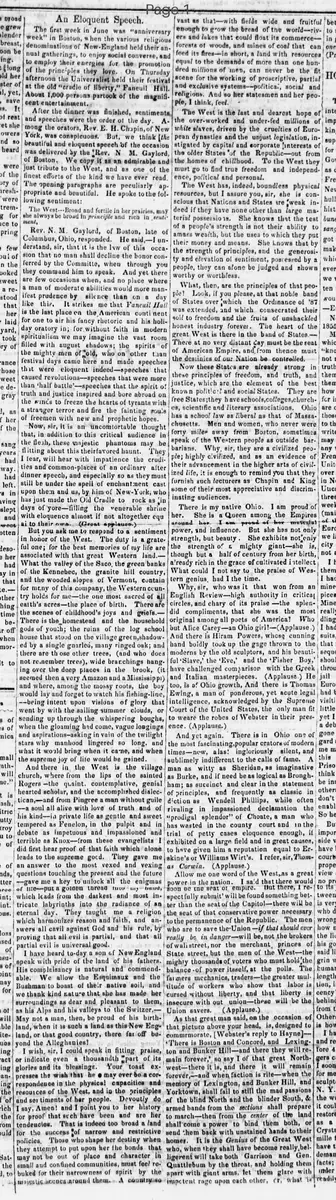
The first week in June was "anniversary week" in Boston, when the various religious denominations of New-England held their annual gatherings, to enjoy social converse, and to employ their energies for, the promotion of the principles they love. On Thursday afternoon the Universalist held their festival at the old "cradle of Liberty." Faneuil Hall. About 1,000 persons partook of the magnificent entertainment.
After the dinner was finished, sentiments and speeches were the order of the day. Among the orators, Rev. E. H. Chapin, of New York, was conspicuous. But, we think the beautiful and eloquent speech of the occasion was delivered by the Rev. N. M. Gaylord, of Boston. We copy it as an admirable and just tribute to the West, and as one of the finest efforts of the kind we have ever read. The opening paragraphs are peculiarly appropriate and beautiful. He spoke to the following sentiment:
The West---Broad and fertile in her prairies, may she always be broad in principle and rich in sentiment.
Rev. N. M. Gaylord, of Boston, late of Columbus, Ohio, responded. He said,--I understand, sir, that it is the law of this occasion that no man shall decline the honor conferred by the Committee, when through you they command him to speak. And yet there are few occasions when, and no place where a man of moderate abilities would more manifest prudence by silence than on a day like this. It strikes me that Faneuil Hall is the last place on the American continent for one to air his fancy rhetoric and his holiday oratory in; for without faith in modern spiritualism we may imagine the vast room filled with august shadows; the spirits of the mighty men of old, who on other than festival days came here and made speeches that were eloquent indeed-speeches that caused revolutions--speeches that were more than 'half battle'--speeches that the spirit of truth and justice inspired and bore abroad on the wings to freeze the hearts of tyrants with a stranger terror and fire the fainting souls of freemen with new and prophetic hopes.
Now, sir, it is an uncomfortable thought that, in addition to this critical audience in the flesh, these majestic phantoms may be flitting about this their favored haunt. They I fear, will hear with impatience the crudities and common-places of an ordinary after dinner speech, and especially so as they must still be under the spell of enchantment cast upon them and us, by him of New-York, who has just made the Old Cradle to rock as in days of yore-filling the venerable shrine with eloquence almost if not altogether equal to their own. (Great applause.)
But you ask me to respond to a sentiment in honor of the West. The duty is a grateful one; for the best memories of my life are associated with that great Western land. What the valley of the Saco, the green banks of the Kennebec, the granite hill country, and the wooded slopes of Vermont, contain for many of this company, the Western country holds for me-the one most sacred of all earth's acres-the place of birth. There are the scenes of childhood's joys and griefs. There is the homestead and the household gods of youth; the ruins of the log school house that stood on the village green, shadowed by a single gnarled, many ringed oak; and there are those other trees, (and who does not remember trees), wide branchings hanging over the deep places in the brook, (it seemed then a very Amazon and a Mississippi) and where, among the mossy roots, the boy would lay and forget to watch his fishing-line, --being intent upon visions of glory that went by with the sailing summer clouds, or sending up through the whispering boughs, when the gloaming had come, vague longings and aspirations-asking in vain of the twilight stars why manhood lingered so long, and what it would bring when it came, and when the supreme joy of life would be gained.
And there in the West is the village church, where from the lips of the sainted Rogers -the quaint, contemplative, genial hearted scholar, and the accomplished dialectician,-and from Pingree a man without guile --a soul all alive with love of truth and of his kind--in private life as gentle and sweet tempered as Fenelon, in the pulpit and in debate as impetuous and impassioned and terrible as Knox--from these evangelists I did first hear proof of that faith which alone leads to the supreme good. They gave me an answer to the most vexed and vexing questions touching the present and the future --gave me a key to unlock all the enigmas of life-put a golden thread into my hand, which leads from the darkest and most intricate labyrinths into the radiance of an eternal day. They taught me a religion
I have heard to-day a son of New England speak with pride of the land of his fathers. His complacency is natural and commendable. We allow the Esquimaux and the Bushman to boast of their native soil, and we thank kind nature that she has made her surroundings as dear and pleasant to them, as his Alps and his valleys to the Switzer,- May not a man, then, be proud of his birth-land, when it is such a land as this New England, or that good country, there far off beyond the Alleghanies?
I wish, sir, I could speak in fitting praise, or indicate even a thousandth part of its glories and its blessings. Your toast expresses the wish that she may ever be a correspondence in the physical capacities and resources of the West, and in the principles and sentiments of her people. Devoutly do I say, Amen! and I point you to her history for proof that such have been and are her tendencies. That is indeed too broad a land for the success of narrow and restrictive policies. Those who shape her destiny when they attempt to put upon her the bonds that may not be out of place and character in small and confined communities, must feel rebuked for their narrowness of spirit by the majestic scenes around them. A country so
with resources equal to the demands of more than one hundred millions of men, can never be the fit scene for the working of proscriptive, partial and exclusive systems--political, social and religious. And so her statesmen and her people, I think, feel.
The West is the last and dearest hope of the over-worked and under-fed millions of white slaves, driven by the cruelties of European dynasties and the unjust legislation, instigated by capital and corporate interests of the older States of the Republic-out from the homes of childhood. To the West they must go to find true freedom and independence, political and personal.
The West has, indeed, boundless physical resources, but I assure you, sir, she is conscious that Nations and States are weak indeed if they have none other than large material possessions. She knows that the test of a people's strength is not their ability to amass wealth, but the uses to which they put their money and means. She knows that by the strength of principles, and the generosity and elevation of sentiment, possessed by a people, they can alone be judged and shown worthy or worthless.
What, then, are the principles of that people? Look, if you please, at that noble band of States over which the Ordinance of '87 was extended, and which consecrated their soil to freedom and the fruits of unshackled honest industry forever. The heart of the great West is there in the band of States.-- There at no very distant day must be the seat of American Empire, and from thence must the destinies of our Nation be controlled.
Now these States are already strong in these principles of freedom, and truth, and justice, which are the element of the best known political and social States. They are free States; they have schools, colleges, churches, scientific and literary associations. Ohio has a school law as liberal as that of Massachusetts. Men and women, who never were forty miles away from Boston, sometimes speak of the Western people as outside barbarians. Why, sir, they are a civilized people; highly civilized, and as an evidence of their advancement in the higher arts of civilized life, it is enough to remind you that they furnish such lecturers as Chapin and King some of their most appreciative and discriminating audiences.
There is my native Ohio. I am proud of her. She is a Queen among the Empires around her. I am proud of her material power, and influence. But she has not only strength, but beauty. She exhibits not only the strength of a mighty giant-she is, though but a half century from her birth, already rich in the grace of cultivated intellect What could I not say to the praise of Western genius, had I the time.
Why, sir, who was it that won from an English Review-high authority in critical circles, and chary of its praise -the splendid compliments, that she was the most original among all poets of America? Who but Alice Cary-an Ohio girl!-(Applause.)
And there is Hiram Powers, whose cunning hand boldly took up the gage thrown to the moderns by the old sculptors, and his beautiful 'Slave,' the 'Eve,' and the 'Fisher Boy,' have challenged comparison with the Greek and Italian masterpieces. (Applause.) He too, is of Ohio growth. And there is Thomas Ewing, a man of ponderous, yet acute legal intelligence, acknowledged by the Supreme Court of the United States, the only man fit to wear the robes of Webster in their presence.(Applause.)
And yet again. There is in Ohio one of the most fascinating, popular orators of modern times-now, alas! ingloriously silent, and sublimely indifferent to the calls of fame. A man as witty as Sheridan, as imaginative as Burke, and if need be as logical as Brougham; as succinct and clear in the statement of principles, and frequently as classic in diction as Wendell Phillips, while often rivaling in impassioned declamation the "prodigal splendor" of Choate, a man who has wasted in the county court and in the trial of petty cases eloquence enough, if exhibited on a large field and in great causes, to have given him a reputation equal to Erskine's or William Wirt's. I refer, sir, Thomas Corwin. (Applause.)
Allow me one word of the West, as a great power in the nation. I said that there would soon be the seat of empire. But there, I respectfully submit, will be found something better than the seat of the Capitol-there will be the seat of that conservative power necessary to the permanence of the Republic. The men who are to save the Union -if that should ever really be in danger-will be, not the brokers of Wall Street, nor the merchant princes of State street, but the men of the West -the mighty thousands of voters who must hold the balance-of power itself, at the polls. The farmers mechanics, traders-the greater multitude of workers who show that labor is cursed without liberty, and that liberty is insecure without union-these will be the Union savers. (Applause.)
As that great man said, on the occasion of that picture above your head, is, designed to commemorate, [Webster's reply to Hayne]-- There is Boston and Concord, and Lexington and Bunker Hill-and there they will remain forever, so say I of that great North-west-there it is, and there it will remain forever,--and when faction is rife-when the memory of Lexington, and Bunker Hill, and Yorktown, shall fail to still the mad passions of the blind North and the blinder South, & armed bands from the sections shall prepare to march-then from the center of the land shall come a power to bind them both, or send them back with unstained hands to their homes. It is the Genius of the Great West who, when they shall have become really belligerent will take both Garrison and Gen. Quattlebum by the throat, and holding them apart with giant arms, let them glare with impotent rage upon each other, or, what is better, like a great Pacificator, induce them to repeat in concert the magic words written in gold upon that wall,--'Liberty and Union, one and inseparable!'
(Prolonged applause.)
What sub-type of article is it?
What themes does it cover?
What keywords are associated?
What entities or persons were involved?
Where did it happen?
Story Details
Key Persons
Location
Faneuil Hall, Boston
Event Date
First Week In June
Story Details
Rev. N. M. Gaylord delivers a speech at the Universalist festival honoring the West, sharing personal childhood memories, praising its principles of freedom and justice, highlighting cultural figures from Ohio, and envisioning the West as the future center of American empire and preserver of the Union.