Thank you for visiting SNEWPapers!
Sign up free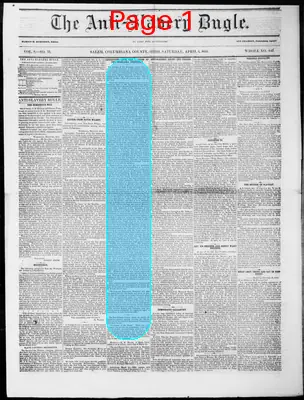
Story
April 1, 1854
Anti Slavery Bugle
New Lisbon, Salem, Columbiana County, Ohio
What is this article about?
Missouri newspaper expresses outrage over the unequal division of Nebraska and Kansas territories, preferential treatment in Indian land purchases for Nebraska, and Senator Douglas's role in repealing the Missouri Compromise to block Missouri's western expansion and railroad ambitions.
Clipping

OCR Quality
98%
Excellent
Full Text
DISCONTENT WITH THE DIVISION OF THE NEBRASKA TERRITORY
The division of the Nebraska region into two territories, and the mode of that division, together with the policy which has governed the negotiations for purchasing the Indian lands in that region, have given great dissatisfaction at the West, in the neighborhood of the Nebraska frontier. The St. Joseph Gazette, a Missouri journal, says:—[N. Y. Eve. Post.]
"Some two months since, instructions were forwarded in haste to Mr. Gatewood, Indian agent, enjoining him to proceed forthwith to treat with, or ascertain the wishes of the Omahas and the Ottoe's nations, bordering the Platte river, and to make arrangements for sending on delegations of chiefs to Washington, who should be fully empowered to treat there for a sale of their lands. Previous to that time, however, Indian agents for tribes west of Missouri, among whom may be cited Mr. James, agent for the Sacs and Foxes, and Mr. Robinson, agent for the Shawnees, Delawares, and others, had transmitted to the department official letters, requesting that they might be permitted to do the same thing, and make a similar arrangement in regard to the tribes under their supervision. These requests reached Washington, were quietly shelved, and the privilege refused. This shows the distinction made in the Indian Bureau between Kansas and Nebraska, for it was granted in the latter, and refused in the former, without a reason given. But this is not all. About the time this course was decided upon, it will be remembered that Senator Douglas, under cover of a mere pretext that this first bill divides the Cherokee country, introduced as a substitute, two separate and distinct bills for Kansas and Nebraska. The dividing line between these territories was the fortieth parallel, which strikes the Missouri river near the mouth of the great Nama ha; and the southern boundary of Kansas was made the thirty-seventh parallel; that is, running north of the Cherokee country altogether, and north of the southwestern counties of this state. In other words, Kansas territory was made to extend from the thirty-seventh to the fortieth parallel, or from Holt county to Jasper county, on our frontier. Nor is the end yet. In addition to the section of a dividing line violating geography as well as topography, the bills thus framed were encumbered, and that, too, in direct conflict with the report of the Committee on Territories, with a clause repealing the Missouri Compromise of 1820, so as to embarrass their passage with the delays of a new slavery agitation.
"Thus it will be seen, that the two territories have been so organized and modelled as to throw Kansas, with its bulk of Indian reservations, just athwart the central portion of Missouri: that the privilege of extinguishing Indian titles, without delay, has been granted in Nebraska and refused in Kansas: that the whole Cherokee country has been purposely left out of the latter territory, and the hope of white settlement there indefinitely postponed for want of a government; and that to the tail of the whole is tacked a new fanaticism. And can any citizen of Missouri fail to apprehend in an instant, the drift of this dovetailed, systematic, contemporaneous movement? Does it not flash upon the intelligence of every one, that it is a blow aimed at the advance of the growing West; that it is a fraudulent attempt to deprive the citizens of this state of all the advantages of entering at once upon the rich vallies of the Missouri, the Kansas, the Neosho: and that it is a deliberate design to defeat every possible chance of centering the Pacific railroad through any part of Missouri. A rival state is to be speedily peopled in the north, by the early extension of the settlement of Nebraska, which is to compete with Kansas and with Missouri for the route to the ocean, and thus that prominence we have already acquired by our liberal policy of internal improvement is to be negatived. The Indians who now occupy the richest lands on our border and far into the interior, will, if suffered to remain any length of time, as is now the foreshadowed policy, effectually prevent the extension of the Saint Joseph and Hannibal, as also the Kansas branch of the Pacific railroad, and the obstacle interposed by the Cherokee nation will defeat even a connection with the Texas route by means of the southwestern branch railroad for this tribe now occupies the whole country through which such a connection would run, and they are left beyond the pale of the territory. Not satisfied with cutting off the heart of the state from all its outgoings, even the arms that might gather a mite of wealth, are amputated also. The beautiful grounds that roll in prairie and forest, in the vallies of the Kansas, the Vermillion, the Wakaroosa, the deep alluvial bottoms of the Missouri, the luxuriant lands which swell up from those streams and crown the divides, must be left untrodden by our farmers until the tide of emigration shall have first borne on the sand hills of the Platte, and have re-built "Old Fort Kearney." The wishes, too, of those who are to be the inhabitants of this region, as expressed most emphatically in the late Nebraska convention, held at this place, have been ignored and disregarded, and in spite of their earnest remonstrance a reckless re-agitation has been commenced upon the subject of a repeal of the act of 1820. All know full well who stands responsible for this share of the guilty plot, and who those are from Missouri who have joined in this work of hedging in the outlets of our trade, and have sacrificed the interests of our citizens to a political intrigue."
After administering a reprimand to Douglas and Atchison, and to the Commissioner of Indian Affairs, for the part they have taken in the matter, the St. Joseph Gazette says:
"We hope our Democratic President will take this matter into his own hands, and see to it himself that this outrage be no longer tolerated, which operates so injuriously upon one section of the Union. No difference should be made between one section and another. It is due to the purity of the President, and it is due to us, that he shall execute the law which provides for making Indian treaties—that he shall cause his clerks to act with impartiality between Kansas and Nebraska—and proceed at once to extinguish the 'vagabond rights' of the Indians, in both territories alike."
The New Orleans Crescent closes an article designed as a protest against reviving the Slavery agitation by the repeal of the Missouri Compromise, with these words:
"Gentlemen of the South! When you were stronger, you got the old compromise; now, when you are weaker, you had better stick to it. Nay, stick to all the compromises, for, be assured that the next agitation—that is to say, this, if you are drawn into it—will, in all human probability, be the last. There'll never be another compromise; rely on that easy prophecy."
The division of the Nebraska region into two territories, and the mode of that division, together with the policy which has governed the negotiations for purchasing the Indian lands in that region, have given great dissatisfaction at the West, in the neighborhood of the Nebraska frontier. The St. Joseph Gazette, a Missouri journal, says:—[N. Y. Eve. Post.]
"Some two months since, instructions were forwarded in haste to Mr. Gatewood, Indian agent, enjoining him to proceed forthwith to treat with, or ascertain the wishes of the Omahas and the Ottoe's nations, bordering the Platte river, and to make arrangements for sending on delegations of chiefs to Washington, who should be fully empowered to treat there for a sale of their lands. Previous to that time, however, Indian agents for tribes west of Missouri, among whom may be cited Mr. James, agent for the Sacs and Foxes, and Mr. Robinson, agent for the Shawnees, Delawares, and others, had transmitted to the department official letters, requesting that they might be permitted to do the same thing, and make a similar arrangement in regard to the tribes under their supervision. These requests reached Washington, were quietly shelved, and the privilege refused. This shows the distinction made in the Indian Bureau between Kansas and Nebraska, for it was granted in the latter, and refused in the former, without a reason given. But this is not all. About the time this course was decided upon, it will be remembered that Senator Douglas, under cover of a mere pretext that this first bill divides the Cherokee country, introduced as a substitute, two separate and distinct bills for Kansas and Nebraska. The dividing line between these territories was the fortieth parallel, which strikes the Missouri river near the mouth of the great Nama ha; and the southern boundary of Kansas was made the thirty-seventh parallel; that is, running north of the Cherokee country altogether, and north of the southwestern counties of this state. In other words, Kansas territory was made to extend from the thirty-seventh to the fortieth parallel, or from Holt county to Jasper county, on our frontier. Nor is the end yet. In addition to the section of a dividing line violating geography as well as topography, the bills thus framed were encumbered, and that, too, in direct conflict with the report of the Committee on Territories, with a clause repealing the Missouri Compromise of 1820, so as to embarrass their passage with the delays of a new slavery agitation.
"Thus it will be seen, that the two territories have been so organized and modelled as to throw Kansas, with its bulk of Indian reservations, just athwart the central portion of Missouri: that the privilege of extinguishing Indian titles, without delay, has been granted in Nebraska and refused in Kansas: that the whole Cherokee country has been purposely left out of the latter territory, and the hope of white settlement there indefinitely postponed for want of a government; and that to the tail of the whole is tacked a new fanaticism. And can any citizen of Missouri fail to apprehend in an instant, the drift of this dovetailed, systematic, contemporaneous movement? Does it not flash upon the intelligence of every one, that it is a blow aimed at the advance of the growing West; that it is a fraudulent attempt to deprive the citizens of this state of all the advantages of entering at once upon the rich vallies of the Missouri, the Kansas, the Neosho: and that it is a deliberate design to defeat every possible chance of centering the Pacific railroad through any part of Missouri. A rival state is to be speedily peopled in the north, by the early extension of the settlement of Nebraska, which is to compete with Kansas and with Missouri for the route to the ocean, and thus that prominence we have already acquired by our liberal policy of internal improvement is to be negatived. The Indians who now occupy the richest lands on our border and far into the interior, will, if suffered to remain any length of time, as is now the foreshadowed policy, effectually prevent the extension of the Saint Joseph and Hannibal, as also the Kansas branch of the Pacific railroad, and the obstacle interposed by the Cherokee nation will defeat even a connection with the Texas route by means of the southwestern branch railroad for this tribe now occupies the whole country through which such a connection would run, and they are left beyond the pale of the territory. Not satisfied with cutting off the heart of the state from all its outgoings, even the arms that might gather a mite of wealth, are amputated also. The beautiful grounds that roll in prairie and forest, in the vallies of the Kansas, the Vermillion, the Wakaroosa, the deep alluvial bottoms of the Missouri, the luxuriant lands which swell up from those streams and crown the divides, must be left untrodden by our farmers until the tide of emigration shall have first borne on the sand hills of the Platte, and have re-built "Old Fort Kearney." The wishes, too, of those who are to be the inhabitants of this region, as expressed most emphatically in the late Nebraska convention, held at this place, have been ignored and disregarded, and in spite of their earnest remonstrance a reckless re-agitation has been commenced upon the subject of a repeal of the act of 1820. All know full well who stands responsible for this share of the guilty plot, and who those are from Missouri who have joined in this work of hedging in the outlets of our trade, and have sacrificed the interests of our citizens to a political intrigue."
After administering a reprimand to Douglas and Atchison, and to the Commissioner of Indian Affairs, for the part they have taken in the matter, the St. Joseph Gazette says:
"We hope our Democratic President will take this matter into his own hands, and see to it himself that this outrage be no longer tolerated, which operates so injuriously upon one section of the Union. No difference should be made between one section and another. It is due to the purity of the President, and it is due to us, that he shall execute the law which provides for making Indian treaties—that he shall cause his clerks to act with impartiality between Kansas and Nebraska—and proceed at once to extinguish the 'vagabond rights' of the Indians, in both territories alike."
The New Orleans Crescent closes an article designed as a protest against reviving the Slavery agitation by the repeal of the Missouri Compromise, with these words:
"Gentlemen of the South! When you were stronger, you got the old compromise; now, when you are weaker, you had better stick to it. Nay, stick to all the compromises, for, be assured that the next agitation—that is to say, this, if you are drawn into it—will, in all human probability, be the last. There'll never be another compromise; rely on that easy prophecy."
What sub-type of article is it?
Historical Event
Deception Fraud
What themes does it cover?
Deception
Misfortune
Justice
What keywords are associated?
Nebraska Territory
Kansas Territory
Indian Lands
Missouri Compromise
Senator Douglas
Pacific Railroad
What entities or persons were involved?
Senator Douglas
Atchison
Mr. Gatewood
Mr. James
Mr. Robinson
Commissioner Of Indian Affairs
Where did it happen?
Nebraska Frontier, Missouri, Kansas
Story Details
Key Persons
Senator Douglas
Atchison
Mr. Gatewood
Mr. James
Mr. Robinson
Commissioner Of Indian Affairs
Location
Nebraska Frontier, Missouri, Kansas
Story Details
Dissatisfaction in Missouri over the division of Nebraska into two territories, favoring Nebraska in Indian land negotiations while denying Kansas, orchestrated by Senator Douglas to repeal the Missouri Compromise and hinder Missouri's expansion and Pacific railroad routes.