Thank you for visiting SNEWPapers!
Sign up free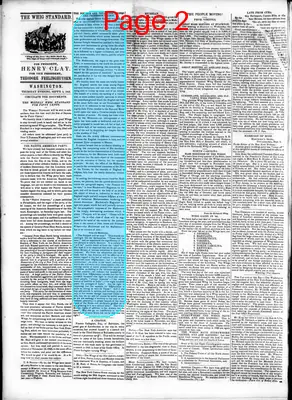
Editorial
September 5, 1844
The Whig Standard
Washington, District Of Columbia
What is this article about?
Editorial critiques the Madisonian's comparison of British conquests in Asia (Punjaub, Affghanistan) to U.S. President John Tyler's expansionist aims toward Texas and Mexico, arguing the cases differ as Britain targets pagans while U.S. would invade Christian Mexico without justification, aiming for territorial gain rather than spreading liberty.
Clipping

OCR Quality
95%
Excellent
Full Text
THE PUNJAUB AND TEXAS—JOHN JONES AND PROFESSOR WILSON.
The only apology which England can possibly offer to the civilized and Christian world for her conquests in Asia, where in less than a century she has conquered a hundred millions of subjects, is the dissemination of Christianity, civilization, and civil liberty, which necessarily takes place from the intercourse which arises between the home government and the foreign dominions. The Romans thought themselves justified in their conquests over barbarians by giving them the single boon of civilization; whereas, the English sceptre is followed by a higher civilization, and what is yet more valuable, civil liberty, and the religion which is true.
The Madisonian, the organ of the great John Tyler, in announcing to the world the purpose of that potentate, of emulating the conquering career of the British sovereign, evinces "a decent respect for the opinions of mankind," by placing the justification of his war-like designs upon the example of Britain.
We humbly think the cases are totally dissimilar. England carries her arms among Pagans and semi-barbarians, and not even there without being able to trump up some sort of an excuse. The breach of a treaty, the sacking of a trading post, or some pretext equally specious, is always the immediate ground which the English set forth as the casus belli—just as our Government was wont to do in reference to the Indians. But the mighty John Tyler, brother to the Sun and Moon, would make war upon a Christian people without the shadow of excuse. No treaty has been violated by the Mexicans—no infringement of our rights has been made or meditated, and yet it is coolly proposed to invade her, rob her of half, and the better half, of her territory, and then pay the cost of the war by despoiling her temples devoted to the worship of God.
Such are the widely different circumstances between the English conquests in Asia, and the proposed Tyler conquests in Mexico.
It cannot be said that an incidental blessing attending the conquering arms of His Accidency would be the further dissemination of Christianity or civilization, for the Mexicans have both—and we believe that the main object of the conquests is not the extension of liberty, but the opposite principle. So that, the effort of the Madisonian to justify the contemplated conquests of the Hero of the Vetoes, by the example of England in Affghan, fails from the totally dissimilar circumstances.
In making the following extract from the Madisonian, we premise, that the quoted sentence with which the paragraph begins, "the Punjaub will be ours," is from Blackwood's Magazine, for August, and will be found in the body of an article, the object of which is, indirectly, to show that England ought and will conquer Affghan, a country of barbarous Mahommedans bordering her present dominions. Blackwood's Magazine is a high tory paper, which fact will partially account for the sympathetic response of the Madisonian to the kingly, domineering sentiment which it utters, "Punjaub will be ours," "Texas will be ours."
As to what class of ideas will be suggested to the mind of the reader by the juxtaposition of the names of John Jones and Professor Wilson—the Blackwood and the Madisonian—that is no concern of ours.
From the Madisonian.
"The Punjaub will be ours." This sounds exceedingly like our declamation. "Texas shall be ours;" and we apprehend the significancy of the two phrases is nearly identical. It is certain the "will be" cannot result without the "shall be."
We wish it to be observed that we do not accuse Great Britain of lawless intentions in these anticipations. We think the admonition she has already had in that direction will be effective of a decent regard to the law of nations in her future operations upon Affghanistan; but we show her calculations; we point to the moral pathway by which she will move on to these objects—the connecting series of moral probabilities which she calculates as leading to the ultimate subjugation of that country; we indicate the necessities of security from Affghanistan inroads that her Government foresees—the light in which she views those people, "always enemies"—the castra stativa of hostility to India—for eight hundred years the scourges of India. Are we right in supposing that her appetite for Affghanistan is quite as strong as ours for Texas? And if she may add section to section, and territory to territory, in her remote though important Indian empire, may we not add (of course by lawful means as we are seeking) a territory to our own in immediate proximity—a proper branch of the main trunk of the State not artificially grafted on it, but growing to it as a natural stem? Has Great Britain rights of addition to her domain, but we none? May she go on indefinitely to increase her extent of terra firma, but we be debarred the right?
The only apology which England can possibly offer to the civilized and Christian world for her conquests in Asia, where in less than a century she has conquered a hundred millions of subjects, is the dissemination of Christianity, civilization, and civil liberty, which necessarily takes place from the intercourse which arises between the home government and the foreign dominions. The Romans thought themselves justified in their conquests over barbarians by giving them the single boon of civilization; whereas, the English sceptre is followed by a higher civilization, and what is yet more valuable, civil liberty, and the religion which is true.
The Madisonian, the organ of the great John Tyler, in announcing to the world the purpose of that potentate, of emulating the conquering career of the British sovereign, evinces "a decent respect for the opinions of mankind," by placing the justification of his war-like designs upon the example of Britain.
We humbly think the cases are totally dissimilar. England carries her arms among Pagans and semi-barbarians, and not even there without being able to trump up some sort of an excuse. The breach of a treaty, the sacking of a trading post, or some pretext equally specious, is always the immediate ground which the English set forth as the casus belli—just as our Government was wont to do in reference to the Indians. But the mighty John Tyler, brother to the Sun and Moon, would make war upon a Christian people without the shadow of excuse. No treaty has been violated by the Mexicans—no infringement of our rights has been made or meditated, and yet it is coolly proposed to invade her, rob her of half, and the better half, of her territory, and then pay the cost of the war by despoiling her temples devoted to the worship of God.
Such are the widely different circumstances between the English conquests in Asia, and the proposed Tyler conquests in Mexico.
It cannot be said that an incidental blessing attending the conquering arms of His Accidency would be the further dissemination of Christianity or civilization, for the Mexicans have both—and we believe that the main object of the conquests is not the extension of liberty, but the opposite principle. So that, the effort of the Madisonian to justify the contemplated conquests of the Hero of the Vetoes, by the example of England in Affghan, fails from the totally dissimilar circumstances.
In making the following extract from the Madisonian, we premise, that the quoted sentence with which the paragraph begins, "the Punjaub will be ours," is from Blackwood's Magazine, for August, and will be found in the body of an article, the object of which is, indirectly, to show that England ought and will conquer Affghan, a country of barbarous Mahommedans bordering her present dominions. Blackwood's Magazine is a high tory paper, which fact will partially account for the sympathetic response of the Madisonian to the kingly, domineering sentiment which it utters, "Punjaub will be ours," "Texas will be ours."
As to what class of ideas will be suggested to the mind of the reader by the juxtaposition of the names of John Jones and Professor Wilson—the Blackwood and the Madisonian—that is no concern of ours.
From the Madisonian.
"The Punjaub will be ours." This sounds exceedingly like our declamation. "Texas shall be ours;" and we apprehend the significancy of the two phrases is nearly identical. It is certain the "will be" cannot result without the "shall be."
We wish it to be observed that we do not accuse Great Britain of lawless intentions in these anticipations. We think the admonition she has already had in that direction will be effective of a decent regard to the law of nations in her future operations upon Affghanistan; but we show her calculations; we point to the moral pathway by which she will move on to these objects—the connecting series of moral probabilities which she calculates as leading to the ultimate subjugation of that country; we indicate the necessities of security from Affghanistan inroads that her Government foresees—the light in which she views those people, "always enemies"—the castra stativa of hostility to India—for eight hundred years the scourges of India. Are we right in supposing that her appetite for Affghanistan is quite as strong as ours for Texas? And if she may add section to section, and territory to territory, in her remote though important Indian empire, may we not add (of course by lawful means as we are seeking) a territory to our own in immediate proximity—a proper branch of the main trunk of the State not artificially grafted on it, but growing to it as a natural stem? Has Great Britain rights of addition to her domain, but we none? May she go on indefinitely to increase her extent of terra firma, but we be debarred the right?
What sub-type of article is it?
Imperialism
Foreign Affairs
War Or Peace
What keywords are associated?
British Conquests
Punjaub
Texas Annexation
Mexican War
John Tyler
Imperialism
Expansionism
Affghanistan
Civil Liberty
What entities or persons were involved?
John Tyler
Madisonian
England
Mexico
Blackwood's Magazine
Professor Wilson
John Jones
Editorial Details
Primary Topic
Critique Of Comparing British Asian Conquests To U.S. Expansion Toward Texas And Mexico
Stance / Tone
Opposition To John Tyler's Expansionist Policies
Key Figures
John Tyler
Madisonian
England
Mexico
Blackwood's Magazine
Professor Wilson
John Jones
Key Arguments
England's Conquests In Asia Justified By Spreading Christianity, Civilization, And Liberty To Pagans And Barbarians
U.S. Plans Under Tyler Target Christian Mexico Without Excuse Or Violation Of Rights
Cases Of British And American Conquests Are Totally Dissimilar
Mexican Conquest Would Not Spread Christianity Or Civilization, As Mexicans Already Have Both
Main Object Of U.S. Conquests Is Territorial Gain, Not Extension Of Liberty
Madisonian's Justification Using British Example Fails Due To Differing Circumstances
Britain's Actions In Affghanistan Driven By Security Needs Against Historical Enemies
U.S. Has Right To Add Adjacent Territory Like Texas, Similar To Britain's Expansions