Thank you for visiting SNEWPapers!
Sign up free
Editorial
January 9, 1793
Gazette Of The United States
New York, New York County, New York
What is this article about?
This editorial defends the U.S. federal government and constitution against partisan factions who defame officials, feign support, and criticize institutions like the Bank and public debt. It stresses education to prevent ignorance-driven crime and urges vigilance against corruption while acknowledging debts as necessary evils.
Clipping
OCR Quality
95%
Excellent
Full Text
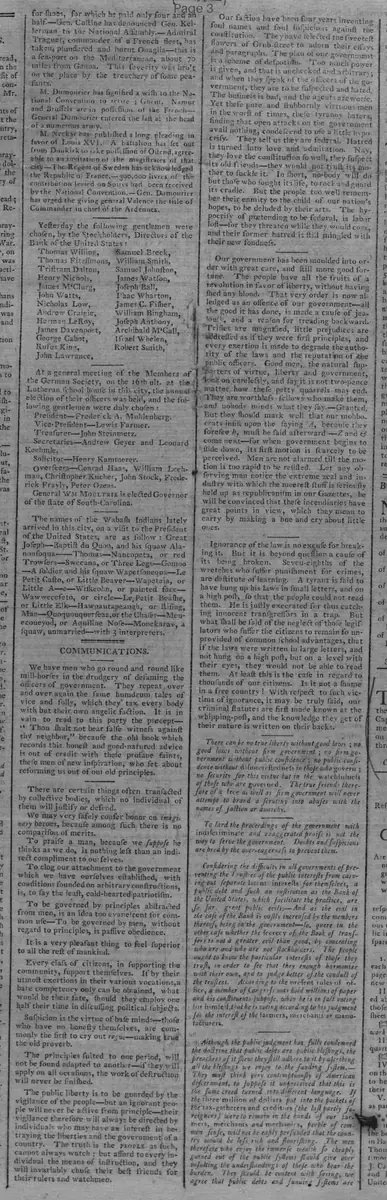
COMMUNICATIONS.
We have men who go round and round like mill-horses in the drudgery of defaming the officers of government. They repeat, over and over again the same humdrum tales of vice and folly, which they tax every body with but their own angelic faction. It is in vain to read to this party the precept— "Thou shalt not bear false witness against thy neighbor," because the old book which records this honest and good-natured advice is out of credit with these profane saints, these men of new inspiration, who set about reforming us out of our old principles.
There are certain things often transacted by collective bodies, which no individual of them will justify or defend.
We may very safely confer honor on imaginary heroes, because among such there is no comparison of merits.
To praise a man, because we suppose he thinks as we do, is nothing less than an indirect compliment to ourselves.
To clog our attachment to the government which we have ourselves established, with conditions founded on arbitrary constructions, is, to say the least, cold-hearted patriotism.
To be governed by principles abstracted from men, is an idea too evanescent for common use—To be governed by men, without regard to principles, is passive obedience.
It is a very pleasant thing to feel superior to all the rest of mankind.
Every class of citizens, in supporting the community, support themselves. If by their utmost exertions in their various vocations, a bare competency only can be obtained, what would be their fate, should they employ one half their time in discussing political subjects.
Suspicion is the virtue of base minds—those who have no honesty themselves, are commonly the first to cry out rogue—making true the old proverb.
The principles suited to one period, will not be found adapted to another—if they will apply on all occasions, the work of destruction will never be finished.
The public liberty is to be guarded by the vigilance of the people—but an ignorant people will never be active from principle—their vigilance therefore will always be directed by individuals who may have an interest in betraying the liberties and the government of a country.
The truth is the PEOPLE as such, cannot always watch; but afford to every individual the means of instruction, and they will invariably choose their best friends for their rulers and watchmen.
Our faction have been four years inventing foul names and foul suspicions against the constitution. They have selected the sweetest flowers of Grub-street to adorn their essays and paragraphs. The plan of our government is a scheme of despotism. Too much power is given, and that is unchecked and arbitrary; and when they speak of the officers of the government, they are to be suspected and hated. The business is bad, and the agents are worse.
Yet these pure and stubbornly virtuous men in the worst of times, these tyranny haters, finding that open attacks on the government avail nothing, condescend to use a little hypocrisy. They tell us they are federal. Hatred is turned into love and admiration. Nay, they love the constitution so well, they suspect its old friends—they would not trust its mother to suckle it. In short, no-body will do but those who sought its life, to rock and guard its cradle. But the people too well remember their enmity to the child of our nation's hopes, to be deluded by their arts. The hypocrisy of pretending to be federal, is labor lost—for they threaten while they would coax, and their former hatred is still mingled with their new fondness.
Our government has been moulded into order with great care, and still more good fortune. The people have all the fruits of a revolution in favor of liberty, without having shed any blood. That very order is now alleged as an offence of our government—all the good it has done, is made a cause of jealousy, and a reason for treading backward.
Trifles are magnified, little prejudices are addressed as if they were first principles, and every exertion is made to degrade the authority of the laws and the reputation of the public officers. Good men, the natural supporters of virtue, liberty and government, look on carelessly, and say it is not two-pence matter, how these petty quarrels may end.
They are worthless fellows who make them, and nobody minds what they say.—Granted.
But they should mark well that our mobbocrats insist upon the saying A, because they foresee B, must be said afterward —Z and & come next—for when government begins to slide down, its first motion is scarcely to be perceived. Men are not alarmed till the motion is too rapid to be resisted. Let any observing man notice the extreme zeal and industry with which the merest stuff is seriously held up as republicanism in our Gazettes, he will be convinced that these incendiaries have great points in view, which they mean to carry by making a hue and cry about little ones.
Ignorance of the law is no excuse for breaking it. But it is beyond question a cause of its being broken. Seven-eighths of the wretches who suffer punishment for crimes, are destitute of learning. A tyrant is said to have hung up his laws in small letters, and on a high post, so that the people could not read them. He is justly execrated for thus catching innocent transgressors in a trap. But what shall be said of the neglect of those legislators who suffer the citizens to remain so unprovided of common school advantages, that if the laws were written in large letters, and not hung on a high post, but on a level with their eyes, they would not be able to read them. At least this is the case in regard to thousands of our citizens. Is it not a shame in a free country! With respect to such victims of ignorance, it may be truly said, our criminal statutes are first made known at the whipping-post, and the knowledge they get of their nature is written on their backs.
There can be no true liberty without good laws; no good laws without firm government; no firm government without public confidence: no public confidence without disinterestedness in those who govern; no security for this virtue but in the watchfulness of those who are governed. The true friend therefore of a free as well as firm government will never attempt to brand a scrutiny into abuses with the names of faction or anarchy.
To lard the proceedings of the government with indiscriminate and exaggerated praise is not the way to serve the government. Doubts and suspicions are bred by the over-eagerness to prevent them.
Considering the difficulty in all governments of preventing the Trustees of the public interests from carving out separate latent interests for themselves, a public debt and such an institution as the Bank of the United States, which facilitate the practice, are so far, great public evils.—And as the evil in the case of the Bank is vastly increased by the members thereof, being in the government—so, quere in the other case whether the secrecy of the Book of transfers is not a greater evil than good, by concealing who are and who are not stockholders. The people ought to know the particular interests of those they trust, in order to see that they enough harmonize with their own, and to judge better of the conduct of the trustees. According to the present rules of office, a member of Congress may hold millions of paper and his constituents suppose, when he is in fact voting for himself, that he is voting according to his judgment for the interest of the farmers, merchants or manufacturers.
Although the public judgment has fully condemned the doctrine that public debts are public blessings, the preachers of it shew they still adhere to it by ascribing all the blessings we enjoy to the funding System.— They must think very contemptuously of American discernment, to suppose it unperceived that this is the same creed turned into different language. If the three million of dollars put into the pockets of the tax-gatherers and creditors (the last partly foreigners) were to remain in the hands of our farmers, merchants and mechanics, people of common sense, will not be easily persuaded that the country would be less rich and flourishing. The men therefore who enjoy the immense wealth so cheaply gained out of the public Systems should give over insulting the understandings of those who bear the burden. They should be content with saying, we agree that public debts and funding Systems are public evils, especially in Republics which ought to watch on all sides against the avenues of corruption; but it would be a greater evil not to pay public debts or not to execute laws in force for that purpose.
We have men who go round and round like mill-horses in the drudgery of defaming the officers of government. They repeat, over and over again the same humdrum tales of vice and folly, which they tax every body with but their own angelic faction. It is in vain to read to this party the precept— "Thou shalt not bear false witness against thy neighbor," because the old book which records this honest and good-natured advice is out of credit with these profane saints, these men of new inspiration, who set about reforming us out of our old principles.
There are certain things often transacted by collective bodies, which no individual of them will justify or defend.
We may very safely confer honor on imaginary heroes, because among such there is no comparison of merits.
To praise a man, because we suppose he thinks as we do, is nothing less than an indirect compliment to ourselves.
To clog our attachment to the government which we have ourselves established, with conditions founded on arbitrary constructions, is, to say the least, cold-hearted patriotism.
To be governed by principles abstracted from men, is an idea too evanescent for common use—To be governed by men, without regard to principles, is passive obedience.
It is a very pleasant thing to feel superior to all the rest of mankind.
Every class of citizens, in supporting the community, support themselves. If by their utmost exertions in their various vocations, a bare competency only can be obtained, what would be their fate, should they employ one half their time in discussing political subjects.
Suspicion is the virtue of base minds—those who have no honesty themselves, are commonly the first to cry out rogue—making true the old proverb.
The principles suited to one period, will not be found adapted to another—if they will apply on all occasions, the work of destruction will never be finished.
The public liberty is to be guarded by the vigilance of the people—but an ignorant people will never be active from principle—their vigilance therefore will always be directed by individuals who may have an interest in betraying the liberties and the government of a country.
The truth is the PEOPLE as such, cannot always watch; but afford to every individual the means of instruction, and they will invariably choose their best friends for their rulers and watchmen.
Our faction have been four years inventing foul names and foul suspicions against the constitution. They have selected the sweetest flowers of Grub-street to adorn their essays and paragraphs. The plan of our government is a scheme of despotism. Too much power is given, and that is unchecked and arbitrary; and when they speak of the officers of the government, they are to be suspected and hated. The business is bad, and the agents are worse.
Yet these pure and stubbornly virtuous men in the worst of times, these tyranny haters, finding that open attacks on the government avail nothing, condescend to use a little hypocrisy. They tell us they are federal. Hatred is turned into love and admiration. Nay, they love the constitution so well, they suspect its old friends—they would not trust its mother to suckle it. In short, no-body will do but those who sought its life, to rock and guard its cradle. But the people too well remember their enmity to the child of our nation's hopes, to be deluded by their arts. The hypocrisy of pretending to be federal, is labor lost—for they threaten while they would coax, and their former hatred is still mingled with their new fondness.
Our government has been moulded into order with great care, and still more good fortune. The people have all the fruits of a revolution in favor of liberty, without having shed any blood. That very order is now alleged as an offence of our government—all the good it has done, is made a cause of jealousy, and a reason for treading backward.
Trifles are magnified, little prejudices are addressed as if they were first principles, and every exertion is made to degrade the authority of the laws and the reputation of the public officers. Good men, the natural supporters of virtue, liberty and government, look on carelessly, and say it is not two-pence matter, how these petty quarrels may end.
They are worthless fellows who make them, and nobody minds what they say.—Granted.
But they should mark well that our mobbocrats insist upon the saying A, because they foresee B, must be said afterward —Z and & come next—for when government begins to slide down, its first motion is scarcely to be perceived. Men are not alarmed till the motion is too rapid to be resisted. Let any observing man notice the extreme zeal and industry with which the merest stuff is seriously held up as republicanism in our Gazettes, he will be convinced that these incendiaries have great points in view, which they mean to carry by making a hue and cry about little ones.
Ignorance of the law is no excuse for breaking it. But it is beyond question a cause of its being broken. Seven-eighths of the wretches who suffer punishment for crimes, are destitute of learning. A tyrant is said to have hung up his laws in small letters, and on a high post, so that the people could not read them. He is justly execrated for thus catching innocent transgressors in a trap. But what shall be said of the neglect of those legislators who suffer the citizens to remain so unprovided of common school advantages, that if the laws were written in large letters, and not hung on a high post, but on a level with their eyes, they would not be able to read them. At least this is the case in regard to thousands of our citizens. Is it not a shame in a free country! With respect to such victims of ignorance, it may be truly said, our criminal statutes are first made known at the whipping-post, and the knowledge they get of their nature is written on their backs.
There can be no true liberty without good laws; no good laws without firm government; no firm government without public confidence: no public confidence without disinterestedness in those who govern; no security for this virtue but in the watchfulness of those who are governed. The true friend therefore of a free as well as firm government will never attempt to brand a scrutiny into abuses with the names of faction or anarchy.
To lard the proceedings of the government with indiscriminate and exaggerated praise is not the way to serve the government. Doubts and suspicions are bred by the over-eagerness to prevent them.
Considering the difficulty in all governments of preventing the Trustees of the public interests from carving out separate latent interests for themselves, a public debt and such an institution as the Bank of the United States, which facilitate the practice, are so far, great public evils.—And as the evil in the case of the Bank is vastly increased by the members thereof, being in the government—so, quere in the other case whether the secrecy of the Book of transfers is not a greater evil than good, by concealing who are and who are not stockholders. The people ought to know the particular interests of those they trust, in order to see that they enough harmonize with their own, and to judge better of the conduct of the trustees. According to the present rules of office, a member of Congress may hold millions of paper and his constituents suppose, when he is in fact voting for himself, that he is voting according to his judgment for the interest of the farmers, merchants or manufacturers.
Although the public judgment has fully condemned the doctrine that public debts are public blessings, the preachers of it shew they still adhere to it by ascribing all the blessings we enjoy to the funding System.— They must think very contemptuously of American discernment, to suppose it unperceived that this is the same creed turned into different language. If the three million of dollars put into the pockets of the tax-gatherers and creditors (the last partly foreigners) were to remain in the hands of our farmers, merchants and mechanics, people of common sense, will not be easily persuaded that the country would be less rich and flourishing. The men therefore who enjoy the immense wealth so cheaply gained out of the public Systems should give over insulting the understandings of those who bear the burden. They should be content with saying, we agree that public debts and funding Systems are public evils, especially in Republics which ought to watch on all sides against the avenues of corruption; but it would be a greater evil not to pay public debts or not to execute laws in force for that purpose.
What sub-type of article is it?
Partisan Politics
Constitutional
Economic Policy
What keywords are associated?
Government Defense
Factions Hypocrisy
Public Education
Public Debt
Funding System
Republican Vigilance
What entities or persons were involved?
Officers Of Government
Faction
People
Mobbocrats
Incendiaries
Bank Of The United States
Editorial Details
Primary Topic
Defense Of The Federal Government Against Factional Opposition
Stance / Tone
Strongly Pro Government And Anti Faction
Key Figures
Officers Of Government
Faction
People
Mobbocrats
Incendiaries
Bank Of The United States
Key Arguments
Factions Defame Government Officers With Repeated False Tales Of Vice And Folly
Hypocrisy Of Factions Pretending To Be Federal While Suspecting The Constitution's Old Friends
Government Achieved Order Without Bloodshed, Yet This Is Used As An Offense
Ignorance Leads To Crime; Neglect Of Education Makes Laws Unknowable To Many Citizens
Public Debt And The Bank Facilitate Corruption By Concealing Interests Of Officials
Public Debts Are Evils, Especially In Republics, But Paying Them Is Necessary To Avoid Greater Evil