Thank you for visiting SNEWPapers!
Sign up free
Alexandria Gazette
Alexandria, Alexandria County, District Of Columbia
What is this article about?
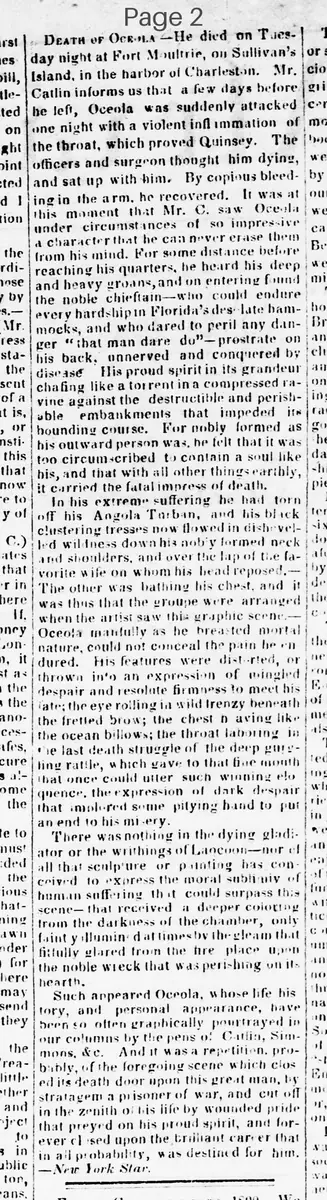
Osceola, the Seminole chief, died of quinsy at Fort Moultrie, Charleston harbor. Artist George Catlin witnessed his intense suffering from throat inflammation, describing the scene of agony with his wives attending him, likening it to classical depictions of suffering.
Clipping
OCR Quality
Full Text
In his extreme suffering he had torn off his Angola Turban, and his black clustering tresses now flowed in disheveled wildness down his nobly formed neck and shoulders, and over the lap of the favorite wife on whom his head reposed. The other was bathing his chest, and it was thus that the groups were arranged when the artist saw this graphic scene. Osceola manfully as he breasted mortal nature, could not conceal the pain he endured. His features were distorted, or thrown into an expression of mingled despair and resolute firmness to meet his fate: the eye rolling in wild frenzy beneath the fretted brow; the chest heaving like the ocean billows; the throat laboring in the last death struggle of the deep gurgling rattle, which gave to that fine mouth that once could utter such winning eloquence, the expression of dark despair that implored some pitying hand to put an end to his misery.
There was nothing in the dying gladiator or the writhings of Laocoon—nor of all that sculpture or painting has conceived to express the moral sublimity of human suffering that could surpass this scene—that received a deeper coloring from the darkness of the chamber, only faintly illuminated at times by the gleam that fitfully glared from the fire place upon the noble wreck that was perishing on its hearth.
Such appeared Osceola, whose life history, and personal appearance, have been so often graphically pourtrayed in our columns by the pens of Catlin, Simmons, &c. And it was a repetition, probably, of the foregoing scene which closed its death door upon this great man, by stratagem a prisoner of war, and cut off in the zenith of his life by wounded pride that preyed on his proud spirit, and forever closed upon the triumphant career that in all probability, was destined for him.
—New York Star.
What sub-type of article is it?
What themes does it cover?
What keywords are associated?
What entities or persons were involved?
Where did it happen?
Story Details
Key Persons
Location
Fort Moultrie, On Sullivan's Island, In The Harbor Of Charleston
Event Date
Tuesday Night
Story Details
Osceola suffered a violent throat inflammation (quinsy) at Fort Moultrie, recovered temporarily via bleeding, but died in agony witnessed by artist Catlin, who described the chieftain's suffering with his wives, his proud spirit broken by disease and captivity.