Thank you for visiting SNEWPapers!
Sign up free
Editorial
November 29, 1825
Constitutional Whig
Richmond, Virginia
What is this article about?
The National Intelligencer reprints an extract from James Barbour's address to the Agricultural Society of Albemarle County, Virginia, advocating humane treatment of slaves as beneficial to owners and slaves, defending the institution against abolitionist interference, and asserting it superior to free people of color.
Clipping
OCR Quality
85%
Good
Full Text
From the National Intelligencer.
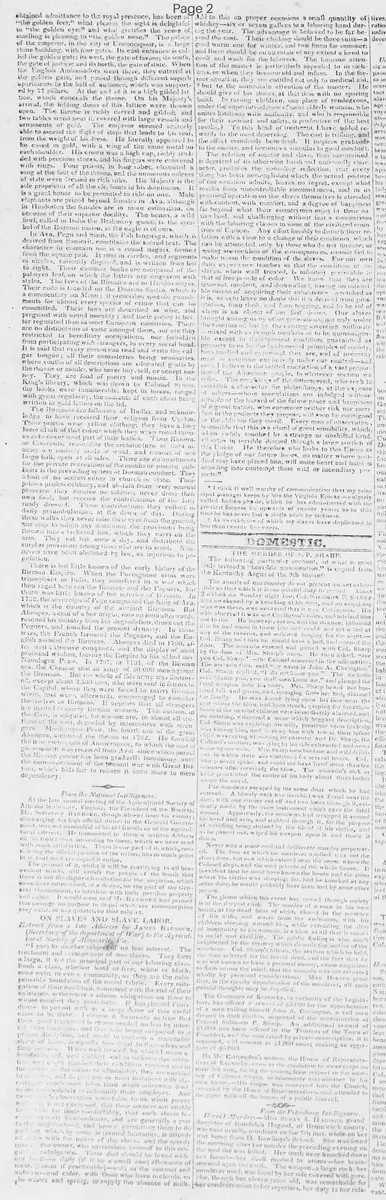
At the late annual meeting of the Agricultural Society of Albemarle County, Virginia, the President of the Society, Mr. Secretary James Barbour, though absent from his county, discharging his high official duties in the General Government, was not unmindful of his old friends or of the agricultural interest. He transmitted to them a written Address on the topics most interesting to them, which we have read with much satisfaction. There is one part of it, which, considering the official position of the writer, has so much point in it, that we have copied it entire.
The perusal of it, whilst it will be gratifying to all benevolent minds, will satisfy the people of the South that there is not the slightest foundation for the suspicion, which some have entertained, of a design, on the part of the General Government, to interfere with their peculiar property and rights. It would seem as if Mr. Barbour had penned this passage on purpose to dispel whatever misconception may exist, in any quarter, on that subject.
ON SLAVES AND SLAVE LABOR.
Extract from a late Address by James Barbour, (Secretary of the department of War) to the Agricultural Society of Albemarle, Va.
"I pass to another subject of no less interest. The treatment and management of our slaves. They form a large, if not the principal part of our labouring class. Such a class, whether bond or free, white or black, must exist in every community, as they are the indispensable foundation of the social fabric. Every mitigation of their condition, consistent with the end of their existence, is therefore a solemn obligation on those to whose comfort they contribute. It has pleased Providence to permit us with us a large share of this useful class to be slaves. Let common consent as true that their good treatment to reason no less by interest than from conscience. And that being subjected to a proper discipline, and made to perform a reasonable share of labour, is equally beneficial to themselves and their owners. When well treated by which I mean handsomely fed, well clothed and in sickness due attention paid to and every comfort their condition requires and more, the owner to administer, they are enabled to accumulate in most cases with ease. Such more than when otherwise dealt completely to indemnify their employer. And observation certain to us, when proper discipline not exercised, that their owners are unable to take care of them comfortably, that such slaves have become insubordinate, and are generally a pest to their neighbours; and hence permit them to do not always by one is termed humanity, is attended with the misery of the slave, and the speedy ruin of the owner, who surrenders himself to this mis indulgence. Their diet should be bread with corn, if—a daily (if it be a small one) allowance of meat (bacon if practicable)—milk in the summer and autumn; and cider, with those who have orchards, in the winter and spring, to supply the absence of milk.
Add to this on proper occasions a small quantity of whiskey—six or seven gallons to a laboring hand during the year. The advantage is believed to be far beyond the cost. Their clothing should be three suits—a good woolen one for winter, and two linen for summer; and there should be on an estate of any extent a hand to cook and wash for the laborers. The humane attention of the master is particularly appealed to in sickness, or when they become old and infirm. In the former situation, they are entitled not only to medical aid, but to the immediate attention of the master. He should give out of his stores, at that time with no sparing hand. In raising children, one place of rendezvous, under the superintendence of some elderly woman, who unites kindness with authority, and who is responsible for their comfort and safety, is productive of the best results. To this kind of treatment I have added rewards to the most deserving. The cost is trifling, and the effect manifestly beneficial. It inspires gratitude to the master, and becomes a stimulus to good conduct. The relation of master and slave, thus maintained, is deprived of its otherwise harsh and ungentle character, produces the consoling reflection, that every thing has been accomplished which the actual posture of our situation admits, leaves no regret, except what results from uncontrollable circumstances, and in its practical operation on the slaves themselves is attended with content, with comfort, and a degree of happiness far beyond what their countrymen enjoy in their native land, and challenging without fear a comparison with the labouring classes in some of the civilized countries of Europe. Any effort forcibly to disturb their relation with a view to a change of their condition which can be attempted only by those who do not foresee, or seeing are reckless of the consequences, cannot fail to make worse their condition of the slaves. For our own daily experience teaches us that the condition of the slaves, when well treated, is infinitely preferable to that of free people of color. We know that they are ignorant, insolent, and demoralized, having no ostensible means of acquiring their subsistence, wretched as it is, so as to leave no doubt that it is derived from prostitution, from theft, and from begging, and to be rid of whom is an object of our first desire. Our slaves brought among us by other generations, not only under the sanction of, but in the most sovereign authority mixed with us in such numbers as to be unmanageable except in their present condition: guaranteed as property to us by the fundamental principles of society, both implied and expressed as they are, and of necessity must continue exclusively under our control—and such, I believe is the settled conviction of a vast proportion of the American people, to whatever section we refer. The creeds of the distempered, who seek to establish a character for philanthropy, at the expense of others—whose speculations are indulged without scruple at the hazard of the future peace and happiness of a great nation, who encounter neither risk nor sacrifice in the projects they propose, will soon be consigned to the oblivion they merit. "Every man of observation, is sensible that this is a chord of great sensibility, which, when rudely touched by a strange or unskilful hand, will rise in terrible discord through a large portion of this Union. He therefore who looks to this Union as the pledge of our future hopes, no matter where accident may have placed him, will unite heart and hand in scowling into contempt those wild incendiary projects."
* I think it well worthy of communication that my principal manager keeps by him the Virginia Epicac—vulgarly called Indian physic, which he has administered with the greatest success for upwards of twenty years; as in that time he has never lost a single adult by sickness.
† As an evidence of which my slaves have doubled in less than twenty five years.
At the late annual meeting of the Agricultural Society of Albemarle County, Virginia, the President of the Society, Mr. Secretary James Barbour, though absent from his county, discharging his high official duties in the General Government, was not unmindful of his old friends or of the agricultural interest. He transmitted to them a written Address on the topics most interesting to them, which we have read with much satisfaction. There is one part of it, which, considering the official position of the writer, has so much point in it, that we have copied it entire.
The perusal of it, whilst it will be gratifying to all benevolent minds, will satisfy the people of the South that there is not the slightest foundation for the suspicion, which some have entertained, of a design, on the part of the General Government, to interfere with their peculiar property and rights. It would seem as if Mr. Barbour had penned this passage on purpose to dispel whatever misconception may exist, in any quarter, on that subject.
ON SLAVES AND SLAVE LABOR.
Extract from a late Address by James Barbour, (Secretary of the department of War) to the Agricultural Society of Albemarle, Va.
"I pass to another subject of no less interest. The treatment and management of our slaves. They form a large, if not the principal part of our labouring class. Such a class, whether bond or free, white or black, must exist in every community, as they are the indispensable foundation of the social fabric. Every mitigation of their condition, consistent with the end of their existence, is therefore a solemn obligation on those to whose comfort they contribute. It has pleased Providence to permit us with us a large share of this useful class to be slaves. Let common consent as true that their good treatment to reason no less by interest than from conscience. And that being subjected to a proper discipline, and made to perform a reasonable share of labour, is equally beneficial to themselves and their owners. When well treated by which I mean handsomely fed, well clothed and in sickness due attention paid to and every comfort their condition requires and more, the owner to administer, they are enabled to accumulate in most cases with ease. Such more than when otherwise dealt completely to indemnify their employer. And observation certain to us, when proper discipline not exercised, that their owners are unable to take care of them comfortably, that such slaves have become insubordinate, and are generally a pest to their neighbours; and hence permit them to do not always by one is termed humanity, is attended with the misery of the slave, and the speedy ruin of the owner, who surrenders himself to this mis indulgence. Their diet should be bread with corn, if—a daily (if it be a small one) allowance of meat (bacon if practicable)—milk in the summer and autumn; and cider, with those who have orchards, in the winter and spring, to supply the absence of milk.
Add to this on proper occasions a small quantity of whiskey—six or seven gallons to a laboring hand during the year. The advantage is believed to be far beyond the cost. Their clothing should be three suits—a good woolen one for winter, and two linen for summer; and there should be on an estate of any extent a hand to cook and wash for the laborers. The humane attention of the master is particularly appealed to in sickness, or when they become old and infirm. In the former situation, they are entitled not only to medical aid, but to the immediate attention of the master. He should give out of his stores, at that time with no sparing hand. In raising children, one place of rendezvous, under the superintendence of some elderly woman, who unites kindness with authority, and who is responsible for their comfort and safety, is productive of the best results. To this kind of treatment I have added rewards to the most deserving. The cost is trifling, and the effect manifestly beneficial. It inspires gratitude to the master, and becomes a stimulus to good conduct. The relation of master and slave, thus maintained, is deprived of its otherwise harsh and ungentle character, produces the consoling reflection, that every thing has been accomplished which the actual posture of our situation admits, leaves no regret, except what results from uncontrollable circumstances, and in its practical operation on the slaves themselves is attended with content, with comfort, and a degree of happiness far beyond what their countrymen enjoy in their native land, and challenging without fear a comparison with the labouring classes in some of the civilized countries of Europe. Any effort forcibly to disturb their relation with a view to a change of their condition which can be attempted only by those who do not foresee, or seeing are reckless of the consequences, cannot fail to make worse their condition of the slaves. For our own daily experience teaches us that the condition of the slaves, when well treated, is infinitely preferable to that of free people of color. We know that they are ignorant, insolent, and demoralized, having no ostensible means of acquiring their subsistence, wretched as it is, so as to leave no doubt that it is derived from prostitution, from theft, and from begging, and to be rid of whom is an object of our first desire. Our slaves brought among us by other generations, not only under the sanction of, but in the most sovereign authority mixed with us in such numbers as to be unmanageable except in their present condition: guaranteed as property to us by the fundamental principles of society, both implied and expressed as they are, and of necessity must continue exclusively under our control—and such, I believe is the settled conviction of a vast proportion of the American people, to whatever section we refer. The creeds of the distempered, who seek to establish a character for philanthropy, at the expense of others—whose speculations are indulged without scruple at the hazard of the future peace and happiness of a great nation, who encounter neither risk nor sacrifice in the projects they propose, will soon be consigned to the oblivion they merit. "Every man of observation, is sensible that this is a chord of great sensibility, which, when rudely touched by a strange or unskilful hand, will rise in terrible discord through a large portion of this Union. He therefore who looks to this Union as the pledge of our future hopes, no matter where accident may have placed him, will unite heart and hand in scowling into contempt those wild incendiary projects."
* I think it well worthy of communication that my principal manager keeps by him the Virginia Epicac—vulgarly called Indian physic, which he has administered with the greatest success for upwards of twenty years; as in that time he has never lost a single adult by sickness.
† As an evidence of which my slaves have doubled in less than twenty five years.
What sub-type of article is it?
Slavery Abolition
Agriculture
Moral Or Religious
What keywords are associated?
Slave Treatment
James Barbour
Agricultural Society
Anti Abolition
Slave Labor
Humane Management
Southern Rights
What entities or persons were involved?
James Barbour
Agricultural Society Of Albemarle County
General Government
Editorial Details
Primary Topic
Treatment And Management Of Slaves
Stance / Tone
Defensive Of Slavery With Advocacy For Humane Treatment
Key Figures
James Barbour
Agricultural Society Of Albemarle County
General Government
Key Arguments
Humane Treatment Of Slaves Benefits Both Owners And Slaves
Proper Discipline Prevents Insubordination And Ruin
Specific Diet, Clothing, And Care Recommendations For Slaves
Slavery Superior To Condition Of Free People Of Color
Abolitionist Efforts Would Worsen Slaves' Condition And Threaten The Union
Slaves Guaranteed As Property Under Societal Principles