Thank you for visiting SNEWPapers!
Sign up free
Gazette Of The United States, & Philadelphia Daily Advertiser
Philadelphia, Philadelphia County, Pennsylvania
What is this article about?
In a US House of Representatives session on January 16, Mr. Harper advocates for increasing import duties to raise revenue, arguing against direct land taxes and citing growing consumption. Mr. Gallatin counters, questioning the necessity and accuracy of revenue estimates, preferring calculations based on peace-time scenarios.
Clipping
OCR Quality
Full Text
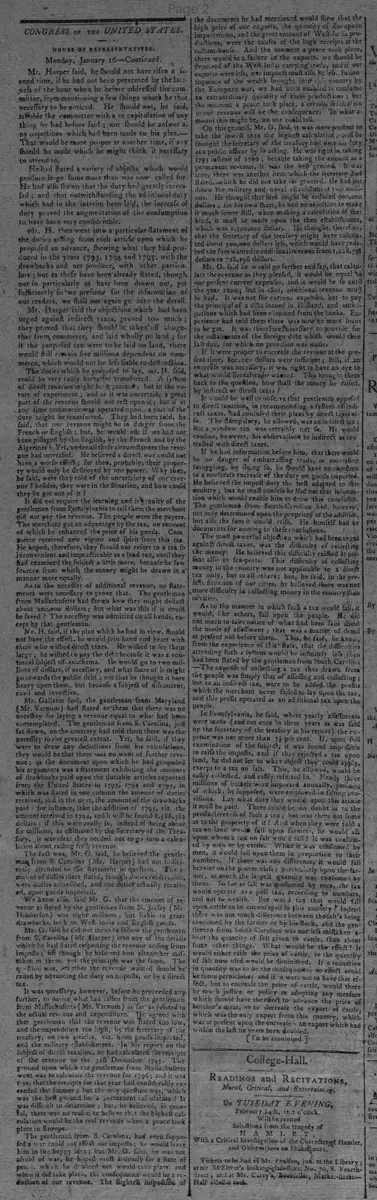
HOUSE OF REPRESENTATIVES.
Monday, January 16—Continued.
Mr. Harper said, he should not have risen a second time, if he had not been prevented by the lateness of the hour when he before addressed the committee, from mentioning a few things which he thought necessary to be noticed. He should not, he said, trouble the committee with a recapitulation of anything he had before said; nor should he answer any objections which had been made to his plan.—That would be more proper at another time, if any should be made which he might think it necessary to attend to.
He had stated a variety of objects which would produce large sums more than was now called for. He had also shown that the duty had greatly increased: and that notwithstanding the additional duty which had in the interim been laid, the increase of duty proved the augmentation of the consumption to have been very considerable.
Mr. H. then went into a particular statement of the duties arising from each article upon which he proposed an advance, showing what they had produced in the years 1793, 1794 and 1795, with the drawbacks and net produce, with other particulars; but as these have been already stated, though not so particularly as have been drawn out, yet sufficiently so we presume for the information of our readers, we shall not again go into the detail.
Mr. Harper said the objections which had been urged against indirect taxes, proved too much; they proved that they should be taken off altogether from commerce, and laid wholly on land; for if the proposed tax were to be laid on land, there would still remain five millions dependent on commerce, which would not be less liable to destruction.
The duties which he proposed to lay, Mr. H. said, could be very easily hereafter transferred. A system of direct taxation might be organized; but in the nature of experiment; and as it was uncertain, a great part of the revenue should not rest upon it; but if at any time commerce was operated upon, a part of the duty might be transferred. They had been told, he said, that our revenue might be in danger from the French or English; but, he would ask if we had not been pillaged by the English, by the French and by the Algerines? Yet, under all these circumstances the revenue had increased. He believed a direct war could not have a worse effect; for then, probably, their property would only be destroyed by one power. Why then, he said, were they told of the uncertainty of our revenue? Besides, they were in the situation, and how could they be got out of it?
It did not require the learning and ingenuity of the gentleman from Pennsylvania to tell them the merchant did not pay the revenue. The people were the payers. The merchant got an advantage by the tax, on account of which he enhanced the price of his goods. Commerce received new vigour and spirit from this tax. He hoped, therefore, they should not resort to a tax so inconvenient and impracticable as a land tax, until they had examined the subject a little more, because he saw sources from which the money might be drawn in a manner more equally.
As to the necessity of additional revenue, no statements were necessary to prove that. The gentleman from Massachusetts had shown how they might deduct about 200,000 dollars; but what was this if it could be saved? The necessity was admitted on all hands, except by that gentleman.
Mr. H. said, if the plan which he had in view, should not have the effect, he would join hand and heart with those who wished direct taxes. He wished to see them large; he wished to pay the debt because it was a continual subject of anathema. He would go to two millions of dollars, if necessary, and what share of it might go towards the public debt; not that he thought it bore heavy upon them, but because a subject of discontent, cavil and invective.
Mr. Gallatin said, the gentleman from Maryland (Mr. Varnum) had stated to them that there was no necessity for laying a revenue equal to what had been contemplated. The gentleman from S. Carolina, just at down, on the contrary had told them there was the necessity to the greatest extent. Yet, he said, if they were to draw any deductions from his calculations, they would be that there was no want of further revenue; as the document upon which he had grounded his arguments was a statement exhibiting the amounts of drawbacks paid upon the dutiable articles exported from the United States in 1793, 1794 and 1795, in which was stated in one column the amount of duties received, and in the next, the amount of the drawbacks paid: for instance, take the addition of 1795, viz. the amount received in 1794, and it will be found 8,588,382 dollars: if this were really so, instead of being about six millions, as estimated by the Secretary of the Treasury, it was clear they needed not to go into a calculation about raising fresh revenue.
The fact was, Mr. G. said, he believed the gentleman from S. Carolina (Mr. Harper) had not sufficiently attended to the statement in question. The amount of duties there stated, though duties receivable, were duties accredited, and not duties actually received, upon goods imported.
We know so, said Mr. G. that the amount of revenue as stated by the gentleman from N. Jersey (Mr. Henderson) was eight millions; but liable to great drawbacks, both on West-India and English goods.
Mr. G. said he did not mean to follow the gentleman from S. Carolina (Mr. Harper) into any of the details which he had stated respecting the revenue arising from imports; for though he believed him altogether mistaken in them, yet the principle was the same. The question was, whether the revenue wanted should be raised by advancing the duty on imports, or by a direct tax.
It was necessary, however, before he proceeded any further, to notice what had fallen from the gentleman from Massachusetts (Mr. Varnum) as far as related to the actual revenue and expenditure. He agreed with that gentleman that the revenue was stated too low, and the expenditure too high, by the Secretary of the Treasury, on two articles, viz. upon goods imported, and the military establishment. In his report on the subject of direct taxation, he had calculated the receipts of the revenue to the 31st December 1795. The ground upon which the gentleman from Massachusetts went was to calculate the revenue for 1796; and it was true, that the receipts for that year had considerably exceeded the former; but the only question was, which was the best ground for a permanent calculation? It was difficult to determine; but, he believed, in general, there was no reason to believe that the highest calculation would be the real revenue when a peace took place in Europe.
The gentleman from S. Carolina, had even supposed a war could not affect our imports; he would leave him in the happy idea; but Mr. G. said, he was not afraid of war, he hoped most ardently for a state of peace, which he doubted not would take place, and when it did take place, the consequence would be a reduction of our revenue. The slightest inspection of
What sub-type of article is it?
What keywords are associated?
What entities or persons were involved?
Where did it happen?
Story Details
Key Persons
Location
House Of Representatives, Congress Of The United States
Event Date
Monday, January 16—Continued
Story Details
Mr. Harper defends increasing import duties for revenue, citing past increases and commerce's resilience, opposing direct land taxes. Mr. Gallatin disputes revenue calculations, arguing they overestimate actual receipts and advocating caution for post-war reductions, debating import duties versus direct taxes.