Thank you for visiting SNEWPapers!
Sign up free
Letter to Editor
February 19, 1841
The Daily Herald
New Haven, New Haven County, Connecticut
What is this article about?
Letter defends the city's public school management system, arguing it equitably distributes expenses via voluntary contributions rather than compulsory taxes, responds to critic 'A Mechanic,' and emphasizes use of the town deposit fund for education benefits all classes.
Clipping
OCR Quality
98%
Excellent
Full Text
"SCHOOL FUND."
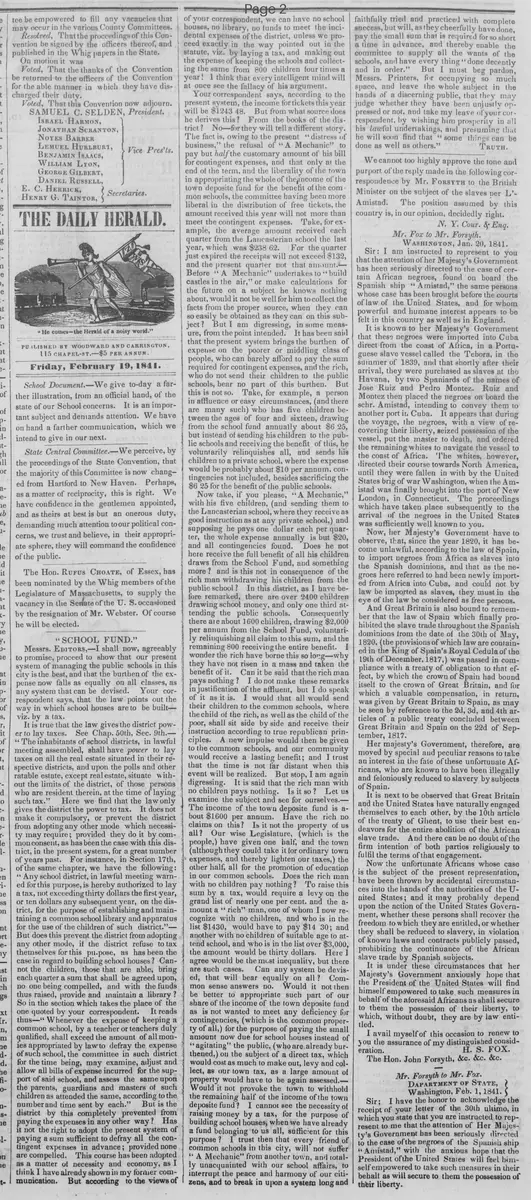
Messrs. Editors,—I shall now, agreeably to promise, proceed to show that our present system of managing the public schools in this city is the best, and that the burthen of the expense now falls as equally on all classes, as any system that can be devised. Your correspondent says, that the law points out the way in which school houses are to be built—viz. by a tax.
It is true that the law gives the district power to lay taxes. See Chap. 50th, Sec. 9th.—"The inhabitants of school districts, in lawful meeting assembled, shall have power to lay taxes on all the real estate situated in their respective districts, and upon the polls and other ratable estate, except real estate, situate without the limits of the district, of those persons who are resident therein, at the time of laying such tax." Here we find that the law only gives the district the power to tax. It does not make it compulsory, or prevent the district from adopting any other mode which necessity may require; provided they do it by common consent, as has been the case with this district, in the present system, for a great number of years past. For instance, in Section 17th, of the same chapter, we have the following:
"Any school district, in lawful meeting warned for this purpose, is hereby authorized to lay a tax, not exceeding thirty dollars the first year, or ten dollars any subsequent year, on the district, for the purpose of establishing and maintaining a common school library and apparatus for the use of the children of such district."—But does this prevent the district from adopting any other mode, if the district refuse to tax themselves for this purpose, as has been the case in regard to building school houses? Cannot the children, those that are able, bring each quarter a sum that shall be agreed upon, no one being compelled, and with the funds thus raised, provide and maintain a library?
So in the section which takes the place of the one quoted by your correspondent. It reads thus—"Whenever the expense of keeping a common school, by a teacher or teachers duly qualified, shall exceed the amount of all monies appropriated by law to defray the expense of such school, the committee in such district for the time being, may examine, adjust and allow all bills of expense incurred for the support of said school, and assess the same upon the parents, guardians and masters of such children as attended the same, according to the number and time sent by each." But is the district by this completely prevented from paying the expenses in any other way? Has it not the right to adopt the present system of paying a sum sufficient to defray all the contingent expenses in advance; provided none are compelled. This course has been adopted as a matter of necessity and economy, as I think I have already shown in my former communication. But according to the views of your correspondent, we can have no school houses, no library, no funds to meet the incidental expenses of the district, unless we proceed exactly in the way pointed out in the statute, viz. by laying a tax, and making out the expense of keeping the schools and collecting the same from 800 children four times a year! I think that every intelligent mind will at once see the fallacy of his argument.
Your correspondent says, according to the present system, the income for tickets this year will be $1243 48. But from what source does he derive this? From the books of the district? No—for they will tell a different story. The fact is, owing to the present "distress of business," the refusal of "A Mechanic" to pay but half the customary amount of his bill for contingent expenses, and that only at the end of the term, and the liberality of the town in appropriating the whole of the income of the town deposit fund for the benefit of the common schools, the committee having been more liberal in the distribution of free tickets, the amount received this year will not more than meet the contingent expenses. Take, for example, the average amount received each quarter from the Lancasterian school the last year, which was $238 62. For the quarter just expired the receipts will not exceed $132. and the present quarter not that amount.—Before "A Mechanic" undertakes to "build castles in the air," or make calculations for the future on a subject he knows nothing about, would it not be well for him to collect the facts from the proper source, when they can so easily be obtained as they can on this subject? But I am digressing, in some measure, from the point intended. It has been said that the present system brings the burthen of expense on the poorer or middling class of people, who can barely afford to pay the sum required for contingent expenses, and the rich, who do not send their children to the public schools, bear no part of this burthen. But this is not so. Take, for example, a person in affluence or easy circumstances, (and there are many such) who has five children between the ages of four and sixteen, drawing from the school fund annually about $6 25, but instead of sending his children to the public schools and receiving the benefit of this, he voluntarily relinquishes all. and sends his children to a private school, where the expense would be probably about $10 per annum, contingencies not included. besides sacrificing the $6 25 for the benefit of the public schools.
Now take, if you please, "A Mechanic," with his five children, (and sending them to the Lancasterian school, where they receive as good instruction as at any private school,) and supposing he pays one dollar each per quarter, the whole expense annually is but $20, and all contingencies found. Does he not here receive the full benefit of all his children draws from the School Fund, and something more? and is this not in consequence of the rich man withdrawing his children from the public school? In this district, as I have before remarked, there are over 2400 children drawing school money, and only one third attending the public schools. Consequently there are about 1600 children, drawing $2,000 per annum from the School Fund. voluntarily relinquishing all claim to this sum, and the remaining 800 receiving the entire benefit. I wonder the rich have borne this so long—why they have not risen in a mass and taken the benefit of it. Can it be said that the rich man pays nothing? I do not make these remarks in justification of the affluent, but I do speak of it as it is. I would that all would send their children to the common schools, where the child of the rich, as well as the child of the poor, shall sit side by side and receive their instruction according to true republican principles. A new impulse would then be given to the common schools, and our community would receive a lasting benefit; and I trust that the time is not far distant when this event will be realized. But stop, I am again digressing. It is said that the rich man with no children pays nothing. Is it so? Let us examine the subject and see for ourselves.—The income of the town deposit fund is about $1600 per annum. Have the rich no claims on this? Is it not the property of us all? Our wise Legislature, (which is the people,) have given one half, and the town (although they could take it for ordinary town expenses, and thereby lighten our taxes,) the other half, all for the promotion of education in our common schools. Does the rich man with no children pay nothing? To raise this sum by a tax, would require a levy on the grand list of nearly one per cent. and the amount a "rich" man, one of whom I now recognize with no children, and who is in the list $1430, would have to pay $14 30; and another with no children of suitable age to attend school, and who is in the list over $3,000, the amount would be thirty dollars. Here I agree would be the most inequality, but there are such cases. Can any system be devised, that will bear equally on all? Common sense answers no. Would it not then be better to appropriate such part of our share of the income of the town deposit fund as is not wanted to meet any deficiency for contingencies, (which is the common property of all,) for the purpose of paying the small amount now due for school houses instead of "agitating" the public, (who are already burdened,) on the subject of a direct tax, which would cost as much to make out, levy and collect, as our town tax, as a large amount of property would have to be again assessed.—Would it not provoke the town to withhold the remaining half of the income of the town deposit fund? I cannot see the necessity of raising money by a tax, for the purpose of building school houses, when we have already a fund belonging to us all, sufficient for this purpose? I trust then that every friend of common schools in this city, will not suffer "A Mechanic" from another town, and totally unacquainted with our school affairs, to interrupt the peace and harmony of our citizens, and to break in upon a system long and faithfully tried and practiced with complete success, but will, as they cheerfully have done, pay the small sum that is required for so short a time in advance, and thereby enable the committee to supply all the wants of the schools, and have every thing "done decently and in order." But I must beg pardon, Messrs. Printers, for occupying so much space, and leave the whole subject in the hands of a discerning public, that they may judge whether they have been unjustly oppressed or not, and take my leave of your correspondent, by wishing him prosperity in all his lawful undertakings, and presuming that he will soon find that "some things can be done as well as others."
TRUTH.
Messrs. Editors,—I shall now, agreeably to promise, proceed to show that our present system of managing the public schools in this city is the best, and that the burthen of the expense now falls as equally on all classes, as any system that can be devised. Your correspondent says, that the law points out the way in which school houses are to be built—viz. by a tax.
It is true that the law gives the district power to lay taxes. See Chap. 50th, Sec. 9th.—"The inhabitants of school districts, in lawful meeting assembled, shall have power to lay taxes on all the real estate situated in their respective districts, and upon the polls and other ratable estate, except real estate, situate without the limits of the district, of those persons who are resident therein, at the time of laying such tax." Here we find that the law only gives the district the power to tax. It does not make it compulsory, or prevent the district from adopting any other mode which necessity may require; provided they do it by common consent, as has been the case with this district, in the present system, for a great number of years past. For instance, in Section 17th, of the same chapter, we have the following:
"Any school district, in lawful meeting warned for this purpose, is hereby authorized to lay a tax, not exceeding thirty dollars the first year, or ten dollars any subsequent year, on the district, for the purpose of establishing and maintaining a common school library and apparatus for the use of the children of such district."—But does this prevent the district from adopting any other mode, if the district refuse to tax themselves for this purpose, as has been the case in regard to building school houses? Cannot the children, those that are able, bring each quarter a sum that shall be agreed upon, no one being compelled, and with the funds thus raised, provide and maintain a library?
So in the section which takes the place of the one quoted by your correspondent. It reads thus—"Whenever the expense of keeping a common school, by a teacher or teachers duly qualified, shall exceed the amount of all monies appropriated by law to defray the expense of such school, the committee in such district for the time being, may examine, adjust and allow all bills of expense incurred for the support of said school, and assess the same upon the parents, guardians and masters of such children as attended the same, according to the number and time sent by each." But is the district by this completely prevented from paying the expenses in any other way? Has it not the right to adopt the present system of paying a sum sufficient to defray all the contingent expenses in advance; provided none are compelled. This course has been adopted as a matter of necessity and economy, as I think I have already shown in my former communication. But according to the views of your correspondent, we can have no school houses, no library, no funds to meet the incidental expenses of the district, unless we proceed exactly in the way pointed out in the statute, viz. by laying a tax, and making out the expense of keeping the schools and collecting the same from 800 children four times a year! I think that every intelligent mind will at once see the fallacy of his argument.
Your correspondent says, according to the present system, the income for tickets this year will be $1243 48. But from what source does he derive this? From the books of the district? No—for they will tell a different story. The fact is, owing to the present "distress of business," the refusal of "A Mechanic" to pay but half the customary amount of his bill for contingent expenses, and that only at the end of the term, and the liberality of the town in appropriating the whole of the income of the town deposit fund for the benefit of the common schools, the committee having been more liberal in the distribution of free tickets, the amount received this year will not more than meet the contingent expenses. Take, for example, the average amount received each quarter from the Lancasterian school the last year, which was $238 62. For the quarter just expired the receipts will not exceed $132. and the present quarter not that amount.—Before "A Mechanic" undertakes to "build castles in the air," or make calculations for the future on a subject he knows nothing about, would it not be well for him to collect the facts from the proper source, when they can so easily be obtained as they can on this subject? But I am digressing, in some measure, from the point intended. It has been said that the present system brings the burthen of expense on the poorer or middling class of people, who can barely afford to pay the sum required for contingent expenses, and the rich, who do not send their children to the public schools, bear no part of this burthen. But this is not so. Take, for example, a person in affluence or easy circumstances, (and there are many such) who has five children between the ages of four and sixteen, drawing from the school fund annually about $6 25, but instead of sending his children to the public schools and receiving the benefit of this, he voluntarily relinquishes all. and sends his children to a private school, where the expense would be probably about $10 per annum, contingencies not included. besides sacrificing the $6 25 for the benefit of the public schools.
Now take, if you please, "A Mechanic," with his five children, (and sending them to the Lancasterian school, where they receive as good instruction as at any private school,) and supposing he pays one dollar each per quarter, the whole expense annually is but $20, and all contingencies found. Does he not here receive the full benefit of all his children draws from the School Fund, and something more? and is this not in consequence of the rich man withdrawing his children from the public school? In this district, as I have before remarked, there are over 2400 children drawing school money, and only one third attending the public schools. Consequently there are about 1600 children, drawing $2,000 per annum from the School Fund. voluntarily relinquishing all claim to this sum, and the remaining 800 receiving the entire benefit. I wonder the rich have borne this so long—why they have not risen in a mass and taken the benefit of it. Can it be said that the rich man pays nothing? I do not make these remarks in justification of the affluent, but I do speak of it as it is. I would that all would send their children to the common schools, where the child of the rich, as well as the child of the poor, shall sit side by side and receive their instruction according to true republican principles. A new impulse would then be given to the common schools, and our community would receive a lasting benefit; and I trust that the time is not far distant when this event will be realized. But stop, I am again digressing. It is said that the rich man with no children pays nothing. Is it so? Let us examine the subject and see for ourselves.—The income of the town deposit fund is about $1600 per annum. Have the rich no claims on this? Is it not the property of us all? Our wise Legislature, (which is the people,) have given one half, and the town (although they could take it for ordinary town expenses, and thereby lighten our taxes,) the other half, all for the promotion of education in our common schools. Does the rich man with no children pay nothing? To raise this sum by a tax, would require a levy on the grand list of nearly one per cent. and the amount a "rich" man, one of whom I now recognize with no children, and who is in the list $1430, would have to pay $14 30; and another with no children of suitable age to attend school, and who is in the list over $3,000, the amount would be thirty dollars. Here I agree would be the most inequality, but there are such cases. Can any system be devised, that will bear equally on all? Common sense answers no. Would it not then be better to appropriate such part of our share of the income of the town deposit fund as is not wanted to meet any deficiency for contingencies, (which is the common property of all,) for the purpose of paying the small amount now due for school houses instead of "agitating" the public, (who are already burdened,) on the subject of a direct tax, which would cost as much to make out, levy and collect, as our town tax, as a large amount of property would have to be again assessed.—Would it not provoke the town to withhold the remaining half of the income of the town deposit fund? I cannot see the necessity of raising money by a tax, for the purpose of building school houses, when we have already a fund belonging to us all, sufficient for this purpose? I trust then that every friend of common schools in this city, will not suffer "A Mechanic" from another town, and totally unacquainted with our school affairs, to interrupt the peace and harmony of our citizens, and to break in upon a system long and faithfully tried and practiced with complete success, but will, as they cheerfully have done, pay the small sum that is required for so short a time in advance, and thereby enable the committee to supply all the wants of the schools, and have every thing "done decently and in order." But I must beg pardon, Messrs. Printers, for occupying so much space, and leave the whole subject in the hands of a discerning public, that they may judge whether they have been unjustly oppressed or not, and take my leave of your correspondent, by wishing him prosperity in all his lawful undertakings, and presuming that he will soon find that "some things can be done as well as others."
TRUTH.
What sub-type of article is it?
Persuasive
Informative
Social Critique
What themes does it cover?
Education
Taxation
Social Issues
What keywords are associated?
School Fund
Public Schools
Voluntary Contributions
Town Deposit Fund
Education Equity
Tax Avoidance
Lancasterian School
A Mechanic Critic
What entities or persons were involved?
Truth.
Messrs. Editors,
Letter to Editor Details
Author
Truth.
Recipient
Messrs. Editors,
Main Argument
the current voluntary contribution system for public schools is superior and more equitable than compulsory taxation, as it leverages the town deposit fund and ensures all classes benefit without coercion, countering 'a mechanic's' arguments for strict tax adherence.
Notable Details
References Chapter 50, Sections 9 And 17 Of The Law
Criticizes 'A Mechanic' For Inaccurate Calculations And Lack Of Knowledge
Discusses Income From Town Deposit Fund ($1600 Annually)
Highlights 2400 Children Drawing School Money, Only 800 Attending Public Schools
Advocates For All Children Attending Common Schools Per Republican Principles