Thank you for visiting SNEWPapers!
Sign up free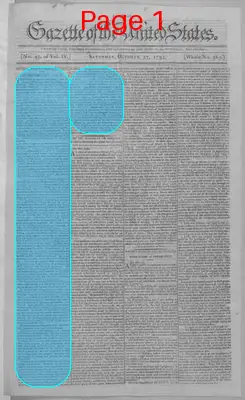
Editorial
October 27, 1792
Gazette Of The United States
New York, New York County, New York
What is this article about?
In 'The Republican No. V,' the author urges supporters of the new U.S. Constitution to awaken from complacency and counter the subversive efforts of its enemies. Americans, more rational than others, resist potential oppression without needing to suffer it, as in the Revolution against Britain. The middle class must defend the government to preserve order against anarchy.
Clipping
OCR Quality
88%
Good
Full Text
FOR THE GAZETTE OF THE UNITED STATES.
THE REPUBLICAN.—NO. V.
The friends of good order maintain that nothing but actual oppression will shake a government. Believing that power in the hands of the people themselves, exercised by their responsible servants, will never furnish just occasion for its own subversion, they consider our political condition as safely founded on a rock. They laugh at the malice of those whom they see employed to undermine it. They suffer them to scatter lies among the people, without taking the pains to expose them, relying that as the burdens imposed by Congress are light, and the advantages produced by the new constitution are great and increasing, no great harm will be done. The force of things, they say, will overpower and confound the puny arts and rage of the enemies of the people. Accordingly, we see that the best friends of the new constitution have become throughout the United States surprisingly inattentive to the base methods which its adversaries are industriously using to bring it into abhorrence. They have slept too long. If the principle on which they rest their hopes of national security be found in its application to our circumstances—in the least questionable.
It may be true that in every other country the feeling of oppression only can rouse the multitude to resistance. If rulers will keep within any tolerable bounds, tranquillity may be maintained under a very bad system. No man on reflection will say that the same remark is applicable to the American nation. Less governed by their feelings, and more capable of reasoning, they are as much inflamed by the foresight of evils as any other people have been by actually suffering them. It is easy to make them feel oppression. It is only necessary to apprise them of the designs of their government to excite them to level the best cemented structure with the dust.
It is in vain to say that a reasoning people are not the dupes of destructive errors. The reason of the bulk is fallible in its best state, not even when exercised on subjects the most susceptible of proof. We know grossly an individual mistakes his interests and duties, when he omits his faculties and applies all his industry to the investigation of them. A nation is infinitely more exposed to error and delusion. The want of unity of views, the want of proofs, and the want of leisure to examine and weigh them, even if they could be come at, render the first conception of political truth exceedingly difficult. Experience indeed comes and puts its seal upon opinions and events—but it is a kind of after-thought—it shows the scars of those wounds which popular frenzy has made deep, and its venom has caused to gangrene. The chance however that a thinking nation will not run mad, is infinitely favorable to liberty and order. It is a political duty which we owe the government, as well as a moral duty which we owe to man, to multiply and improve the means of education. Our reflections, after being led into this train, as well as our recollection of the causes of the late war, will convince us that actual oppression need not be suffered to dispose our people to subvert the government supposed to meditate it. If we regard facts merely, probably of all known systems of colonial government, that of Britain was the mildest and the most truly maternal. But if we attend to principles, none was ever more formidable. The claim of a right to bind us in all cases whatsoever, was of all theories of despotism the most indiscreet and the most unlimited. We ought to be proud of the good sense of our people which did not wait for the exercise of this claim to be convinced of its nature. But we should be persuaded by the fact, that less than intolerable oppression will overthrow a government: even it. To this reasoning founded on the moral superiority of Americans over the greater part of the world, we may add the diversity of our habits. To nations who have grown gray under bad systems, the very vices of their governments seem reverend. That use is second nature, is a proverb. We may almost say it is more powerful than nature, for it controls it. Centuries have passed since the theories of European governments were framed. Some oppressive change of administration seems necessary to change the obedient habits of nations. Is the case of America similar? If we have fixed habits, they are the habits of Change. We have scarcely grown cold in any of our institutions. Our governments smell even yet of the hands that made them, of the yeast of that faction which leavened the mass.
On these topics much might be said. But without dilating on them, much will be thought. The intention of these remarks, is to convince the friends of the constitution that they repose in a state of false security. They rely on a principle which is only partially true in our country. It is time for them to rouse and to oppose the wicked arts of the enemies of the constitution with that manly and watchful spirit, which, for the happiness and honor of our country, procured its adoption. Men are employed to steal this blessing from the people. Rumors that can neither be proved nor refuted, are spread on all sides. Calumny on men and measures lies hid, like an assassin, in bye places. Resistance to the laws is openly threatened in the back parts of Pennsylvania, and in one Gazette that Spirit is most impudently applauded. The middle order of society, the men who have some property and families to protect, are the trustees and keepers of the constitution—of the liberties of our nation. To them it belongs to come forward to the post of duty which they occupied when the constitution was in its passage. The government leans on them for protection, and in turn their security and that of their children and property rests on the preservation of the government. If they neglect to support authority when they see it as at present artfully undermined and insolently braved, they may have cause to lament their supineness when it will be too late. If good men were as attentive to support a free constitution as bad men are to subvert it, we might indulge the hope of transmitting it as a precious inheritance to our latest posterity.
As men's passions, when inflamed, easily overpower their soundest opinions, it is necessary to balance one emotion by another, to oppose the zeal of good men for order and government to the restless activity of incendiaries. Let the former contemplate the excellence of the constitution. The people of France are risking all, for one of less worth—and while our patriots see in that image of our country all that can interest their affections, let them resolve to watch for it, and if necessary, to defend it. For the time is coming when the evil spirit of politics will be unchained, and men will have to choose whether they will prefer order, the law and the constitution, or anarchy, confusion and civil discord.
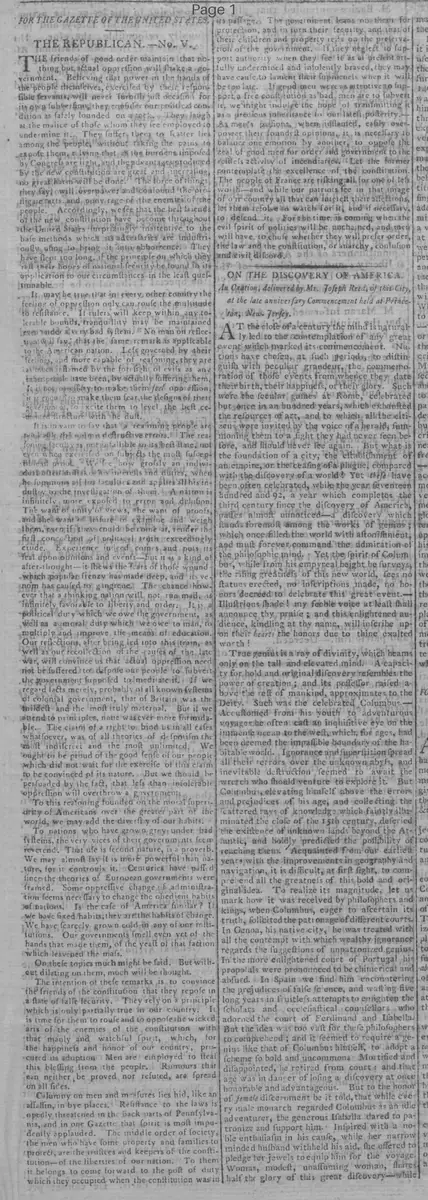
THE REPUBLICAN.—NO. V.
The friends of good order maintain that nothing but actual oppression will shake a government. Believing that power in the hands of the people themselves, exercised by their responsible servants, will never furnish just occasion for its own subversion, they consider our political condition as safely founded on a rock. They laugh at the malice of those whom they see employed to undermine it. They suffer them to scatter lies among the people, without taking the pains to expose them, relying that as the burdens imposed by Congress are light, and the advantages produced by the new constitution are great and increasing, no great harm will be done. The force of things, they say, will overpower and confound the puny arts and rage of the enemies of the people. Accordingly, we see that the best friends of the new constitution have become throughout the United States surprisingly inattentive to the base methods which its adversaries are industriously using to bring it into abhorrence. They have slept too long. If the principle on which they rest their hopes of national security be found in its application to our circumstances—in the least questionable.
It may be true that in every other country the feeling of oppression only can rouse the multitude to resistance. If rulers will keep within any tolerable bounds, tranquillity may be maintained under a very bad system. No man on reflection will say that the same remark is applicable to the American nation. Less governed by their feelings, and more capable of reasoning, they are as much inflamed by the foresight of evils as any other people have been by actually suffering them. It is easy to make them feel oppression. It is only necessary to apprise them of the designs of their government to excite them to level the best cemented structure with the dust.
It is in vain to say that a reasoning people are not the dupes of destructive errors. The reason of the bulk is fallible in its best state, not even when exercised on subjects the most susceptible of proof. We know grossly an individual mistakes his interests and duties, when he omits his faculties and applies all his industry to the investigation of them. A nation is infinitely more exposed to error and delusion. The want of unity of views, the want of proofs, and the want of leisure to examine and weigh them, even if they could be come at, render the first conception of political truth exceedingly difficult. Experience indeed comes and puts its seal upon opinions and events—but it is a kind of after-thought—it shows the scars of those wounds which popular frenzy has made deep, and its venom has caused to gangrene. The chance however that a thinking nation will not run mad, is infinitely favorable to liberty and order. It is a political duty which we owe the government, as well as a moral duty which we owe to man, to multiply and improve the means of education. Our reflections, after being led into this train, as well as our recollection of the causes of the late war, will convince us that actual oppression need not be suffered to dispose our people to subvert the government supposed to meditate it. If we regard facts merely, probably of all known systems of colonial government, that of Britain was the mildest and the most truly maternal. But if we attend to principles, none was ever more formidable. The claim of a right to bind us in all cases whatsoever, was of all theories of despotism the most indiscreet and the most unlimited. We ought to be proud of the good sense of our people which did not wait for the exercise of this claim to be convinced of its nature. But we should be persuaded by the fact, that less than intolerable oppression will overthrow a government: even it. To this reasoning founded on the moral superiority of Americans over the greater part of the world, we may add the diversity of our habits. To nations who have grown gray under bad systems, the very vices of their governments seem reverend. That use is second nature, is a proverb. We may almost say it is more powerful than nature, for it controls it. Centuries have passed since the theories of European governments were framed. Some oppressive change of administration seems necessary to change the obedient habits of nations. Is the case of America similar? If we have fixed habits, they are the habits of Change. We have scarcely grown cold in any of our institutions. Our governments smell even yet of the hands that made them, of the yeast of that faction which leavened the mass.
On these topics much might be said. But without dilating on them, much will be thought. The intention of these remarks, is to convince the friends of the constitution that they repose in a state of false security. They rely on a principle which is only partially true in our country. It is time for them to rouse and to oppose the wicked arts of the enemies of the constitution with that manly and watchful spirit, which, for the happiness and honor of our country, procured its adoption. Men are employed to steal this blessing from the people. Rumors that can neither be proved nor refuted, are spread on all sides. Calumny on men and measures lies hid, like an assassin, in bye places. Resistance to the laws is openly threatened in the back parts of Pennsylvania, and in one Gazette that Spirit is most impudently applauded. The middle order of society, the men who have some property and families to protect, are the trustees and keepers of the constitution—of the liberties of our nation. To them it belongs to come forward to the post of duty which they occupied when the constitution was in its passage. The government leans on them for protection, and in turn their security and that of their children and property rests on the preservation of the government. If they neglect to support authority when they see it as at present artfully undermined and insolently braved, they may have cause to lament their supineness when it will be too late. If good men were as attentive to support a free constitution as bad men are to subvert it, we might indulge the hope of transmitting it as a precious inheritance to our latest posterity.
As men's passions, when inflamed, easily overpower their soundest opinions, it is necessary to balance one emotion by another, to oppose the zeal of good men for order and government to the restless activity of incendiaries. Let the former contemplate the excellence of the constitution. The people of France are risking all, for one of less worth—and while our patriots see in that image of our country all that can interest their affections, let them resolve to watch for it, and if necessary, to defend it. For the time is coming when the evil spirit of politics will be unchained, and men will have to choose whether they will prefer order, the law and the constitution, or anarchy, confusion and civil discord.
What sub-type of article is it?
Constitutional
Partisan Politics
What keywords are associated?
Constitution Defense
Political Subversion
American Rationality
Public Education
Colonial Principles
Middle Class Duty
Anarchy Prevention
What entities or persons were involved?
Congress
Enemies Of The Constitution
American People
Britain
France
Middle Order Of Society
Editorial Details
Primary Topic
Defense Of The New Constitution Against Subversion
Stance / Tone
Urging Vigilance And Support For The Constitution
Key Figures
Congress
Enemies Of The Constitution
American People
Britain
France
Middle Order Of Society
Key Arguments
Actual Oppression Is Not Needed To Rouse Americans; Foresight Of Evils Suffices Due To Their Rational Nature.
The New Constitution's Supporters Have Been Inattentive To Adversaries' Tactics.
Education Is A Duty To Prevent National Error And Delusion.
British Colonial Government Was Mild In Fact But Despotic In Principle, Leading To Revolution.
Americans' Habits Of Change Make Them Less Tolerant Of Potential Oppression.
Middle Class Must Actively Defend The Government Against Rumors, Calumny, And Threats.
Balance Passions By Contemplating The Constitution's Excellence, Especially Compared To France's.
Vigilance Is Needed To Prevent Anarchy And Preserve Order.