Thank you for visiting SNEWPapers!
Sign up free
Editorial
January 26, 1935
The Bismarck Tribune
Bismarck, Mandan, Burleigh County, Morton County, North Dakota
What is this article about?
The Tribune reprints a Fargo News editorial highlighting $8 million monthly wage losses from 1934 strikes, equivalent to over two million man-days, amid government anti-depression efforts; suggests recouping losses could aid prosperity.
Clipping
OCR Quality
95%
Excellent
Full Text
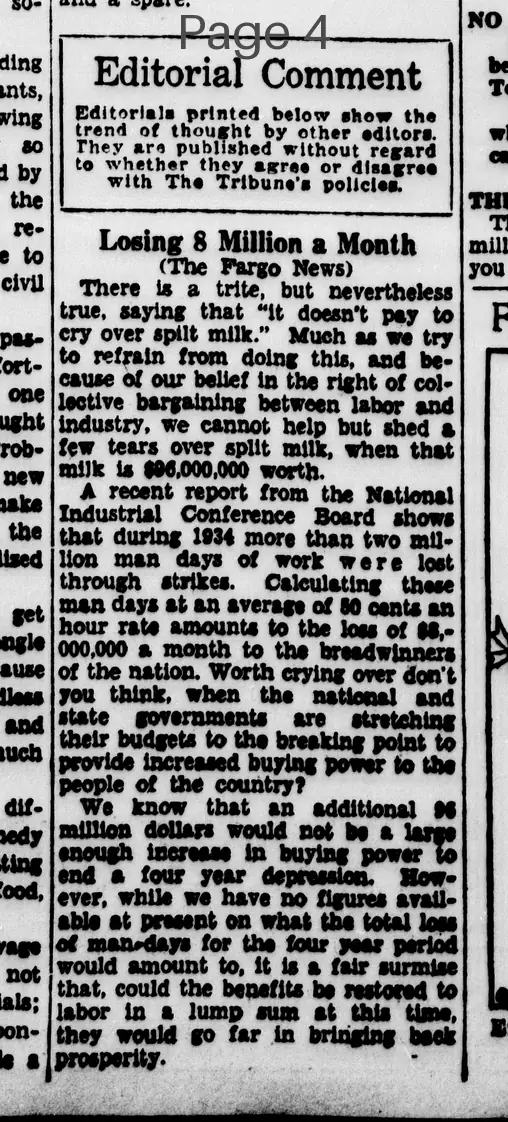
Editorial Comment
Editorials printed below show the trend of thought by other editors. They are published without regard to whether they agree or disagree with The Tribune's policies.
Losing 8 Million a Month
(The Fargo News)
There is a trite, but nevertheless true, saying that "it doesn't pay to cry over spilt milk." Much as we try to refrain from doing this, and because of our belief in the right of collective bargaining between labor and industry, we cannot help but shed a few tears over spilt milk, when that milk is $96,000,000 worth.
A recent report from the National Industrial Conference Board shows that during 1934 more than two million man days of work were lost through strikes.
Calculating these man days at an average of 50 cents an hour rate amounts to the loss of $8,000,000 a month to the breadwinners of the nation. Worth crying over don't you think, when the national and state governments are stretching their budgets to the breaking point to provide increased buying power to the people of the country?
We know that an additional $9 million dollars would not be a large enough increase in buying power to end a four year depression, however, while we have no figures available at present on what the total loss of man-days for the four year period would amount to, it is a fair surmise that, could the benefits be restored to labor in a lump sum at this time, they would go far in bringing back prosperity.
Editorials printed below show the trend of thought by other editors. They are published without regard to whether they agree or disagree with The Tribune's policies.
Losing 8 Million a Month
(The Fargo News)
There is a trite, but nevertheless true, saying that "it doesn't pay to cry over spilt milk." Much as we try to refrain from doing this, and because of our belief in the right of collective bargaining between labor and industry, we cannot help but shed a few tears over spilt milk, when that milk is $96,000,000 worth.
A recent report from the National Industrial Conference Board shows that during 1934 more than two million man days of work were lost through strikes.
Calculating these man days at an average of 50 cents an hour rate amounts to the loss of $8,000,000 a month to the breadwinners of the nation. Worth crying over don't you think, when the national and state governments are stretching their budgets to the breaking point to provide increased buying power to the people of the country?
We know that an additional $9 million dollars would not be a large enough increase in buying power to end a four year depression, however, while we have no figures available at present on what the total loss of man-days for the four year period would amount to, it is a fair surmise that, could the benefits be restored to labor in a lump sum at this time, they would go far in bringing back prosperity.
What sub-type of article is it?
Labor
Economic Policy
What keywords are associated?
Strikes
Man Days Lost
Economic Loss
Depression
Buying Power
Collective Bargaining
What entities or persons were involved?
National Industrial Conference Board
The Fargo News
Labor
Industry
National And State Governments
Editorial Details
Primary Topic
Economic Losses From Strikes In 1934
Stance / Tone
Lamenting Strike Related Losses While Supporting Collective Bargaining
Key Figures
National Industrial Conference Board
The Fargo News
Labor
Industry
National And State Governments
Key Arguments
Over Two Million Man Days Lost Through Strikes In 1934
Equivalent To $8,000,000 Monthly Loss At 50 Cents Per Hour
This Loss Is Significant Amid Government Efforts To Increase Buying Power
Restoring These Lost Benefits Could Help End The Depression