Thank you for visiting SNEWPapers!
Sign up free
Editorial
April 5, 1805
Norfolk Gazette And Publick Ledger
Norfolk, Virginia
What is this article about?
This editorial criticizes the Richmond Enquirer's editor, Mr. Ritchie, for misrepresenting British constitutional law in defending Mr. Randolph's proposal to remove U.S. federal judges upon joint congressional address. The author argues the proposal undermines judicial independence by eliminating presidential discretion, unlike the British system requiring royal consent.
Clipping
OCR Quality
98%
Excellent
Full Text
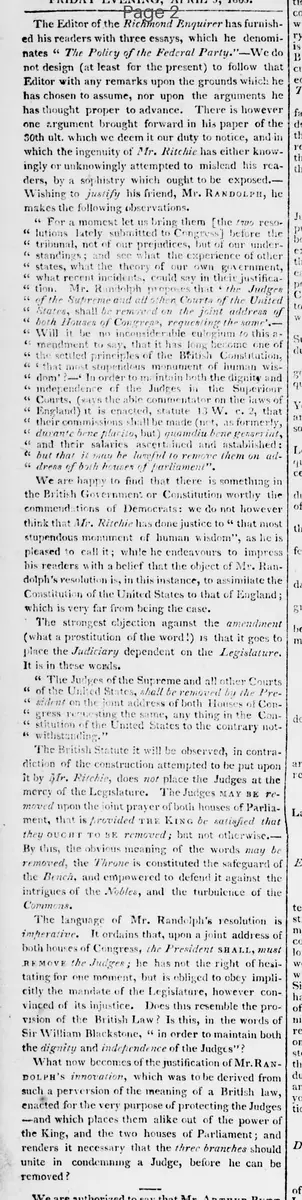
The Editor of the Richmond Enquirer has furnished his readers with three essays, which he denominates "The Policy of the Federal Party." We do not design (at least for the present) to follow that Editor with any remarks upon the grounds which he has chosen to assume, nor upon the arguments he has thought proper to advance. There is however one argument brought forward in his paper of the 30th ult. which we deem it our duty to notice, and in which the ingenuity of Mr. Ritchie has either knowingly or unknowingly attempted to mislead his readers, by a sophistry which ought to be exposed.
Wishing to justify his friend, Mr. Randolph, he makes the following observations.
"For a moment let us bring them [the two resolutions lately submitted to Congress] before the tribunal, not of our prejudices, but of our understandings; and see what the experience of other states, what the theory of our own government, what recent incidents, could say in their justification. Mr. Randolph proposes that the Judges of the Supreme and all other Courts of the United States, shall be removed on the joint address of both Houses of Congress, requesting the same."
"Will it be no inconsiderable eulogium to this amendment to say, that it has long become one of the settled principles of the British Constitution, that most stupendous monument of human wisdom?" In order to maintain both the dignity and independence of the Judges in the Superior Courts, (says the able commentator on the laws of England) it is enacted, statute 13 W. c. 2, that their commissions shall be made (not, as formerly, durante bene placito, but) quamdiu bene gesserint, and their salaries ascertained and established: but that it may be lawful to remove them on address of both houses of parliament".
We are happy to find that there is something in the British Government or Constitution worthy the commendations of Democrats: we do not however think that Mr. Ritchie has done justice to "that most stupendous monument of human wisdom", as he is pleased to call it; while he endeavours to impress his readers with a belief that the object of Mr. Randolph's resolution is, in this instance, to assimilate the Constitution of the United States to that of England: which is very far from being the case.
The strongest objection against the amendment (what a prostitution of the word!) is that it goes to place the Judiciary dependent on the Legislature. It is in these words.
"The Judges of the Supreme and all other Courts of the United States, shall be removed by the President on the joint address of both Houses of Congress requesting the same, any thing in the Constitution of the United States to the contrary notwithstanding."
The British Statute it will be observed, in contradiction of the construction attempted to be put upon it by Mr. Ritchie, does not place the Judges at the mercy of the Legislature. The Judges MAY BE removed upon the joint prayer of both houses of Parliament, that is provided THE KING be satisfied that they OUGHT TO BE removed: but not otherwise.
By this, the obvious meaning of the words may be removed, the Throne is constituted the safeguard of the Bench, and empowered to defend it against the intrigues of the Nobles, and the turbulence of the Commons.
The language of Mr. Randolph's resolution is imperative. It ordains that, upon a joint address of both houses of Congress, the President SHALL, must remove the Judges: he has not the right of hesitating for one moment, but is obliged to obey implicitly the mandate of the Legislature, however convinced of its injustice. Does this resemble the provision of the British Law? Is this, in the words of Sir William Blackstone, "in order to maintain both the dignity and independence of the Judges"?
What now becomes of the justification of Mr. Randolph's innovation, which was to be derived from such a perversion of the meaning of a British law, enacted for the very purpose of protecting the Judges --and which places them alike out of the power of the King, and the two houses of Parliament; and renders it necessary that the three branches should unite in condemning a Judge, before he can be removed?
Wishing to justify his friend, Mr. Randolph, he makes the following observations.
"For a moment let us bring them [the two resolutions lately submitted to Congress] before the tribunal, not of our prejudices, but of our understandings; and see what the experience of other states, what the theory of our own government, what recent incidents, could say in their justification. Mr. Randolph proposes that the Judges of the Supreme and all other Courts of the United States, shall be removed on the joint address of both Houses of Congress, requesting the same."
"Will it be no inconsiderable eulogium to this amendment to say, that it has long become one of the settled principles of the British Constitution, that most stupendous monument of human wisdom?" In order to maintain both the dignity and independence of the Judges in the Superior Courts, (says the able commentator on the laws of England) it is enacted, statute 13 W. c. 2, that their commissions shall be made (not, as formerly, durante bene placito, but) quamdiu bene gesserint, and their salaries ascertained and established: but that it may be lawful to remove them on address of both houses of parliament".
We are happy to find that there is something in the British Government or Constitution worthy the commendations of Democrats: we do not however think that Mr. Ritchie has done justice to "that most stupendous monument of human wisdom", as he is pleased to call it; while he endeavours to impress his readers with a belief that the object of Mr. Randolph's resolution is, in this instance, to assimilate the Constitution of the United States to that of England: which is very far from being the case.
The strongest objection against the amendment (what a prostitution of the word!) is that it goes to place the Judiciary dependent on the Legislature. It is in these words.
"The Judges of the Supreme and all other Courts of the United States, shall be removed by the President on the joint address of both Houses of Congress requesting the same, any thing in the Constitution of the United States to the contrary notwithstanding."
The British Statute it will be observed, in contradiction of the construction attempted to be put upon it by Mr. Ritchie, does not place the Judges at the mercy of the Legislature. The Judges MAY BE removed upon the joint prayer of both houses of Parliament, that is provided THE KING be satisfied that they OUGHT TO BE removed: but not otherwise.
By this, the obvious meaning of the words may be removed, the Throne is constituted the safeguard of the Bench, and empowered to defend it against the intrigues of the Nobles, and the turbulence of the Commons.
The language of Mr. Randolph's resolution is imperative. It ordains that, upon a joint address of both houses of Congress, the President SHALL, must remove the Judges: he has not the right of hesitating for one moment, but is obliged to obey implicitly the mandate of the Legislature, however convinced of its injustice. Does this resemble the provision of the British Law? Is this, in the words of Sir William Blackstone, "in order to maintain both the dignity and independence of the Judges"?
What now becomes of the justification of Mr. Randolph's innovation, which was to be derived from such a perversion of the meaning of a British law, enacted for the very purpose of protecting the Judges --and which places them alike out of the power of the King, and the two houses of Parliament; and renders it necessary that the three branches should unite in condemning a Judge, before he can be removed?
What sub-type of article is it?
Constitutional
Legal Reform
Partisan Politics
What keywords are associated?
Judicial Independence
Constitutional Amendment
British Constitution
Federal Judiciary
Congressional Address
Richmond Enquirer
Mr Randolph
What entities or persons were involved?
Mr. Ritchie
Mr. Randolph
Richmond Enquirer
Congress
President
Supreme Court Judges
British Parliament
King
Sir William Blackstone
Editorial Details
Primary Topic
Criticism Of Proposal To Remove Federal Judges On Congressional Address
Stance / Tone
Critical Of Ritchie And Randolph, Defending Judicial Independence
Key Figures
Mr. Ritchie
Mr. Randolph
Richmond Enquirer
Congress
President
Supreme Court Judges
British Parliament
King
Sir William Blackstone
Key Arguments
Ritchie's Argument Misrepresents British Statute 13 W. C. 2 By Ignoring The King's Required Consent For Judge Removal
Randolph's Resolution Makes Judicial Removal Mandatory Upon Congressional Address, Eliminating Presidential Discretion
The Proposal Places The Judiciary Dependent On The Legislature, Undermining Independence
British Law Protects Judges By Requiring Unity Of All Three Branches For Removal
The Amendment Contradicts The Purpose Of Maintaining Judicial Dignity And Independence