Thank you for visiting SNEWPapers!
Sign up free
Editorial
August 25, 1804
The Enquirer
Richmond, Henrico County, Virginia
What is this article about?
Concluding essay on banks argues they can support Virginia farmers by lending against tobacco notes as secure deposits, enabling better market timing for crops like tobacco. Contrasts with risks of land-based or crop-pledge lending. Briefly notes benefits to merchants and potential for local trade and manufactures.
Clipping
OCR Quality
95%
Excellent
Full Text
ENQUIRER
RICHMOND:
SATURDAY, AUGUST 25, 1804.
ON BANKS:
NO. V... Concluded.
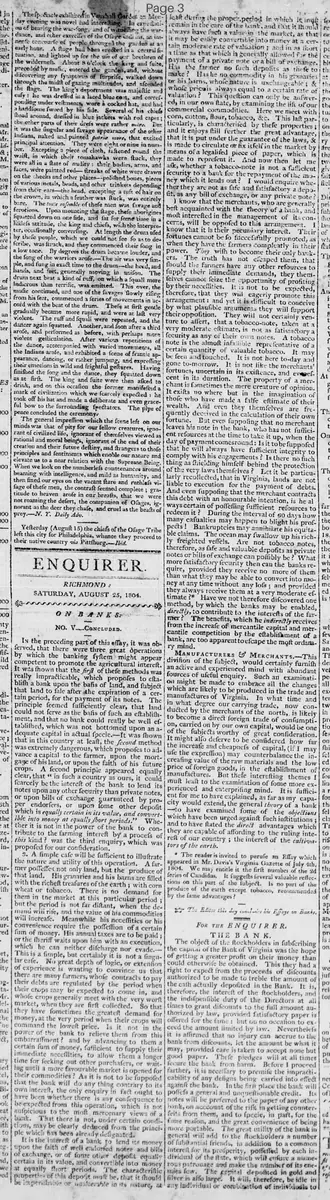
In the preceding part of this essay, it was observed, that there were three great operations by which the banking system might appear competent to promote the agricultural interest. It was shown that the first of these methods was really impracticable, which proposes to establish a bank upon the basis of land, and subject that land to sale after the expiration of a certain period, for the payment of its notes. The principle seemed sufficiently clear, that land could not serve as the basis of such an establishment, and that no bank could really be well established, which was not bottomed upon an adequate capital in actual specie.—It was shown that in this country at least, the second method was extremely dangerous, which proposes to advance a capital to the farmer, upon the mortgage of his land, or upon the faith of his future crops. A second principle appeared equally clear, that "in such a country as ours, it could scarcely be the interest of the bank to lend its notes upon any other security than private notes, or upon bills of exchange guaranteed by proper endorsers, or upon some other deposit which is equally certain in its value, and convertible into money at equally short periods." Whether it is not in the power of the bank to contribute to the farming interest by a process of this kind? was the third enquiry, which was proposed for our consideration.
4. A simple case will be sufficient to illustrate the nature and utility of this operation. A farmer possesses not only land, but the produce of that land. His granaries and his barns are filled with the richest treasures of the earth; with corn wheat or tobacco. There is no demand for them in the market at this particular period; but the period is not far distant, when the demand will rise, and the value of his commodities will increase. Meanwhile his necessities or his convenience require the possession of a certain sum of money. His annual taxes are to be paid; or the sheriff waits upon him with an execution, which he can neither discharge nor evade.— This is a simple, but certainly it is not a singular case. No great depth of logic, or extension of experience is wanting to convince us that there are many farmers, whose contracts to pay their debts are regulated by the period when their crops may be expected to come in, and whose crops generally meet with the very worst market, when they are first collected. So that they have sometimes the greatest demand for money, at the very period when their crops will command the lowest price. Is it not in the power of the bank to relieve them from this embarrassment? and by advancing to them a certain sum of money, sufficient to supply their immediate necessities, to allow them a longer time for seeking out other purchasers, or waiting until a more favourable market is opened for their commodities? As it is not to be supposed that the bank will do any thing contrary to its own interest, the only enquiry in fact ought to have been whether there is any consequence to be expected from this operation, which is not auspicious to the most mercenary views of a bank. That there is not, under certain conditions, may be clearly deduced from the principle which has been already designated.
It is the interest of a bank to lend its money upon the faith of well endorsed notes and bills of exchange, or of some other deposit equally certain in its value, and convertible into money at equally short periods. The characteristic properties of this deposit must be, that it should be imperishable or unalterable in its nature, at least during the proper period in which it may remain in the care of the bank, and that it should always have such a value in the market, as that it may be easily convertible into money at a certain moderate rate of valuation; and in as short a time as that which is generally allowed for the payment of a private note or a bill of exchange. Has the farmer no such deposits as these to make? Has he no commodity in his granaries or his barns, whose nature is unchangeable; & whose price is always equal to a certain rate of valuation? This question can only be answered, in our own state, by examining the list of our commercial commodities. Here we meet with corn, cotton, flour, tobacco, &c. This last particularly, is characterized by these properties; and it enjoys still further the great advantage, that it is put under the guarantee of the laws, & is made to circulate or fix itself in the market by means of a legalized piece of paper, which is made to represent it. And now then let me ask, whether a tobacco-note is not a sufficient security to a bank for the repayment of the money which it lends out? I would enquire whether they are not as safe and satisfactory a deposit, as any bill of exchange, or any private note? I know that the merchants, who are generally best acquainted with the theory of a bank, and most interested in the management of its concerns, will be opposed to this arrangement. I know that it is their pecuniary interest. Their fortunes cannot be so successfully promoted, as when they have the farmers completely in their power. They wish to become their only bankers. The truth has not escaped them, that should the farmers have any other resources to supply their immediate demands, they themselves cannot seize the opportunity of profiting by their necessities. It is not to be expected, therefore, that they will eagerly promote this arrangement: and yet it is difficult to conceive by what plausible arguments they will support their opposition. They will not certainly venture to assert, that a tobacco-note, taken at a very moderate estimate, is not as satisfactory a security as any of their own notes. A tobacco note is the almost infallible representative of a certain quantity of valuable tobacco. It may be seen and touched. It is not here to-day and gone to-morrow. It is not like the merchants fortunes, uncertain in its existence, and evanescent in its duration. The property of a merchant is sometimes the mere creature of opinion. It exists no where but in the imagination of those who have made a false estimate of their wealth. And even they themselves are frequently deceived in the calculation of their own fortune. But ever supposing that no merchant leaves his note in the bank, who has not sufficient resources at the time to take it up, when the day of payment comes round: Is it to be supposed that he will always have sufficient integrity to comply with his engagements? Is there no such thing as shielding himself behind the protection of the very laws themselves? Let it be particularly recollected, that in Virginia, lands are not liable to execution for the payment of debts. And even supposing that the merchant contracts this debt with an honourable intention, is he always certain of possessing sufficient resources to redeem it? During the interval of 60 days how many casualties may happen to blight his prospects! Bankruptcies may annihilate his equitable claims. The ocean may swallow up his richly freighted vessels. Are not tobacco notes, therefore, as safe and valuable deposits as private notes or bills of exchange can possibly be? What more satisfactory security then can the banks require, provided they receive no more of them than what they may be able to convert into money at any time without any loss: and provided they always receive them at a very moderate estimate?* Have we not therefore discovered one method, by which the banks may be enabled, directly, to contribute to the interests of the farmer? The benefits, which he indirectly receives from the increase of mercantile capital and mercantile competition by the establishment of a bank, are too apparent to escape the most ordinary mind.
Manufacturers & Merchants.—This division of the subject, would certainly furnish an active and experienced mind with abundant sources of useful enquiry. Such an examination might be made to embrace all the changes which are likely to be produced in the trade and manufactures of Virginia. In what time and in what degree our carrying trade, now conducted by the merchants of the north, is likely to become a direct foreign trade of consumption, carried on by our own capital, would be one of the subjects worthy of great consideration. It might also deserve to be considered how far the increase and cheapness of capital, (if I may use the expression) may counterbalance the increasing value of the raw materials and the low price of foreign goods, in the establishment of manufactures. But these interesting themes I must leave to the examination of some more experienced and enterprising mind. It is sufficient for me to have explained, as far as my capacity would extend, the general theory of a bank —to have examined some of the objections which have been urged against such institutions; and to have stated the direct advantages which they are capable of affording to the ruling interest of our country; the interest of the cultivators of the earth.
RICHMOND:
SATURDAY, AUGUST 25, 1804.
ON BANKS:
NO. V... Concluded.
In the preceding part of this essay, it was observed, that there were three great operations by which the banking system might appear competent to promote the agricultural interest. It was shown that the first of these methods was really impracticable, which proposes to establish a bank upon the basis of land, and subject that land to sale after the expiration of a certain period, for the payment of its notes. The principle seemed sufficiently clear, that land could not serve as the basis of such an establishment, and that no bank could really be well established, which was not bottomed upon an adequate capital in actual specie.—It was shown that in this country at least, the second method was extremely dangerous, which proposes to advance a capital to the farmer, upon the mortgage of his land, or upon the faith of his future crops. A second principle appeared equally clear, that "in such a country as ours, it could scarcely be the interest of the bank to lend its notes upon any other security than private notes, or upon bills of exchange guaranteed by proper endorsers, or upon some other deposit which is equally certain in its value, and convertible into money at equally short periods." Whether it is not in the power of the bank to contribute to the farming interest by a process of this kind? was the third enquiry, which was proposed for our consideration.
4. A simple case will be sufficient to illustrate the nature and utility of this operation. A farmer possesses not only land, but the produce of that land. His granaries and his barns are filled with the richest treasures of the earth; with corn wheat or tobacco. There is no demand for them in the market at this particular period; but the period is not far distant, when the demand will rise, and the value of his commodities will increase. Meanwhile his necessities or his convenience require the possession of a certain sum of money. His annual taxes are to be paid; or the sheriff waits upon him with an execution, which he can neither discharge nor evade.— This is a simple, but certainly it is not a singular case. No great depth of logic, or extension of experience is wanting to convince us that there are many farmers, whose contracts to pay their debts are regulated by the period when their crops may be expected to come in, and whose crops generally meet with the very worst market, when they are first collected. So that they have sometimes the greatest demand for money, at the very period when their crops will command the lowest price. Is it not in the power of the bank to relieve them from this embarrassment? and by advancing to them a certain sum of money, sufficient to supply their immediate necessities, to allow them a longer time for seeking out other purchasers, or waiting until a more favourable market is opened for their commodities? As it is not to be supposed that the bank will do any thing contrary to its own interest, the only enquiry in fact ought to have been whether there is any consequence to be expected from this operation, which is not auspicious to the most mercenary views of a bank. That there is not, under certain conditions, may be clearly deduced from the principle which has been already designated.
It is the interest of a bank to lend its money upon the faith of well endorsed notes and bills of exchange, or of some other deposit equally certain in its value, and convertible into money at equally short periods. The characteristic properties of this deposit must be, that it should be imperishable or unalterable in its nature, at least during the proper period in which it may remain in the care of the bank, and that it should always have such a value in the market, as that it may be easily convertible into money at a certain moderate rate of valuation; and in as short a time as that which is generally allowed for the payment of a private note or a bill of exchange. Has the farmer no such deposits as these to make? Has he no commodity in his granaries or his barns, whose nature is unchangeable; & whose price is always equal to a certain rate of valuation? This question can only be answered, in our own state, by examining the list of our commercial commodities. Here we meet with corn, cotton, flour, tobacco, &c. This last particularly, is characterized by these properties; and it enjoys still further the great advantage, that it is put under the guarantee of the laws, & is made to circulate or fix itself in the market by means of a legalized piece of paper, which is made to represent it. And now then let me ask, whether a tobacco-note is not a sufficient security to a bank for the repayment of the money which it lends out? I would enquire whether they are not as safe and satisfactory a deposit, as any bill of exchange, or any private note? I know that the merchants, who are generally best acquainted with the theory of a bank, and most interested in the management of its concerns, will be opposed to this arrangement. I know that it is their pecuniary interest. Their fortunes cannot be so successfully promoted, as when they have the farmers completely in their power. They wish to become their only bankers. The truth has not escaped them, that should the farmers have any other resources to supply their immediate demands, they themselves cannot seize the opportunity of profiting by their necessities. It is not to be expected, therefore, that they will eagerly promote this arrangement: and yet it is difficult to conceive by what plausible arguments they will support their opposition. They will not certainly venture to assert, that a tobacco-note, taken at a very moderate estimate, is not as satisfactory a security as any of their own notes. A tobacco note is the almost infallible representative of a certain quantity of valuable tobacco. It may be seen and touched. It is not here to-day and gone to-morrow. It is not like the merchants fortunes, uncertain in its existence, and evanescent in its duration. The property of a merchant is sometimes the mere creature of opinion. It exists no where but in the imagination of those who have made a false estimate of their wealth. And even they themselves are frequently deceived in the calculation of their own fortune. But ever supposing that no merchant leaves his note in the bank, who has not sufficient resources at the time to take it up, when the day of payment comes round: Is it to be supposed that he will always have sufficient integrity to comply with his engagements? Is there no such thing as shielding himself behind the protection of the very laws themselves? Let it be particularly recollected, that in Virginia, lands are not liable to execution for the payment of debts. And even supposing that the merchant contracts this debt with an honourable intention, is he always certain of possessing sufficient resources to redeem it? During the interval of 60 days how many casualties may happen to blight his prospects! Bankruptcies may annihilate his equitable claims. The ocean may swallow up his richly freighted vessels. Are not tobacco notes, therefore, as safe and valuable deposits as private notes or bills of exchange can possibly be? What more satisfactory security then can the banks require, provided they receive no more of them than what they may be able to convert into money at any time without any loss: and provided they always receive them at a very moderate estimate?* Have we not therefore discovered one method, by which the banks may be enabled, directly, to contribute to the interests of the farmer? The benefits, which he indirectly receives from the increase of mercantile capital and mercantile competition by the establishment of a bank, are too apparent to escape the most ordinary mind.
Manufacturers & Merchants.—This division of the subject, would certainly furnish an active and experienced mind with abundant sources of useful enquiry. Such an examination might be made to embrace all the changes which are likely to be produced in the trade and manufactures of Virginia. In what time and in what degree our carrying trade, now conducted by the merchants of the north, is likely to become a direct foreign trade of consumption, carried on by our own capital, would be one of the subjects worthy of great consideration. It might also deserve to be considered how far the increase and cheapness of capital, (if I may use the expression) may counterbalance the increasing value of the raw materials and the low price of foreign goods, in the establishment of manufactures. But these interesting themes I must leave to the examination of some more experienced and enterprising mind. It is sufficient for me to have explained, as far as my capacity would extend, the general theory of a bank —to have examined some of the objections which have been urged against such institutions; and to have stated the direct advantages which they are capable of affording to the ruling interest of our country; the interest of the cultivators of the earth.
What sub-type of article is it?
Economic Policy
Agriculture
Trade Or Commerce
What keywords are associated?
Banks
Agriculture
Tobacco Notes
Farmers
Merchants
Virginia Economy
Lending Security
Crop Markets
What entities or persons were involved?
Banks
Farmers
Merchants
Tobacco Notes
Virginia
Editorial Details
Primary Topic
Banks Aiding Farmers Through Tobacco Note Loans
Stance / Tone
Supportive Of Banks For Agricultural Benefit
Key Figures
Banks
Farmers
Merchants
Tobacco Notes
Virginia
Key Arguments
Land Cannot Serve As Basis For Banks; Need Specie Capital.
Lending On Future Crops Or Land Mortgages Is Dangerous.
Banks Should Lend On Secure, Convertible Deposits Like Endorsed Notes Or Bills.
Farmers Can Use Tobacco As Secure Deposit Via Tobacco Notes.
Tobacco Notes Are As Safe As Merchant Notes, Backed By Law And Tangible Goods.
Merchants Oppose This As It Reduces Their Control Over Farmers.
Banks Can Directly Help Farmers By Advancing Money Against Crops For Better Market Timing.
Indirect Benefits From Increased Mercantile Capital.
Potential For Banks To Boost Virginia Trade And Manufactures.