Thank you for visiting SNEWPapers!
Sign up free
Editorial
January 27, 1914
The Richmond Virginian
Richmond, Virginia
What is this article about?
Editorial argues that popular will has shifted power from states to federal government, citing John Marshall and Democratic changes, to combat monopolies and social ills; praises expansion into suffrage, marriage laws, and labor, favoring Hamiltonian over Jeffersonian approach.
Clipping
OCR Quality
98%
Excellent
Full Text
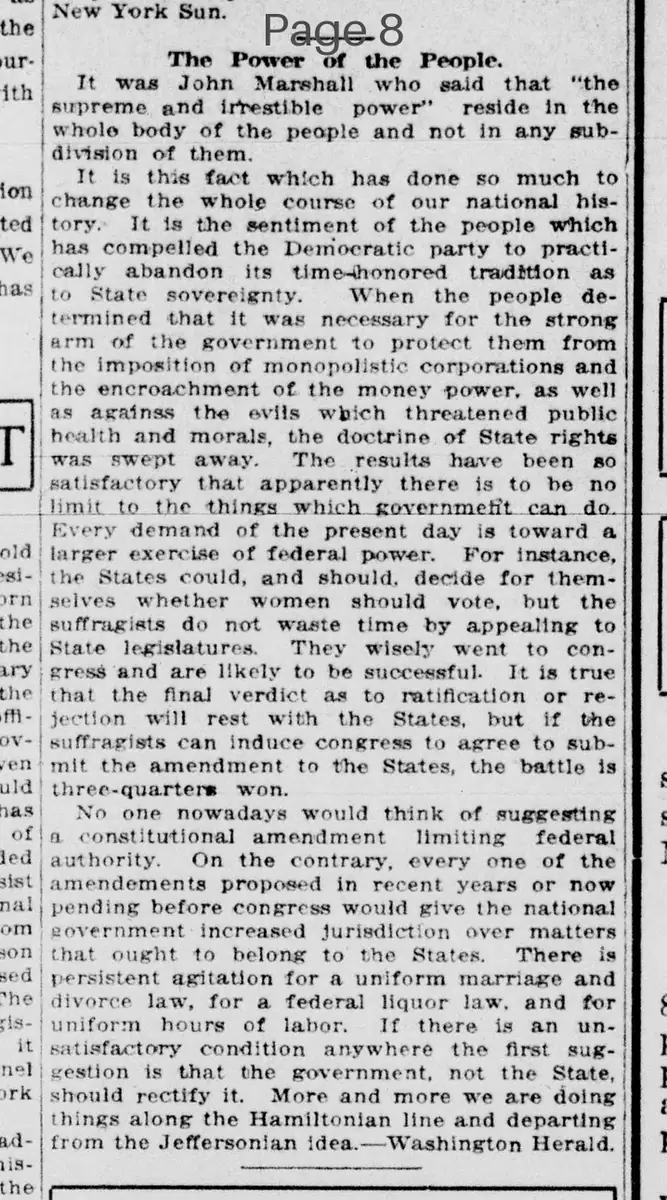
The Power of the People.
It was John Marshall who said that "the supreme and irresistible power" reside in the whole body of the people and not in any subdivision of them.
It is this fact which has done so much to change the whole course of our national history. It is the sentiment of the people which has compelled the Democratic party to practically abandon its time-honored tradition as to State sovereignty.
When the people determined that it was necessary for the strong arm of the government to protect them from the imposition of monopolistic corporations and the encroachment of the money power, as well as against the evils which threatened public health and morals, the doctrine of State rights was swept away.
The results have been so satisfactory that apparently there is to be no limit to the things which government can do. Every demand of the present day is toward a larger exercise of federal power. For instance, the States could, and should, decide for themselves whether women should vote, but the suffragists do not waste time by appealing to State legislatures. They wisely went to congress and are likely to be successful. It is true that the final verdict as to ratification or rejection will rest with the States, but if the suffragists can induce congress to agree to submit the amendment to the States, the battle is three-quarters won.
No one nowadays would think of suggesting a constitutional amendment limiting federal authority. On the contrary, every one of the amendments proposed in recent years or now pending before congress would give the national government increased jurisdiction over matters that ought to belong to the States. There is persistent agitation for a uniform marriage and divorce law, for a federal liquor law, and for uniform hours of labor. If there is an unsatisfactory condition anywhere the first suggestion is that the government, not the State, should rectify it. More and more we are doing things along the Hamiltonian line and departing from the Jeffersonian idea.
-Washington Herald.
It was John Marshall who said that "the supreme and irresistible power" reside in the whole body of the people and not in any subdivision of them.
It is this fact which has done so much to change the whole course of our national history. It is the sentiment of the people which has compelled the Democratic party to practically abandon its time-honored tradition as to State sovereignty.
When the people determined that it was necessary for the strong arm of the government to protect them from the imposition of monopolistic corporations and the encroachment of the money power, as well as against the evils which threatened public health and morals, the doctrine of State rights was swept away.
The results have been so satisfactory that apparently there is to be no limit to the things which government can do. Every demand of the present day is toward a larger exercise of federal power. For instance, the States could, and should, decide for themselves whether women should vote, but the suffragists do not waste time by appealing to State legislatures. They wisely went to congress and are likely to be successful. It is true that the final verdict as to ratification or rejection will rest with the States, but if the suffragists can induce congress to agree to submit the amendment to the States, the battle is three-quarters won.
No one nowadays would think of suggesting a constitutional amendment limiting federal authority. On the contrary, every one of the amendments proposed in recent years or now pending before congress would give the national government increased jurisdiction over matters that ought to belong to the States. There is persistent agitation for a uniform marriage and divorce law, for a federal liquor law, and for uniform hours of labor. If there is an unsatisfactory condition anywhere the first suggestion is that the government, not the State, should rectify it. More and more we are doing things along the Hamiltonian line and departing from the Jeffersonian idea.
-Washington Herald.
What sub-type of article is it?
Constitutional
Suffrage
Economic Policy
What keywords are associated?
Federal Power
State Sovereignty
Suffrage Amendment
Monopolies
Money Power
Constitutional Amendments
Hamiltonian Federalism
What entities or persons were involved?
John Marshall
Democratic Party
Suffragists
Congress
States
Hamiltonian
Jeffersonian
Editorial Details
Primary Topic
Expansion Of Federal Power And Decline Of State Sovereignty
Stance / Tone
Supportive Of Increased Federal Authority
Key Figures
John Marshall
Democratic Party
Suffragists
Congress
States
Hamiltonian
Jeffersonian
Key Arguments
Supreme Power Resides In The Whole Body Of The People, Not Subdivisions.
Popular Sentiment Compelled Democrats To Abandon State Sovereignty Traditions.
Federal Government Needed To Protect Against Monopolies, Money Power, And Threats To Health And Morals.
State Rights Doctrine Swept Away For Satisfactory Results.
Demands For Larger Federal Power, E.G., Suffrage Via Constitutional Amendment.
Recent Amendments Expand Federal Jurisdiction Over State Matters Like Marriage, Divorce, Liquor, Labor Hours.
Shift From Jeffersonian To Hamiltonian Ideas.