Thank you for visiting SNEWPapers!
Sign up free
Rhode Island American And Providence Gazette
Providence, Providence County, Rhode Island
What is this article about?
The North American Review examines French spoliations on American commerce from 1778 onward, estimating losses at 15-20 million dollars due to decrees revoking treaty protections, leading to indiscriminate captures of U.S. vessels by French forces and in ports, especially in the West Indies, with oppressive enforcement.
Clipping
OCR Quality
Full Text
From the Connecticut Mirror.
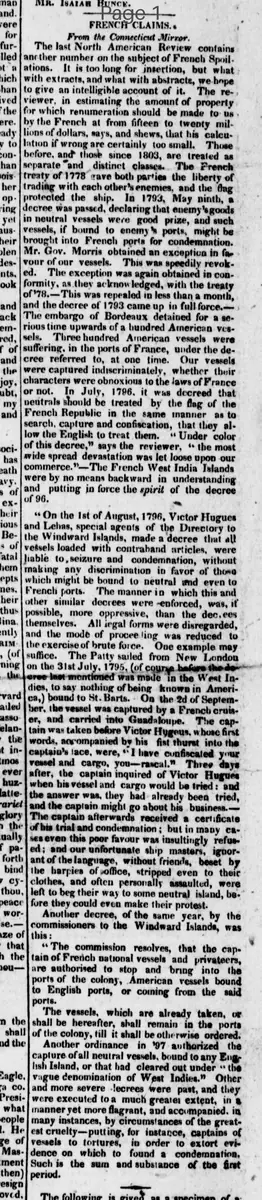
The last North American Review contains another number on the subject of French Spoliations. It is too long for insertion, but what with extracts, and what with abstracts, we hope to give an intelligible account of it. The reviewer, in estimating the amount of property for which remuneration should be made to us by the French at from fifteen to twenty millions of dollars, says, and shews, that his calculation if wrong are certainly too small. Those before, and those since 1803, are treated as separate and distinct classes. The French treaty of 1778 gave both parties the liberty of trading with each other's enemies, and the flag protected the ship. In 1793, May ninth, a decree was passed, declaring that enemy's goods in neutral vessels were good prize, and such vessels, if bound to enemy's ports, might be brought into French ports for condemnation. Mr. Gov. Morris obtained an exception in favour of our vessels. This was speedily revoked. The exception was again obtained in conformity, as they acknowledged, with the treaty of '78.—This was repealed in less than a month, and the decree of 1793 came up in full force.—The embargo of Bordeaux detained for a serious time upwards of a hundred American vessels. Three hundred American vessels were suffering, in the ports of France, under the decree referred to, at one time. Our vessels were captured indiscriminately, whether their characters were obnoxious to the laws of France or not. In July, 1796, it was decreed that neutrals should be treated by the flag of the French Republic in the same manner as to search, capture and confiscation, that they allow the English: to treat them. "Under color of this decree," says the reviewer, "the most wide spread devastation was let loose upon our commerce." The French West India Islands were by no means backward in understanding and putting in force the spirit of the decree of 96.
"On the 1st of August, 1796, Victor Hugues and Lebas, special agents of the Directory to the Windward Islands, made a decree that all vessels loaded with contraband articles, were liable to seizure and condemnation, without making any discrimination in favor of those which might be bound to neutral and even to French ports. The manner in which this and other similar decrees were enforced, was, if possible, more oppressive, than the decrees themselves. All legal forms were disregarded, and the mode of proceeding was reduced to the exercise of brute force. One example may suffice. The Patty sailed from New London on the 31st July, 1795. (of course before the decree last mentioned was made in the West Indies, to say nothing of being known in America,) bound to St. Barts. On the 2d of September, the vessel was captured by a French cruiser, and carried into Guadaloupe. The captain was taken before Victor Hugues, whose first words, accompanied by his fist thrust into the captain's face, were, "I have confiscated your vessel and cargo, you rascal." Three days after, the captain inquired of Victor Hugues when his vessel and cargo would be tried: and the answer was, they had already been tried, and the captain might go about his business.—The captain afterwards received a certificate of his trial and condemnation; but in many cases even this poor favour was insultingly refused; and our unfortunate ship masters, ignorant of the language, without friends, beset by the harpies of office, stripped even to their clothes, and often personally assaulted, were left to beg their way to some neutral island, before they could even make their protest.
Another decree, of the same year, by the commissioners to the Windward Islands, was this:
"The commission resolves, that the captains of French national vessels and privateers, are authorised to stop and bring into the ports of the colony, American vessels bound to English ports, or coming from the said ports.
The vessels, which are already taken, or shall be hereafter, shall remain in the ports of the colony, till it shall be otherwise ordered."
Another ordinance in '97 authorized the capture of all neutral vessels, bound to any English Island, or that had cleared out under "the vague denomination of West Indies." Other and more severe decrees were past, and they were executed to a much greater extent, in a manner yet more flagrant, and accompanied, in many instances, by circumstances of the greatest cruelty—putting, for instance, captains of vessels to tortures, in order to extort evidence on which to found a condemnation.
Such is the sum and substance of the first period.
What sub-type of article is it?
What keywords are associated?
What entities or persons were involved?
Where did it happen?
Foreign News Details
Primary Location
France
Event Date
1778 To 1797
Key Persons
Outcome
estimation of property losses at 15-20 million dollars; over 100 american vessels detained in bordeaux; 300 american vessels suffering in french ports; numerous captures and confiscations of american vessels.
Event Details
Review of French spoliations on American commerce, starting with 1778 treaty protections revoked by 1793 decree allowing capture of neutral vessels with enemy goods; exceptions obtained and revoked; 1796 decree treating neutrals as English; oppressive enforcement in France and West Indies, including example of Patty captured in 1795, immediate confiscation by Victor Hugues; further decrees authorizing captures of American vessels bound to or from English ports; executions with brutality and torture.