Thank you for visiting SNEWPapers!
Sign up free
The New Hampshire Gazette
Portsmouth, Rockingham County, New Hampshire
What is this article about?
American commentary on the new French Constitution, quoting a Belfast paper from Jan. 3 that criticizes it as granting kingly powers to the chief magistrate (likely Bonaparte), elevating functionaries into a noble order, and limiting popular sovereignty despite universal suffrage appeals. Sieyes and Bonaparte are mentioned as assured of military and national control.
Clipping
OCR Quality
Full Text
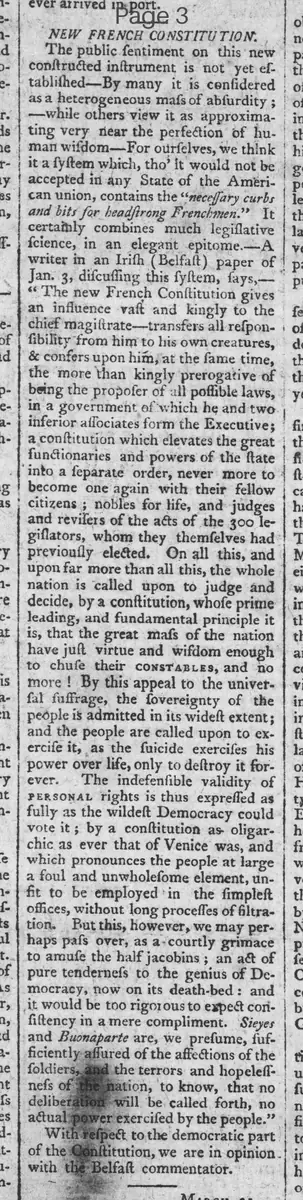
The public sentiment on this new constructed instrument is not yet established--By many it is considered as a heterogeneous mass of absurdity ; --while others view it as approximating very near the perfection of human wisdom--For ourselves, we think it a system which, tho' it would not be accepted in any State of the American union, contains the "necessary curbs and bits for headstrong Frenchmen." It certainly combines much legislative science, in an elegant epitome.--A writer in an Irish (Belfast) paper of Jan. 3, discussing this system, says,--
" The new French Constitution gives an influence vast and kingly to the chief magistrate--transfers all responsibility from him to his own creatures, & confers upon him, at the same time, the more than kingly prerogative of being the proposer of all possible laws, in a government of which he and two inferior associates form the Executive; a constitution which elevates the great functionaries and powers of the state into a separate order, never more to become one again with their fellow citizens ; nobles for life, and judges and revisers of the acts of the 300 legislators, whom they themselves had previously elected. On all this, and upon far more than all this, the whole nation is called upon to judge and decide, by a constitution, whose prime leading, and fundamental principle it is, that the great mass of the nation have just virtue and wisdom enough to chuse their constables, and no more ! By this appeal to the universal suffrage, the sovereignty of the people is admitted in its widest extent; and the people are called upon to exercise it, as the suicide exercises his power over life, only to destroy it for ever.
The indefensible validity of personal rights is thus expressed as fully as the wildest Democracy could vote it; by a constitution as oligarchic as ever that of Venice was, and which pronounces the people at large a foul and unwholesome element, unfit to be employed in the simplest offices, without long process of filtration. But this, however, we may perhaps pass over, as a courtly grimace to amuse the half jacobins ; an act of pure tenderness to the genius of Democracy, now on its death-bed: and it would be too rigorous to expect consistency in a mere compliment. Sieyes and Buonaparte are, we presume, sufficiently assured of the affections of the soldiers, and the terrors and hopelessness of the nation, 'to know, that no deliberation will be called forth, no actual power exercised by the people.'"
With respect to the democratic part of the Constitution, we are in opinion with the Belfast commentator.
What sub-type of article is it?
What keywords are associated?
What entities or persons were involved?
Where did it happen?
Foreign News Details
Primary Location
France
Event Date
Jan. 3
Key Persons
Outcome
the constitution grants vast kingly influence to the chief magistrate, elevates functionaries into a lifelong noble order, limits popular sovereignty despite universal suffrage, and is seen as oligarchic with democratic pretense.
Event Details
Public opinion on the new French Constitution is divided, with some viewing it as absurd and others as wise. An American writer notes it suits headstrong Frenchmen and combines legislative science. A Jan. 3 Belfast paper criticizes it for giving the chief magistrate kingly powers, responsibility transfer to subordinates, law proposal prerogative, and creating a separate noble order of functionaries who judge legislators. It appeals to universal suffrage but deems the masses unfit for more than basic roles, comparing it to Venetian oligarchy with democratic facade. Sieyes and Buonaparte are assured of military support and national hopelessness, ensuring no real popular power.