Thank you for visiting SNEWPapers!
Sign up free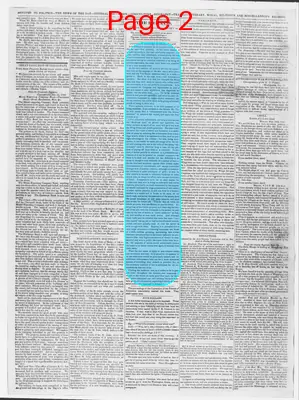
Editorial
January 25, 1842
Rutland Herald
Rutland, Rutland County, Vermont
What is this article about?
The editorial critiques the U.S. House's repeal of the recently passed Bankrupt Law without operational experience, questions the Whig party's vote shift, anticipates Senate opposition or presidential veto by Tyler, and supports the law despite concerns over potential fraud by dishonest debtors.
Clipping
OCR Quality
95%
Excellent
Full Text
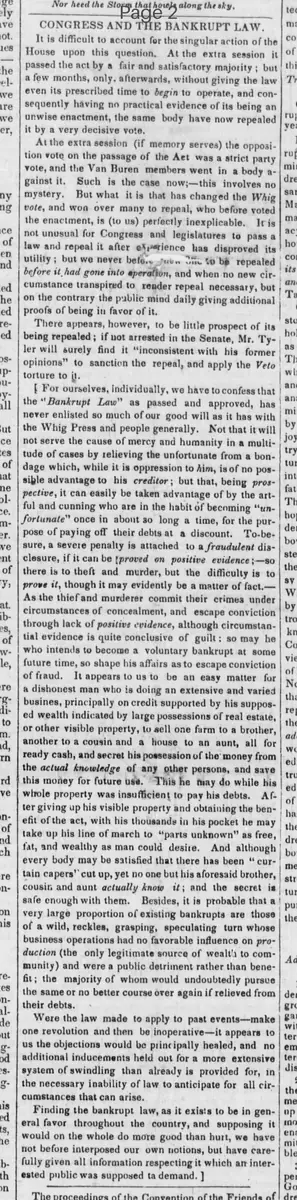
CONGRESS AND THE BANKRUPT LAW.
It is difficult to account for the singular action of the House upon this question. At the extra session it passed the act by a fair and satisfactory majority; but a few months, only, afterwards, without giving the law even its prescribed time to begin to operate, and consequently having no practical evidence of its being an unwise enactment, the same body have now repealed it by a very decisive vote.
At the extra session (if memory serves) the opposition vote on the passage of the Act was a strict party vote, and the Van Buren members went in a body against it. Such is the case now;—this involves no mystery. But what it is that has changed the Whig vote, and won over many to repeal, who before voted the enactment, is (to us) perfectly inexplicable. It is not unusual for Congress and legislatures to pass a law and repeal it after experience has disproved its utility; but we never before knew one to be repealed before it had gone into operation, and when no new circumstance transpired to render repeal necessary, but on the contrary the public mind daily giving additional proofs of being in favor of it.
There appears, however, to be little prospect of its being repealed; if not arrested in the Senate, Mr. Tyler will surely find it "inconsistent with his former opinions" to sanction the repeal, and apply the Veto torture to it.
For ourselves, individually, we have to confess that the "Bankrupt Law" as passed and approved, has never enlisted so much of our good will as it has with the Whig Press and people generally. Not that it will not serve the cause of mercy and humanity in a multitude of cases by relieving the unfortunate from a bondage which, while it is oppression to him, is of no possible advantage to his creditor; but that, being prospective, it can easily be taken advantage of by the artful and cunning who are in the habit of becoming "unfortunate" once in about so long a time, for the purpose of paying off their debts at a discount. To-be-sure, a severe penalty is attached to a fraudulent disclosure, if it can be proved on positive evidence;—so there is to theft and murder, but the difficulty is to prove it, though it may evidently be a matter of fact.—
As the thief and murderer commit their crimes under circumstances of concealment, and escape conviction through lack of positive evidence, although circumstantial evidence is quite conclusive of guilt: so may he who intends to become a voluntary bankrupt at some future time, so shape his affairs as to escape conviction of fraud. It appears to us to be an easy matter for a dishonest man who is doing an extensive and varied business, principally on credit supported by his supposed wealth indicated by large possessions of real estate, or other visible property, to sell one farm to a brother, another to a cousin and a house to an aunt, all for ready cash, and secret his possession of the money from the actual knowledge of any other persons, and save this money for future use. This he may do while his whole property was insufficient to pay his debts. After giving up his visible property and obtaining the benefit of the act, with his thousands in his pocket he may take up his line of march to "parts unknown" as free, fat, and wealthy as man could desire. And although every body may be satisfied that there has been "curtain capers" cut up, yet no one but his aforesaid brother, cousin and aunt actually know it; and the secret is safe enough with them. Besides, it is probable that a very large proportion of existing bankrupts are those of a wild, reckless, grasping, speculating turn whose business operations had no favorable influence on production (the only legitimate source of wealth to community) and were a public detriment rather than benefit; the majority of whom would undoubtedly pursue the same or no better course over again if relieved from their debts.
Were the law made to apply to past events—make one revolution and then be inoperative—it appears to us the objections would be principally healed, and no additional inducements held out for a more extensive system of swindling than already is provided for, in the necessary inability of law to anticipate for all circumstances that can arise.
Finding the bankrupt law, as it exists to be in general favor throughout the country, and supposing it would on the whole do more good than hurt, we have not before interposed our own notions, but have carefully given all information respecting it which an interested public was supposed to demand.
It is difficult to account for the singular action of the House upon this question. At the extra session it passed the act by a fair and satisfactory majority; but a few months, only, afterwards, without giving the law even its prescribed time to begin to operate, and consequently having no practical evidence of its being an unwise enactment, the same body have now repealed it by a very decisive vote.
At the extra session (if memory serves) the opposition vote on the passage of the Act was a strict party vote, and the Van Buren members went in a body against it. Such is the case now;—this involves no mystery. But what it is that has changed the Whig vote, and won over many to repeal, who before voted the enactment, is (to us) perfectly inexplicable. It is not unusual for Congress and legislatures to pass a law and repeal it after experience has disproved its utility; but we never before knew one to be repealed before it had gone into operation, and when no new circumstance transpired to render repeal necessary, but on the contrary the public mind daily giving additional proofs of being in favor of it.
There appears, however, to be little prospect of its being repealed; if not arrested in the Senate, Mr. Tyler will surely find it "inconsistent with his former opinions" to sanction the repeal, and apply the Veto torture to it.
For ourselves, individually, we have to confess that the "Bankrupt Law" as passed and approved, has never enlisted so much of our good will as it has with the Whig Press and people generally. Not that it will not serve the cause of mercy and humanity in a multitude of cases by relieving the unfortunate from a bondage which, while it is oppression to him, is of no possible advantage to his creditor; but that, being prospective, it can easily be taken advantage of by the artful and cunning who are in the habit of becoming "unfortunate" once in about so long a time, for the purpose of paying off their debts at a discount. To-be-sure, a severe penalty is attached to a fraudulent disclosure, if it can be proved on positive evidence;—so there is to theft and murder, but the difficulty is to prove it, though it may evidently be a matter of fact.—
As the thief and murderer commit their crimes under circumstances of concealment, and escape conviction through lack of positive evidence, although circumstantial evidence is quite conclusive of guilt: so may he who intends to become a voluntary bankrupt at some future time, so shape his affairs as to escape conviction of fraud. It appears to us to be an easy matter for a dishonest man who is doing an extensive and varied business, principally on credit supported by his supposed wealth indicated by large possessions of real estate, or other visible property, to sell one farm to a brother, another to a cousin and a house to an aunt, all for ready cash, and secret his possession of the money from the actual knowledge of any other persons, and save this money for future use. This he may do while his whole property was insufficient to pay his debts. After giving up his visible property and obtaining the benefit of the act, with his thousands in his pocket he may take up his line of march to "parts unknown" as free, fat, and wealthy as man could desire. And although every body may be satisfied that there has been "curtain capers" cut up, yet no one but his aforesaid brother, cousin and aunt actually know it; and the secret is safe enough with them. Besides, it is probable that a very large proportion of existing bankrupts are those of a wild, reckless, grasping, speculating turn whose business operations had no favorable influence on production (the only legitimate source of wealth to community) and were a public detriment rather than benefit; the majority of whom would undoubtedly pursue the same or no better course over again if relieved from their debts.
Were the law made to apply to past events—make one revolution and then be inoperative—it appears to us the objections would be principally healed, and no additional inducements held out for a more extensive system of swindling than already is provided for, in the necessary inability of law to anticipate for all circumstances that can arise.
Finding the bankrupt law, as it exists to be in general favor throughout the country, and supposing it would on the whole do more good than hurt, we have not before interposed our own notions, but have carefully given all information respecting it which an interested public was supposed to demand.
What sub-type of article is it?
Legal Reform
Economic Policy
Partisan Politics
What keywords are associated?
Bankrupt Law
Congress Repeal
Whig Vote
Fraud Concerns
Presidential Veto
Economic Relief
What entities or persons were involved?
House Of Representatives
Senate
Mr. Tyler
Van Buren Members
Whig Vote
Editorial Details
Primary Topic
Repeal Of The Bankrupt Law
Stance / Tone
Critical Of Repeal With Reservations On Fraud Potential
Key Figures
House Of Representatives
Senate
Mr. Tyler
Van Buren Members
Whig Vote
Key Arguments
House Repealed The Bankrupt Law Without Operational Experience
Opposition Vote Remains Party Line
Whig Shift Inexplicable Given Public Support
Law Risks Fraud By Dishonest Debtors Despite Penalties
Retrospective Application Would Mitigate Fraud Concerns
Overall, Law Does More Good Than Harm