Thank you for visiting SNEWPapers!
Sign up free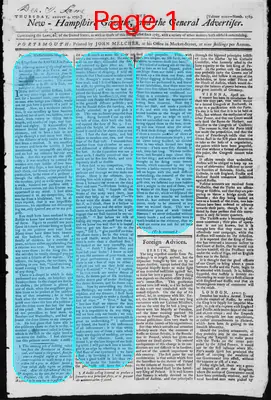
Story
August 4, 1791
The New Hampshire Gazette And General Advertiser
Portsmouth, Rockingham County, New Hampshire
What is this article about?
Account of Mr. de la Tude and Mr. de Ligne's daring escape plan from the Bastille prison in France, crafting ropes from clothing, tools from table hinges, and removing chimney bars over months of secret labor.
Clipping
OCR Quality
97%
Excellent
Full Text
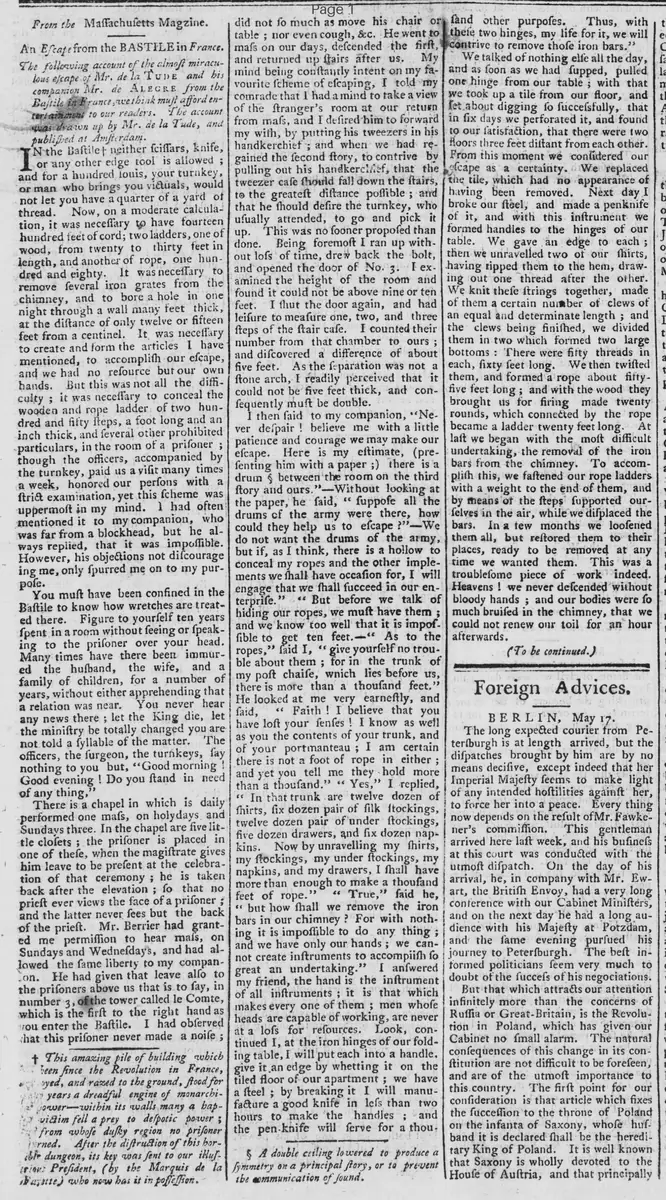
From the Massachusetts Magazine.
An Estate from the BASTILE in France.
The following account of the almost miraculous escape of Mr. de la Tude and his companion Mr. de Ligne from the Bastile in France we think must afford entertainment to our readers. The account was drawn up by Mr. de la Tude, and published at Amsterdam.
In the Bastile neither scissors, knife, or any other edge tool is allowed; and for a hundred louis, your turnkey, or man who brings you victuals, would not let you have a quarter of a yard of thread. Now, on a moderate calculation, it was necessary to have fourteen hundred feet of cord; two ladders, one of wood, from twenty to thirty feet in length, and another of rope, one hundred and eighty. It was necessary to remove several iron grates from the chimney, and to bore a hole in one night through a wall many feet thick, at the distance of only twelve or fifteen feet from a sentinel. It was necessary to create and form the articles I have mentioned, to accomplish our escape, and we had no resource but our own hands. But this was not all the difficulty; it was necessary to conceal the wooden and rope ladder of two hundred and fifty steps, a foot long and an inch thick, and several other prohibited particulars, in the room of a prisoner; though the officers, accompanied by the turnkey, paid us a visit many times a week, honored our persons with a strict examination, yet this scheme was uppermost in my mind. I had often mentioned it to my companion, who was far from a blockhead, but he always replied, that it was impossible. However, his objections not discouraging me, only spurred me on to my purpose.
You must have been confined in the Bastile to know how wretches are treated there. Figure to yourself ten years pent in a room without seeing or speaking to the prisoner over your head. Many times have there been immured the husband, the wife, and a family of children, for a number of years, without either apprehending that a relation was near. You never hear any news there; let the King die, let the ministry be totally changed you are not told a syllable of the matter. The officers, the surgeon, the turnkeys, say nothing to you but, "Good morning Good evening! Do you stand in need of any thing,"
There is a chapel in which is daily performed one mass, on holydays and Sundays three. In the chapel are five little closets; the prisoner is placed in one of these, when the magistrate gives him leave to be present at the celebration of that ceremony: he is taken back after the elevation; so that no priest ever views the face of a prisoner; and the latter never sees but the back of the priest. Mr. Berrier had granted me permission to hear mass, on Sundays and Wednesdays, and had allowed the same liberty to my companion. He had given that leave also to the prisoners above us that is to say, in number 3, of the tower called le Comte, which is the first to the right hand as you enter the Bastile. I had observed that this prisoner never made a noise;
This amazing pile of building which has been since the Revolution in France, destroyed, and razed to the ground, stood for years a dreadful engine of monarchical power—within its walls many a hapless victim fell a prey to despotic power; from whose dusky region no prisoner returned. After the destruction of this horrible dungeon, its key was sent to our illustrious President, (by the Marquis de la Fayette) who now has it in possession.
did not so much as move his chair or table; nor even cough, &c. He went to mass on our days, descended the first, and returned up stairs after us. My mind being constantly intent on my favourite scheme of escaping, I told my comrade that I had a mind to take a view of the stranger's room at our return from mass, and I desired him to forward my wish, by putting his tweezers in his handkerchief; and when we had regained the second story, to contrive by pulling out his handkerchief, that the tweezer case should fall down the stairs, to the greatest distance possible; and that he should desire the turnkey, who usually attended, to go and pick it up. This was no sooner proposed than done. Being foremost I ran up without loss of time, drew back the bolt, and opened the door of No. 3. I examined the height of the room and found it could not be above nine or ten feet. I shut the door again, and had leisure to measure one, two, and three steps of the stair case. I counted their number from that chamber to ours; and discovered a difference of about five feet. As the separation was not a stone arch. I readily perceived that it could not be five feet thick, and consequently must be double.
I then said to my companion, "Never despair! believe me with a little patience and courage we may make our escape. Here is my estimate, (presenting him with a paper;) there is a drum between the room on the third story and ours."—Without looking at the paper, he said, "suppose all the drums of the army were there, how could they help us to escape?" We do not want the drums of the army, but if, as I think, there is a hollow to conceal my ropes and the other implements we shall have occasion for, I will engage that we shall succeed in our enterprise." "But before we talk of hiding our ropes, we must have them; and we know too well that it is imposs. ible to get ten feet." As to the ropes," said I, "give yourself no trouble about them; for in the trunk of my post chaise, which lies before us, there is more than a thousand feet."
He looked at me very earnestly, and said, "Faith! I believe that you have lost your senses! I know as well as you the contents of your trunk, and of your portmanteau; I am certain there is not a foot of rope in either; and yet you tell me they hold more than a thousand." "Yes," I replied, "In that trunk are twelve dozen of shirts, six dozen pair of silk stockings, twelve dozen pair of under stockings, five dozen drawers, and six dozen napkins. Now by unravelling my shirts, my stockings, my under stockings, my napkins, and my drawers, I shall have more than enough to make a thousand feet of rope."
"True," said he, "but how shall we remove the iron bars in our chimney? For with nothing it is impossible to do any thing; and we have only our hands; we cannot create instruments to accomplish so great an undertaking." I answered my friend, the hand is the instrument of all instruments; it is that which makes every one of them; men whose heads are capable of working, are never at a loss for resources. Look, continued I, at the iron hinges of our folding table, I will put each into a handle. give it an edge by whetting it on the tiled floor of our apartment: we have a steel; by breaking it I will manufacture a good knife in less than two hours to make the handles: and the pen-knife will serve for a thou.
sand other purposes. Thus, with these two hinges, my life for it, we will contrive to remove those iron bars."
We talked of nothing else all the day, and as soon as we had supped, pulled one hinge from our table; with that we took up a tile from our floor, and set about digging so successfully, that in six days we perforated it, and found to our satisfaction. that there were two floors three feet distant from each other. From this moment we considered our escape as a certainty. We replaced the tile, which had no appearance of having been removed. Next day I broke our steel, and made a penknife of it, and with this instrument we formed handles to the hinges of our table. We gave an edge to each; then we unravelled two of our shirts, having ripped them to the hem, drawing out one thread after the other. We knit these strings together, made of them a certain number of clews of an equal and determinate length; and the clews being finished, we divided them in two which formed two large bottoms: There were fifty threads in each, sixty feet long. We then twisted them, and formed a rope about fifty-five feet long; and with the wood they brought us for firing made twenty rounds, which connected by the rope became a ladder twenty feet long. At last we began with the most difficult undertaking, the removal of the iron bars from the chimney. To accomplish this, we fastened our rope ladders with a weight to the end of them, and by means of the steps supported ourselves in the air. while we displaced the bars. In a few months we loosened them all, but restored them to their places, ready to be removed at any time we wanted them. This was a troublesome piece of work indeed. Heavens! we never descended without bloody hands; and our bodies were so much bruised in the chimney. that we could not renew our toil for an hour afterwards.
(To be continued.)
An Estate from the BASTILE in France.
The following account of the almost miraculous escape of Mr. de la Tude and his companion Mr. de Ligne from the Bastile in France we think must afford entertainment to our readers. The account was drawn up by Mr. de la Tude, and published at Amsterdam.
In the Bastile neither scissors, knife, or any other edge tool is allowed; and for a hundred louis, your turnkey, or man who brings you victuals, would not let you have a quarter of a yard of thread. Now, on a moderate calculation, it was necessary to have fourteen hundred feet of cord; two ladders, one of wood, from twenty to thirty feet in length, and another of rope, one hundred and eighty. It was necessary to remove several iron grates from the chimney, and to bore a hole in one night through a wall many feet thick, at the distance of only twelve or fifteen feet from a sentinel. It was necessary to create and form the articles I have mentioned, to accomplish our escape, and we had no resource but our own hands. But this was not all the difficulty; it was necessary to conceal the wooden and rope ladder of two hundred and fifty steps, a foot long and an inch thick, and several other prohibited particulars, in the room of a prisoner; though the officers, accompanied by the turnkey, paid us a visit many times a week, honored our persons with a strict examination, yet this scheme was uppermost in my mind. I had often mentioned it to my companion, who was far from a blockhead, but he always replied, that it was impossible. However, his objections not discouraging me, only spurred me on to my purpose.
You must have been confined in the Bastile to know how wretches are treated there. Figure to yourself ten years pent in a room without seeing or speaking to the prisoner over your head. Many times have there been immured the husband, the wife, and a family of children, for a number of years, without either apprehending that a relation was near. You never hear any news there; let the King die, let the ministry be totally changed you are not told a syllable of the matter. The officers, the surgeon, the turnkeys, say nothing to you but, "Good morning Good evening! Do you stand in need of any thing,"
There is a chapel in which is daily performed one mass, on holydays and Sundays three. In the chapel are five little closets; the prisoner is placed in one of these, when the magistrate gives him leave to be present at the celebration of that ceremony: he is taken back after the elevation; so that no priest ever views the face of a prisoner; and the latter never sees but the back of the priest. Mr. Berrier had granted me permission to hear mass, on Sundays and Wednesdays, and had allowed the same liberty to my companion. He had given that leave also to the prisoners above us that is to say, in number 3, of the tower called le Comte, which is the first to the right hand as you enter the Bastile. I had observed that this prisoner never made a noise;
This amazing pile of building which has been since the Revolution in France, destroyed, and razed to the ground, stood for years a dreadful engine of monarchical power—within its walls many a hapless victim fell a prey to despotic power; from whose dusky region no prisoner returned. After the destruction of this horrible dungeon, its key was sent to our illustrious President, (by the Marquis de la Fayette) who now has it in possession.
did not so much as move his chair or table; nor even cough, &c. He went to mass on our days, descended the first, and returned up stairs after us. My mind being constantly intent on my favourite scheme of escaping, I told my comrade that I had a mind to take a view of the stranger's room at our return from mass, and I desired him to forward my wish, by putting his tweezers in his handkerchief; and when we had regained the second story, to contrive by pulling out his handkerchief, that the tweezer case should fall down the stairs, to the greatest distance possible; and that he should desire the turnkey, who usually attended, to go and pick it up. This was no sooner proposed than done. Being foremost I ran up without loss of time, drew back the bolt, and opened the door of No. 3. I examined the height of the room and found it could not be above nine or ten feet. I shut the door again, and had leisure to measure one, two, and three steps of the stair case. I counted their number from that chamber to ours; and discovered a difference of about five feet. As the separation was not a stone arch. I readily perceived that it could not be five feet thick, and consequently must be double.
I then said to my companion, "Never despair! believe me with a little patience and courage we may make our escape. Here is my estimate, (presenting him with a paper;) there is a drum between the room on the third story and ours."—Without looking at the paper, he said, "suppose all the drums of the army were there, how could they help us to escape?" We do not want the drums of the army, but if, as I think, there is a hollow to conceal my ropes and the other implements we shall have occasion for, I will engage that we shall succeed in our enterprise." "But before we talk of hiding our ropes, we must have them; and we know too well that it is imposs. ible to get ten feet." As to the ropes," said I, "give yourself no trouble about them; for in the trunk of my post chaise, which lies before us, there is more than a thousand feet."
He looked at me very earnestly, and said, "Faith! I believe that you have lost your senses! I know as well as you the contents of your trunk, and of your portmanteau; I am certain there is not a foot of rope in either; and yet you tell me they hold more than a thousand." "Yes," I replied, "In that trunk are twelve dozen of shirts, six dozen pair of silk stockings, twelve dozen pair of under stockings, five dozen drawers, and six dozen napkins. Now by unravelling my shirts, my stockings, my under stockings, my napkins, and my drawers, I shall have more than enough to make a thousand feet of rope."
"True," said he, "but how shall we remove the iron bars in our chimney? For with nothing it is impossible to do any thing; and we have only our hands; we cannot create instruments to accomplish so great an undertaking." I answered my friend, the hand is the instrument of all instruments; it is that which makes every one of them; men whose heads are capable of working, are never at a loss for resources. Look, continued I, at the iron hinges of our folding table, I will put each into a handle. give it an edge by whetting it on the tiled floor of our apartment: we have a steel; by breaking it I will manufacture a good knife in less than two hours to make the handles: and the pen-knife will serve for a thou.
sand other purposes. Thus, with these two hinges, my life for it, we will contrive to remove those iron bars."
We talked of nothing else all the day, and as soon as we had supped, pulled one hinge from our table; with that we took up a tile from our floor, and set about digging so successfully, that in six days we perforated it, and found to our satisfaction. that there were two floors three feet distant from each other. From this moment we considered our escape as a certainty. We replaced the tile, which had no appearance of having been removed. Next day I broke our steel, and made a penknife of it, and with this instrument we formed handles to the hinges of our table. We gave an edge to each; then we unravelled two of our shirts, having ripped them to the hem, drawing out one thread after the other. We knit these strings together, made of them a certain number of clews of an equal and determinate length; and the clews being finished, we divided them in two which formed two large bottoms: There were fifty threads in each, sixty feet long. We then twisted them, and formed a rope about fifty-five feet long; and with the wood they brought us for firing made twenty rounds, which connected by the rope became a ladder twenty feet long. At last we began with the most difficult undertaking, the removal of the iron bars from the chimney. To accomplish this, we fastened our rope ladders with a weight to the end of them, and by means of the steps supported ourselves in the air. while we displaced the bars. In a few months we loosened them all, but restored them to their places, ready to be removed at any time we wanted them. This was a troublesome piece of work indeed. Heavens! we never descended without bloody hands; and our bodies were so much bruised in the chimney. that we could not renew our toil for an hour afterwards.
(To be continued.)
What sub-type of article is it?
Adventure
Survival
Personal Triumph
What themes does it cover?
Bravery Heroism
Triumph
Misfortune
What keywords are associated?
Bastille Escape
Prison Break
Handmade Ropes
Iron Bars Removal
Chimney Ladder
What entities or persons were involved?
Mr. De La Tude
Mr. De Ligne
Where did it happen?
Bastile In France
Story Details
Key Persons
Mr. De La Tude
Mr. De Ligne
Location
Bastile In France
Story Details
Mr. de la Tude convinces companion Mr. de Ligne to attempt escape from Bastille by crafting ropes from unraveled clothing, tools from table hinges and steel, digging through floors, and loosening chimney iron bars over months while concealing efforts from guards.